Search
Choose a style
Dark
Light

OLG maps out projected online gambling growth

The Ontario Lottery and Gaming Corporation (OLG) expects its online gambling operations to exceed $1 billion in revenue by April 2028.

The crown corporation’s Fiscal 2025-28 Business Plan outlines the expectations for the next few fiscal years. It has budgeted for its digital business, which includes casino, sports betting and lottery online products, to produce revenue of $819 million for the fiscal year ended March 31, 2025.

OLG forecasts its online gaming revenue will then grow to $895 million in FY 2025-26, $971 million FY 2026-27 and around $1.05 billion in FY 2027-28. That digital growth is projected to outpace the growth in OLG’s total gaming revenue across all sectors and channels.

All proceeds from OLG gambling go towards the provincial government. Those net proceeds are expected to be $48 million in FY 2024-25 and rise to $50 million in FY 2025-26, $52 million in FY 2026-27 and $54 million in FY 2027-28.

As noted by Dave Briggs of Gaming News Canada, unlike its iGaming Ontario-managed commercial rivals in the Ontario market, OLG also offers online lottery products. Removing iLottery to look at only online casino and digital sports betting in the projection numbers, OLG’s online revenue is about one-fifth of the total produced by all 49 other regulated operators.

“OLG’s digital business realized record levels of wagering in a hyper-competitive market and will continue to grow active players with new products and by enhancing the customer and responsible gaming experience,” the report said. “The investments we’ve made in OLG.ca and our PROLINE+ brand have established OLG as a market leader in the new competitive digital environment.”

OLG holds meaty slice of Ontario pie

More than three years after Ontario welcomed commercial competition to the provincial government’s online gambling platform, OLG purports to be the market leader.

The crown corporation will announce its actual results for the 2024-25 fiscal year later in 2025. Last year, the 2023-24 report came in October, more than six months after the year finished and after iGO published its own full annual figures. It showed that OLG’s total gross online gaming and sports betting revenue was $630 million, up 12% year-over-year.

Combining the OLG and iGO reports for the period from April 1, 2023, to March 31, 2024, OLG’s $630 million in gross gaming revenue was around 21% of the total of just over $3 billion reported by OLG plus all iGO operators.

In its latest Business Plan, OLG acknowledged that Ontario’s open-model market “continues to put pressure on our digital business.” However, it maintained that it is uniquely positioned to compete.

At the end of last year, the Auditor General of Ontario commended OLG for making good progress in competing with the province’s array of commercial online casino operators. The report found that as of November 2024, OLG had at least begun to implement 70% of recommendations made in 2022. That included developing a comprehensive strategy to introduce new iGaming products amid the influx of regulated competitors.

The report noted that between Feb. 1 and April 30, 2024, OLG launched 80 new games or about six new games per week.

GeoComply highlights innovation and more at Canadian Gaming Summit

Canadian Gaming Summit is just around the corner, taking place in Toronto from June 17-19.

Bronze headline sponsor GeoComply knows the North American gaming industry inside out, and the Vancouver-headquartered geocompliance specialists looked ahead to this year’s Summit with us.

What elements of Canadian Gaming Summit work so well for your organization, and why is it important for you to be there this year?

The Canadian Gaming Summit uniquely convenes the entire ecosystem grappling with the challenge of sophisticated digital fraud and evolving regulations.

Beyond our reputation for compliance, GeoComply delivers crucial insights and solutions to manage today’s increasingly complex risk environment. The Summit allows us to directly engage with operators, regulators and partners, highlighting proactive anti-fraud strategies that are essential for combating threats such as account takeover, advanced bonus abuse and payment fraud. Attending CGS this year is critical for demonstrating our risk intelligence capabilities, which empower operators to safeguard their revenue, players, and reputations in Canadaʼs dynamic gaming market.

Whatʼs your key objective at this yearʼs event and what are the main products/services youʼll be promoting?

Our primary objective at CGS is to emphasize the critical role that robust risk intelligence and anti-fraud solutions play in operators’ success and survival in this rapidly changing market. We want operators to understand that partnership with GeoComply means access to powerful tools that proactively combat sophisticated threats:

  • GeoComply fraud and risk solutions: This encompasses our advanced capabilities designed to detect and neutralize threats throughout the player lifecycle. We leverage our unique, high-integrity data derived from location compliance checks to fuel sophisticated anti-fraud models. This includes identifying advanced location spoofing, device tampering, account takeovers, bonus abuse, chargeback fraud and multi-accounting.
  • Our automated fraud solution: This machine learning-powered solution delivers real-time risk assessments and automated actions, stopping fraud before financial loss occurs. It identifies suspicious behavior based on device, location and transaction patterns, allowing operators to block high-risk activity in seconds or minutes, not days. We want operators to know that powerful location-enhanced anti-fraud capabilities are often included at no extra cost with their core GeoComply partnership, delivering immediate ROI.
  • IDComply: GeoComplyʼs specialized KYC solution is also a tool to mitigate risk. This secure, multi-layered identity verification is the crucial frontline defence against fraudulent account creation.
  • Geolocation compliance: This remains foundational. We’ll emphasize how our best-in-class compliance technology provides the high-integrity data essential for our advanced risk and fraud detection engines.

What would you highlight as the biggest opportunity in the betting and gaming industry over the next couple of years?

The biggest opportunity lies in leveraging advanced risk intelligence to enable sustainable growth in regulated markets.

As the industry expands and matures across North America and globally, competition intensifies and player acquisition costs rise. Simultaneously, fraud becomes more sophisticated and organized. Those who can effectively mitigate threats — such as bonus abuse, account takeovers and chargebacks — while maintaining a frictionless experience for legitimate users will gain a critical competitive edge.

The future isn’t just about accessing new markets; it’s about building trusted, profitable operations within them. That requires operators to move beyond basic compliance and adopt proactive, data-driven anti-fraud strategies that protect the bottom line and enhance player lifetime value. GeoComply is uniquely positioned to help operators achieve this by integrating high-integrity data and real-time intelligence into every stage of the player journey.

What elements of your business do you feel are best placed to take advantage of that opportunity?

GeoComply is well-positioned to help operators capitalize on this opportunity, thanks to a combination of technological leadership, data scale and industry expertise.

With over 98% market share in North American regulated online gaming, we process more than two billion compliance checks per month. This creates an unparalleled dataset that powers our machine learning models, revealing fraud patterns competitors simply canʼt detect.

We’ve invested heavily in AI and machine learning to develop cutting-edge solutions like our location-enhanced fraud tools specifically designed to combat modern iGaming fraud vectors. Our system intervenes in real-time, flagging and assessing potential fraud in milliseconds to minutes. Our risk research team analyzes millions of daily transactions to identify new threats, allowing us to deploy system-wide updates and new prevention rules to our engine every 18 hours.

We understand the interconnectedness of compliance, KYC and anti-fraud and our integrated suite allows operators to manage these critical functions seamlessly, breaking down traditional silos.

Our compliance roots provide the data backbone, but itʼs relentless innovation in fraud prevention that truly empowers operators to grow profitably and securely in todayʼs competitive gaming landscape.

What areas of the business should we be looking to for innovation in the next 12 months?

Innovation is continuous, driven by the pace of regulatory change and the constant evolution of fraud tactics. Over the next 12 months, weʼre focused on pushing the boundaries in several key areas:

  • AI/ML enhancement: We’re continually improving our automated fraud solution’s machine learning models to boost accuracy and reduce false positives, enabling earlier detection of complex fraud such as synthetic identity fraud, advanced account takeovers, and collusion rings.
  • Expanding risk signals: Weʼre integrating broader data signals into our models — such as behavioural analytics, enriched device intelligence, and potentially KYC inputs — to build even more comprehensive and context-aware risk profiles.
  • Automated risk orchestration: Making it easier for operators to implement automated actions based on our location-enhanced fraud solution’s outputs. This includes refining APIs and developing more sophisticated workflows that allow for tiered responses (e.g., block, challenge, allow) based on granular risk scoring.
  • Proactive threat intelligence: Our teams are investing in tools to monitor sources like the dark web to identify emerging threats and compromised credentials, empowering clients with timely alerts and updated anti-fraud rule sets.
  • Streamlined KYC and fraud integration: We are depending on the integration between IDComply and our fraud solutions, ensuring that identity verification data seamlessly informs risk assessments right from onboarding.

What new technology do you feel will have the biggest impact for stakeholders?

AI and machine learning will continue to be the most transformative technologies across the gaming ecosystem. While not entirely new, their sophistication and application are evolving rapidly — and the impact is profound:

  • For operators, AI is enabling a shift from reactive to predictive fraud prevention. It can identify complex fraud rings and subtle anomalies far more effectively than rules-based systems. It can also personalize player experiences and potentially optimize operational efficiencies and risk mitigation.
  • For players: AI improves playersʼ safety by accelerating the detection of account takeovers and contributes to responsible gaming efforts by recognizing behavior patterns linked to problematic play, allowing for earlier and more targeted interventions.
  • For regulators: AI-powered tools can assist in monitoring market integrity, analyzing vast datasets for compliance checks, and potentially identifying unlicensed activity more efficiently.

The key is harnessing AI responsibly and ethically. Its power lies in analyzing complex data sets at scale to provide actionable insights, leading to safer gaming environments, more effective compliance, and enhanced operational integrity.

What core challenges do you help solve for your customers/partners?

While GeoComply is grounded in compliance, our focus is on solving the most critical business risks our customers face:

  • Preventing financial losses from fraud: We help operators stop costly threats like payment fraud, chargebacks, account takeovers, bonus abuse, and coordinated spoofing. Tools like our automated fraud solution are built specifically to detect and block fraudulent fund extraction.
  • Improving operational efficiency: Manual fraud review is time-consuming and resource-intensive. Our automated risk intelligence solutions significantly reduce the burden on fraud teams, allowing them to focus on higher-value strategic initiatives.
  • Combating sophisticated and organized fraud: We specialize in identifying complex fraud techniques that evade traditional detection methods, such as location spoofing through Wi-Fi injection, device tampering, and collusion from high-risk or sanctioned regions.
  • Balancing security and user experience: Our risk solutions are designed to be precise, targeting high-risk activity while minimizing friction for legitimate players. We protect the customer experience and reduce unnecessary drop-offs.
  • Mitigating compliance risk: By preventing fraudulent behavior tied to AML violations or sanctioned geographies, our risk tools help operators stay compliant and avoid regulatory pitfalls.
  • Navigating risk in new market entries: For operators entering new markets like Canada, we provide the fraud mitigation infrastructure needed to launch with confidence and comply with local regulations.

Who have you especially enjoyed working with over the past year and why?

We’ve particularly valued partnerships over the past year where operators have engaged deeply with us to tackle specific, sophisticated fraud challenges collaboratively. These engagements often involve operators facing significant financial impact from evolving threats who are open to leveraging advanced technologies and data insights.

What makes these collaborations enjoyable is the shared commitment to proactive risk mitigation. When partners provide detailed feedback, allow us to pilot new anti-fraud techniques and work closely with our fraud and risk management teams, it creates a powerful feedback loop. This allows us to rapidly refine our models, demonstrate tangible ROI in fraud reduction and operational efficiency and ultimately build solutions that benefit the entire industry by staying ahead of bad actors.

Our location-enhanced fraud solution alone saved one operator over $5 million in two months by thwarting sophisticated spoofing attacks, while also dramatically increasing their fraud team’s efficiency. Seeing a partner significantly reduce multi-million dollar fraud losses through these joint efforts is incredibly rewarding.

Can you tell us how you worked with that partner and how the relationship is developing?

Typically, these deep anti-fraud collaborations start when an operator identifies a significant pain point – perhaps a surge in sophisticated spoofing from a specific region or heavy losses from bonus abuse rings. Our engagement goes beyond just deploying a standard product.

We often begin with a deep data analysis phase, where our FARM team works alongside the operator’s risk team to understand the specific fraud patterns they’re seeing, leveraging GeoComply’s vast dataset for context. We might then configure specific rules or deploy beta features, like components of our automated fraud solution that are tailored to their immediate threat. This often involves setting up proof-of-concept (POC) tests where we closely monitor performance, accuracy (false positives/negatives), and the impact on legitimate users.

A critical element is the feedback loop and integration of automated actions. For instance, in successful POCs like the one detailed for our location-enhanced fraud solution, the operator implemented logic to automatically suspend accounts or block transactions based on the real-time flags we provided. This automation is key to realizing the full value by stopping fraud in near real-time.

As the relationship develops, it moves beyond tackling one specific issue. We share broader threat intelligence, discuss roadmap alignment for risk solutions, and the operator’s feedback directly influences our product development. The partnership becomes truly strategic, focused on continuously enhancing its risk management infrastructure to stay ahead of threats.

What are you hoping to learn from Canadian Gaming Summit and which elements of the agenda will you be focusing on the most?

We’ll be actively present with our booth #A160, serving as a central knowledge hub for current and potential partners to connect with our team.

Our primary goal is to engage directly with operators and demonstrate GeoComply’s advanced capabilities in risk management and fraud prevention, focusing on these key topics:

  • Proactive fraud defence: Discussing how operators can move beyond reactive measures by using tools to automatically detect and block threats like sophisticated spoofing, account takeovers, and payment fraud before they cause financial damage. We’ll share insights from successful implementations, such as the significant savings achieved by operators using our automated fraud solution.
  • Leveraging data for risk intelligence: Explaining how having a unique, compliance-grade data foundation provides an unparalleled advantage in identifying complex fraud patterns and assessing true user risk.
  • Integrated risk management: Demonstrating how our solutions work together – combining location intelligence, identity verification and advanced fraud detection – to provide a holistic view of risk across the player journey.
  • Efficiency through automation: Showcasing how automated risk assessment and fraud flagging can dramatically reduce the burden on manual review teams, saving significant operational costs.
  • Balancing security and experience: Addressing how our precise risk tools target bad actors effectively while ensuring a smooth, frictionless experience for legitimate Canadian players.

Manitoba court grants lottery injunction against Bodog

A Manitoba court has granted Manitoba Liquor & Lotteries (MBLL) an injunction against offshore online casino and sportsbook operator Bodog as the crown corporation seeks to prevent the brand from offering online gambling products and services to the province’s residents.

MBLL filed the application against the unlicensed gambling site’s parent company, Il Nido Ltd.and its Canadian trademark owner Sanctum IP Holdings Ltd. in late January.

The application alleged that the real-money bodog.eu and “free play” bodog.net platforms are breaking laws by violating MBLL’s authority over gambling. MBLL’s PlayNow.com is the sole platform authorized by provincial law to offer online gaming in Manitoba.

The lotteries asserted, among other things, that the “sole purpose” of the free-play version of the site is to direct players to the real-money gambling site.

Bodog may not operate or advertise to Manitobans, must geo-block the province

In the court order signed on Monday, a judge ruled in favour of the lottery’s request.

“This court orders and declares that the respondents have no lawful authority to offer online gambling products and services, whether through bodog.eu, bodog.net or any other related successor or replacement websites, or to advertise such online products and services to persons located in Manitoba, as such activities are contrary to sections 201, 202, and 206 of the Criminal Code,” stated the order, which was obtained by Canadian Gaming Business.

The order also states that Bodog’s advertising to Manitobans constitutes a false and misleading representation contrary to the Competition Act, as well as a false description of its goods and services that is likely to mislead the public in violation of the Trademarks Act.

As a result, a permanent injunction has been issued by the court, requiring Bodog’s operators, affiliates, employees and representatives to cease operating and advertising bodog.eu “or any website offering substantially the same or similar products and services” in a manner accessible to persons located in Manitoba. Bodog may not advertise to anyone via TV, streaming, website, social media networks, radio stations or in person at events or public forums.

In addition, Bodog is now compelled to implement geo-blocking technology on bodog.eu to prevent anyone located in Manitoba from accessing, viewing, purchasing or otherwise engaging with any online gambling products or services offered by the companies.

The court will provide the judge’s written reasoning for the approved injunction in the coming weeks, a court spokesperson told Canadian Gaming Business.

Nobody appeared at the court hearing on behalf of Il Nido and Sanctum, despite the companies having been served with a court order in March. Canadian Gaming Business reached out to Bodog and Il Nido for comment on Tuesday but had not heard back at the time of writing.

CLC willing to take further action

The filing with the Manitoba Court of King’s Bench was made by MBLL but done on behalf of the Canadian Lottery Coalition (CLC), which consists of MBLL, the Atlantic Lottery Corporation, the British Columbia Lottery Corporation, Lotteries and Gaming Saskatchewan and Loto-Québec.

While the application was filed on behalf of all CLC member lotteries, it pertains only to activity that happens within the province of Manitoba.

However, in February, a CLC spokesperson told Canadian Gaming Business that although the injunction is the first of its kind from either MBLL or the coalition, the CLC and its members are “committed to the idea of addressing unlawful gambling through all available means on a pan-national basis.”

“It fits within a broader set of activities undertaken since the coalition was first formed, always with the same overarching goals in mind: namely, to curtail illegal online gambling across Canada, to create a safer online gaming landscape for Canadians and to protect Canadians against the wide array of illegal sites that operate with no federal or provincial regulatory oversight and aren’t bound by anti-money laundering legislation,” the CLC added at the time.

Bodog dark in Québec and Nova Scotia, called out by Ontario

As and when Bodog complies with the injuncton order, Manitoba will be the third province in which the Antigua and Barbuda-based operator does not operate. It has been dark in Québec for several years and last September, it quietly took itself offline in Nova Scotia, where the only licensed online gaming offerings are provided by the multi-provincial ALC.

Bodog.eu’s website says that it “accepts players from all across Canada, except for those residing in the province[s] of Quebec and Nova Scotia.” Despite the implication there that implying that it offers its wares in Ontario, Bodog does not have a license from the Alcohol and Gaming Commission of Ontario (AGCO) to operate in Canada’s only regulated commercial online gaming market. CGB also reached out to the AGCO as well as other non-CLC member lotteries for comment.

Two weeks ago, the AGCO specifically called out Bodog in a public statement in which it said it had called upon more than a dozen traditional and digital media platforms to “step up the fight” and stop advertising unregulated gambling sites in Ontario. The regulator said that, by promoting unregulated online casinos and sportsbooks, legitimate media offer operators like Bodog “a veneer of legitimacy.”

The AGCO noted that Bodog is “actively targeting Ontarians by advertising on popular traditional and digital media platforms” despite not holding a licence to operate in the province.

High Roller applies for Ontario licence, intends to do same in Alberta

Las Vegas-based High Roller Technologies has applied to the Alcohol and Gaming Commission of Ontario (AGCO) for an operator licence in the province.

The company operates the High Roller and Fruta brands and intends to launch its flagship brand HighRoller.com in Ontario in the second half of 2025, the firm announced on Tuesday.

High Roller also divulged that it intends to pursue licensure in Alberta to expand its regulated market footprint in Canada once that province sets up and opens its own commercial online gambling market.

“The submission of our licensing application to access Ontario’s regulated online gambling market is an important milestone in our company’s journey,” said High Roller CEO Ben Clemes. “Once our application is approved, we anticipate that we will have the opportunity to launch our online casino product into the market later this year.

“Ontario is missing an elegant brand like High Roller. We’re excited to roll out the red carpet for our new customers, and we’re looking forward to showcasing our tremendous product.”

High Roller Technologies is a publicly traded company listed on the New York Stock Exchange (NYSE). It offers a real-money online casino platform that hosts a portfolio of over 5,300 games from more than 90 game providers.

The company announced earlier this month that it had begun a refresh and revitalization of both the High Roller and Fruta brands in anticipation of regulated market expansion

“Launching in Ontario is our first step into North America,” Clemes said at that time. “We’re also thrilled to see Alberta take action to open a competitive regulated market. The momentum we built towards the end of Q1 has carried into Q2, and we’re gaining strength.”

Also this month, the company announced the appointment of Adam Felman as its new chief financial officer. Felman is the former CFO and director of Digital Gaming Corporation, a leading online gaming company and B2B supplier which was sold to Betway and Jackpot City operator Super Group and 2023 and whose B2B assets were sold to Games Global in 2024.

Soft2Bet’s Martin Collins on why company’s dual role gives it an edge

As a rapidly growing iGaming solutions provider, Soft2Bet has a great deal of experience in the online gambling industry in Europe. It holds 19 licences in numerous jurisdictions across the world and plays a dual role as B2B provider and B2C operator.

These days, the company has its eyes on deepening its footprint in the North American market. It launched an incontrovertibly Canadian brand, ToonieBet, in the Ontario regulated market last year, and company personnel will be present at June’s Canadian Gaming Summit to share their own expertise and soak up more of the Canadian industry.

Ahead of CGS, Canadian Gaming Business spoke to Soft2Bet’s Chief Business Development Officer, Martin Collins, about ToonieBet, standing out as a local brand and what he’s most intrigued about among the wide range of topics up for discussion at the event.

CGB: Soft2Bet is an experienced B2B supplier and also works as a B2C operator in markets such as Ontario. How does each role inform the other?

Collins: Our dual role as both a supplier and operator allows us to battle test our platform and gamification solutions as a B2C operator before we roll it out to the market from a B2B perspective. All of our solutions are backed by real market data that show how gamification like MEGA is transforming the industry with unmatched scalability, customization, and proven player-centric features. 

By leveraging data from our own brands, Soft2Bet continuously refines and enhances our technology to deliver smarter, more effective solutions for our partners to utilize.

CGB: With a name like “ToonieBet,” that brand’s Canadian focus is clear. How does Soft2Bet work to ensure it speaks the language of Ontario gamblers?

Collins: ToonieBet is built for Canadian players and embodies Ontario’s gaming culture through localized user experience that integrates Soft2Bet’s proven gamification solutions.

Launching ToonieBet on desktop, Apple App Store, and Google Play, we invited all Ontario players to explore its standout online casino and the full spectrum of sports betting, all delivered through a fast, secure, and fully localised platform.

Additionally, ToonieBet’s partnership as the Official Online Casino Partner of the Ottawa Senators strengthens our connection to one of Ontario’s professional sports teams and passionate hockey fans.

CGB: In such a saturated market like Ontario’s, with ~50 regulated operators, what truly makes a localized brand stand out above others?

Collins: ToonieBet stands out through Soft2Bet’s innovative technology, deep localization, and strategic partnerships. When we created ToonieBet, we wanted to speak to the local culture. A “toonie” is a Canadian $2 coin, so from the start we are creating something unique and applicable to the region. We integrated collectible Canadian coins that users can acquire through various challenges and saw incredible engagement with the feature.

Our platform, accessible on mobile and desktop, offers more than 3700 casino games and 150,000 pre-match and live events monthly, tailored for Ontario’s diverse players. As noted earlier, our partnership with the Senators is not only providing us with significant visibility in-arena and with fan promotions, but we are building trust with Ontario’s sports community.

CGB: The Ottawa Senators online casino partnership offers great visibility for ToonieBet. Was a partnership with a sports team always a goal, and what in particular is Soft2Bet hoping to achieve through that collaboration?

Collins: Partnering Soft2Bet’s ToonieBet brand with the Ottawa Senators is a significant milestone that reinforces our strong brand presence in Ontario.

Overall, this partnership goes beyond branding to provide fans with engaging experiences like contests and chances to win tickets and prizes. It was a great opportunity for the Ottawa Senators and Soft2Bet to ​​provide fans with an exciting experience.

CGB: We know Soft2Bet has big plans on the operator side in the U.S. this year. What’s on the agenda for the rest of 2025?

Collins: Soft2Bet’s U.S. expansion is a major step in our growth as a leading iGaming turnkey solutions provider. We are planning to launch a new iGaming brand in New Jersey in 2025.

Leveraging our 19 global licenses, commitment to responsible gaming, success in Ontario with ToonieBet, and our award-winning MEGA product, Soft2Bet aims to redefine gamification in the U.S. and deliver an exceptional gaming experience for players.

CGB: Alberta will be a prominent topic again at this year’s Canadian Gaming Summit. What should be top of mind for commercial operators and suppliers and operators who are interested in stepping into that province when it opens its doors?

Collins: Having the experience of entering several markets and jurisdictions, it’s important to know that Alberta’s iGaming market will be unique to Alberta and a product that is tailored to the market will outperform one that is not. We will always prioritize innovation and localization, which Soft2Bet’s MEGA product is uniquely suited to do. MEGA’s gamification drives a 400% increase in screen time, a 65% rise in net gaming revenue and a 45% boost in average revenue per user, offering customizable experiences in iGaming and local sports betting.

Compliance is equally critical. Our dedicated responsible gaming and fraud detection tools and dedicated teams ensure adherence to the highest standards across all markets under our 19 global licenses — as demonstrated by Soft2Bet’s success in Ontario with ToonieBet and our upcoming U.S. launch.

AGCO bans horse trainer 10 years for buying performance-enhancing drugs

Ontario’s gambling and horse racing regulator has banned a standardbred horse trainer from racing for 10 years after finding he bought performance-enhancing drugs in violation of the province’s anti-doping rules for horse racing.

The Alcohol and Gaming Commission of Ontario (AGCO) said in a statement that Jeffrey Gillis was one of 27 trainers, veterinarians and others charged as a result of an investigation led by the U.S. Federal Bureau of Investigation (FBI).

Gillis and others were charged with offences “relating to the systematic shipment and administration of illegal performance-enhancing drugs (PEDs) to racehorses competing across multiple jurisdictions.”

Gillis is a trainer who has worked at Toronto’s Woodbine Racetrack and Woodbine Mohawk Park in Campbellville, Ont. He has won multiple awards and trained Covered Bridge, the horse which won Atlantic Canada’s prestigious Gold Cup and Saucer in both 2023 and 2024.

The AGCO said in its statement that Gillis, who has also been fined $40,000, purchased illegal drugs including “a substance held out to be an illegal, blood-boosting synthetic erythropoietin” from U.S.-based veterinarian Seth Fishman, who was sentenced to 11 years in prison in July 2022 for making “untestable” performance-enhancing drugs, per the U.S. Attorney’s Office for the southern district of New York.

The regulator alleged that Gillis purchased or attempted to purchase drugs from Fishman multiple times between Oct. 14, 2018 and June 27, 2019.

Now, no horse fully or partly owned by Gillis is eligible to race for the next decade. Any horses trained by Gillis are ineligible to race but could be released to another trainer or sold.

“This case underscores our unwavering commitment to protecting the integrity of the sport and the welfare of horses,” said AGCO CEO and Registrar Karin Schnarr. “Any attempt to cheat the system and use performance-enhancing drugs is a serious breach of trust and the AGCO will hold offenders accountable.”

The AGCO noted that a licensed horse racing participant has the right to appeal the AGCO’s action to the independent adjudicative body, the Horse Racing Appeal Panel.

Last November, the AGCO banned another trainer, Richard Moreau, and harness driver Sylvain Filion for 10 years each after a horse tested positive for a performance-enhancing drug during standard testing for the North America Cup.

New PROLINE sportsbook lounges continue BCLC’s casino mission

So much sports betting is done online or via mobile these days, but that doesn’t mean retail sports betting doesn’t still have its place. For the British Columbia Lottery Corporation (BCLC), providing a quality in-person experience has arguably never been more important for those who can offer it.

Amid stiff competition for customers’ money both online and on the ground, giving people an experience they will remember — and want to have again in the future — can be a differentiator. 

“Everything is online-focused, that’s where a lot of the competition is,” BCLC’s Senior Manager of Sports, Aaron Myette, tells Canadian Gaming Business. “But we have a significant advantage in having these retail spaces that others don’t. It’s about how successful we can be in our province in providing the best sports experience for British Columbians.

“We’re competitive by nature, so we want to compete, but our passion is our players and their experience. They go hand-in-hand.”

“We have a significant advantage in having these retail spaces that others don’t.”

BCLC launched its new PROLINE retail sportsbook on the eve of the last NFL season, a revamped digitized offering that replaced the Sports Action product that had been operational for more than three decades. 

The upgrades have included offering retail singles bets for the first and expanding what was a small basic set of markets into a much wider and deeper range. Among the new additions is in-play betting, the first time that has been available in-person.

It’s paid dividends. The crown corporation projected it would finish the 2024-25 fiscal year with higher retail sports betting sales than the previous year, despite in-person sports wagering being unavailable for four months last year prior to the retail PROLINE launch.

“It’s outperforming Sports Action already,” Myette says. “We want to create an awesome sportsbook and we’re very pleased with how it has been performing.”

Proof is in the pudding

Part of the overhaul also included making sure that BCLC’s casinos offer an experience that British Columbian bettors would be hard-pressed to get anywhere else.

The lottery opened its first two PROLINE-branded sportsbook lounges, at Chances Casino Kelowna and Parq Casino in Vancouver, in time for sneak previews on Super Bowl day. The third, at Chances Maple Ridge, will open this Saturday, May 24, and a fourth is scheduled to open later next month at Casino of the Rockies in Cranbrook.

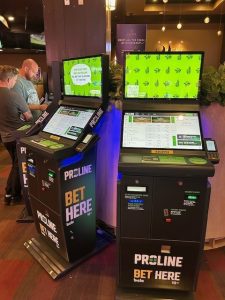
The lounges host huge television screens to broadcast games and events, hospitality booths with food and beverage service and numerous betting terminals that give players the ability to place a broad range of pre-game and in-game wagers, including parlays and live markets.

At Vancouver’s Parq, BCLC’s retail sports betting leader, the official opening on the night before the Super Bowl yielded traffic that was 600% above average for a Saturday night. That momentum continued strongly through the wildly popular 4 Nations Face-Off hockey tournament and the March Madness college basketball tournaments.

The hope is that will continue into the summer, despite the warm season typically being a quiet time for Canadian sportsbooks after the Stanley Cup has been lifted and the NBA has been won. BCLC is committed to hosting continued events at its sportsbooks, such as appealing UFC cards or other big sporting moments.

Casino sportsbooks as destinations

The crown corporation has been thoughtful in where it has begun opening refurbished PROLINE sportsbooks. “Our players are province-wide, so we want to start creating experiences where they are at,” Myette explains. “We didn’t want to just throw them all in the same spot and have competing sites.”

Each site will cater to its own audience. At Casino Rockies, for example, a significant proportion of the clientele tends to be golfers, so building an experience around that will be important.

That word is key: experience.

“If we can create that mindset that you don’t need to cross a border or an ocean for a destination, that’s what it’s all about … We want our B.C. players to know they can find a world-class gambling experience in their own backyard.”

Casinos rely on a combination of regular visitors, passing trade, and visitors from further afield. As a new summer heralds the arrival of tourism season in B.C., the BCLC wants to ensure its casino resorts are top of mind for residents and vacationers.

“We want a sports viewing experience, that’s number one,” adds Myette. “But the sportsbook lounges aren’t limited to sports. What can we do for our fans? What’s the experience we can create? Come to Parq, you can watch a game in the sportsbook from your own booth, you can have some food and drinks, you can experience the casino, you can play a round of golf, you can visit the Seawall. 

“We want to look beyond what the sports calendar provides to what our partners can provide and what our city can provide. That, to me, is not only a unique advantage but the next step for really giving added value to our players.”

A one-stop shop on the doorstep

BCLC is also acutely aware of the competition it faces. 

It unveiled a campaign this spring titled “What’s played here stays here” that aimed to inform and remind players that the money spent on PROLINE and PlayNow goes back to the province.

As part of the announcement, the crown corporation referenced not only unregulated grey market sites in its own jurisdiction that offer their services to British Columbians but also licensed and regulated casinos in nearby U.S. states such as Washington which “aggressively” market to west-coast Canadians. That’s even without mentioning the obvious allure of heading further down the west coast to the bright lights of Las Vegas; BCLC also cited Vegas casinos as legitimate competitors who look to appeal to B.C. residents.

“There is appeal in going down to Washington State,” Myette acknowledges. “They’ve got some beautiful properties there and they’re great people. Rightly, they’re marketing to our folks up in British Columbia. For us, it’s about creating those destinations here. People from the States, from elsewhere in Canada, even from other parts of B.C. are coming to Vancouver for that destination experience. 

“If we can create that mindset with British Columbians that you don’t need to cross a border or an ocean for a destination, that’s what it’s all about. We want our B.C. players to know they can find a world-class gambling experience in their own backyard.”

A version of this story appears in the Summer 2025 issue of Canadian Gaming Business magazine.

April was second-most lucrative month ever for Ontario operators

Ontario’s licensed online gambling operators made their second-highest monthly revenue total ever in April 2025.

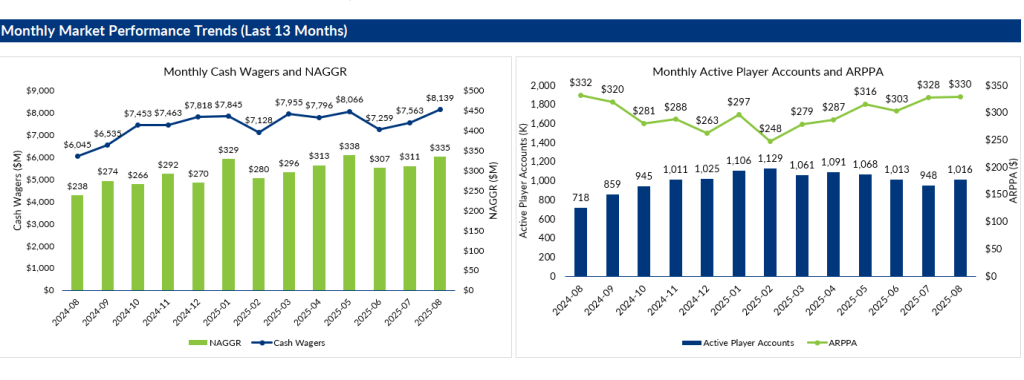
iGaming Ontario’s (iGO) latest figures, published on Wednesday, show that the province’s 49 iGO-managed online casinos and sportsbooks took a collective $313.3 million in non-adjusted gross gaming revenue (NAGGR) last month. That was a 5.8% monthly increase from March’s total of $296.0 million and a year-over-year rise of 25.3%.

It means that the first month of the Ontario regulated market’s fourth year of existence ranked second out of 37 months for operator revenue. April 2025 was beaten only by January 2025, when platforms took a record $328.4 million.

NAGGR, the metric iGO uses to track revenue, includes total cash wagers, including rake fees, tournament fees and other fees, minus player winnings.

April’s podium position came despite the fact that gaming volume dipped slightly month-over-month, down from an all-time high of $7.96 billion in March to $7.79 billion. Still, the April 2025 handle is up 26.4% from April 2024.

There were 1.09 million active player accounts as of April 30, 2025, each producing an average revenue for operators of $287.

Did we mention casino is king?

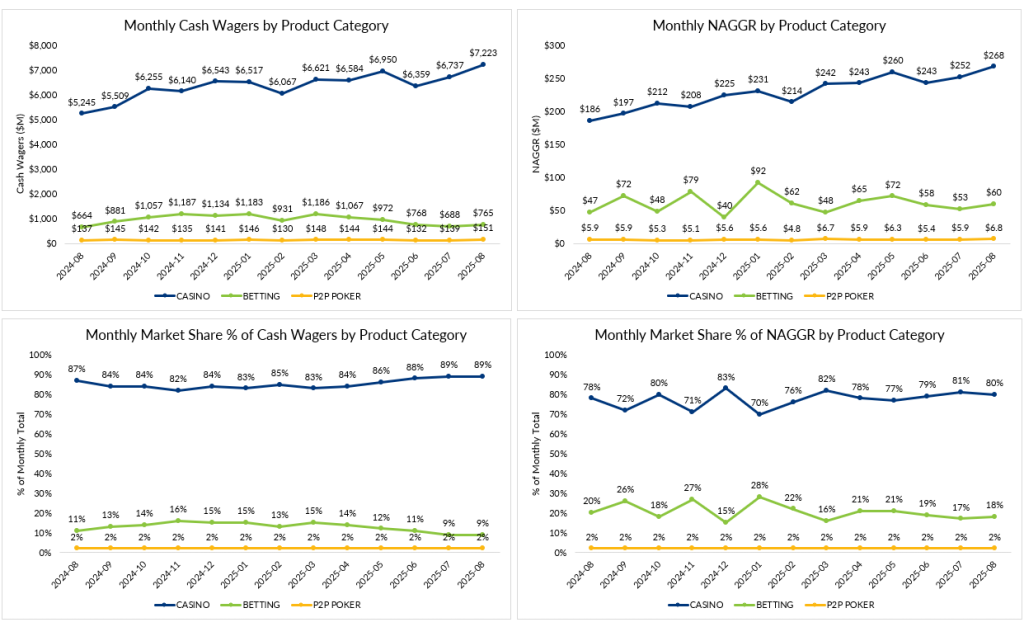
As always, online casino gaming dominated in April, accounting for 84% of player spend ($6.58 billion) and 78% of gross revenue ($242.8 million).

Those totals were up 29.4% and 35.4% year-over-year, with the growth in operators’ revenue notably exceeding the increase in player spend on that vertical. The April onelinc asino revenue number was the biggest in the province’s three-year history.

Online casino in iGO’s numbers includes online games such as slots, table games, live dealer and peer-to-peer bingo.

Ontario online sportsbooks are making less money than last year

Highlighting the fact that online casino reigns supreme was the sports betting data.

Sports wagering spending was at its second-lowest total since last October, at $1.07 billion, down 10% from March and up a modest 14.1% year-over-year. Sports betting revenue was $64.5 million in April, a big 34% rebound month-over-month from a poor March but a 0.9% decline year-over-year.

That means that for the second month in a row, while Ontario sports betting handle grew year-over-year, Ontario’s regulated online sportsbooks made less money than they did in the corresponding month in 2024. In March, sportsbook revenue of $48.0 million was down 6.1% from March 2024’s $51.1 million.

Ontario gamblers approaching $200B spend — plus the rest

April 2025’s results mean that in three years plus an extra month, Ontarians have wagered $189.3 billion on online casino gaming, sports betting and poker. Licensed operators have made nearly $7.4 billion, yielding close to $1.5 billion in tax revenue for the province.

iGO’s reporting does not include activity on Ontario Lottery and Gaming’s (OLG) platforms. The government-run operator, which is not part of iGO’s reporting remit and is effectively the market’s 50th licensed operator, ostensibly holds around 20% of the province’s regulated online gambling market by revenue share.

It also does not include what Ontarians are still spending on unlicensed sites. Ipsos data published last month suggested that 16.3% of Ontario gamblers wager only on unregulated websites and one-fifth of the rest gamble on unlicensed sites as well as licensed ones.

Last week, the Alcohol and Gaming Commission of Ontario (AGCO), publicly called upon media platforms to stop advertising unregulated online gambling sites in the province, specifically calling out offshore operator Bodog. The market regulator and formerly iGO’s parent organization added that, by advertising unregulated online casinos and sportsbooks, legitimate media offer those operators “a veneer of legitimacy” and add to consumer confusion.

Canadian Gaming Business Magazine: Moving at full speed ahead

Summer is close, and that means it’s time for SBC Media’s second issue of Canadian Gaming Business Magazine of 2025, with a focus on how the industry and its various stakeholders are not only keeping up with the pace of change but staying ahead of the curve.

As we were putting together this issue soon after Ontario’s regulated market celebrated its third anniversary, we’ve taken some time to reflect on where we are now. Our cover story is a chat with Responsible Gambling Council (RGC) VP Tracy Parker about why Canada has such a strong reputation for robust responsible gambling, how things have evolved since single-event sports betting came onto the scene and where we still need to go.

There’s also a dive into the fraudulent casino advertising trend that unfortunately seems to be sweeping across the internet and social media in Canada (and beyond), and we chat with Great Canadian Entertainment’s Chuck Keeling about how it harms both operators and consumers.

After the first Canadian general election since Ontario began regulating online gambling, sportsbooks tell us why offering political betting can be an important piece of their puzzle, and we also dive into how the Alcohol and Gaming Commission of Ontario (AGCO) and fellow stakeholders tackle the tough topic of match-fixing.

We check in with leaders at the lotteries out east and west. Through his first year on the job, new Atlantic Lottery Corporation (ALC) CEO Dallas McCready discusses his hopes and aims for the crown corporation and for gaming out east, while British Columbia Lottery Corporation (BCLC) chat with us about providing a full service to in-person customers out west.

Elsewhere, Betty Canada discuss their shift to a franchising model and we speak with Indigenous Gaming Partners (IGP) about First Nations casino opportunities in Alberta. Plus, we look at how esports has become a core offering for some operators. And, with a Canadian co-hosted FIFA World Cup on the horizon in summer 2026, what kind of opportunities could it bring for sportsbooks and their partners?

You can pick up a physical copy of Canadian Gaming Business Magazine at the 2025 Canadian Gaming Summit or read the digital version of the magazine below.

PointsBet Canada’s Scott Vanderwel on balancing sports and casino

As a day-one licensed operator in Ontario’s regulated online gambling market, PointsBet has accomplished quite a bit in Canadian gaming over the last three years and more. That makes PointsBet Canada CEO Scott Vanderwel well-placed to speak on the state of the industry at SBC’s Canadian Gaming Summit in Toronto from June 17-19.

Vanderwel will speak on a panel entitled To market, to market: where will all the new customers come from? That discussion will look at how operators can differentiate themselves in a crowded Ontario market, as well as a focus on the pathway to entry in Alberta’s upcoming regulated market.

In the lead-up to CGS, Canadian Gaming Business spoke to Vanderwel about Ontario and Alberta, PointsBet’s market position, how it juggles both sports betting and online casino and what he’s looking forward to at the Summit.

CGB: Three years into Ontario’s regulated market, what do you make of the market’s progress when it comes to stated goals like channelization, player protection and expansion of consumer choice?

Vanderwel: Ontario’s iGaming market has shown strong progress since its April 2022 launch. Channelization has been a big win — the vast majority of players are now betting on regulated sites, showing folks do value safe, legal options. That said, there still are some consumers dabbling in unregulated platforms, so there’s room for improvement. Likewise, player protection is in a good spot, with PointsBet and other legal operators prioritizing responsible gaming tools and adhering to stringent regulatory standards. On innovation and consumer choice, the market’s deep slate of regulated operators and sites creates an extremely competitive environment, benefiting consumers by driving diverse sports betting offerings and expanded online casino portfolios. That healthy competition has the market buzzing with variety. Overall, it’s been a great start for iGaming in Ontario, but collectively as an industry we need to keep our foot on the gas and keep the momentum going.

CGB: Is PointsBet happy with its market position in Ontario? What are the company’s goals in the province for the rest of 2025 and beyond?

CGB: I think it’s fair to say PointsBet is pleased with our progress to date in Ontario. In a market with so many competing operators, we’ve managed to carve out a solid spot, showing steady user growth and great feedback on both our sportsbook and casino. For the rest of 2025 and beyond, we’re aiming to keep users engaged with better personalization, further improve our casino offering, and continue leveraging our relationships with local sports leagues and teams to stay true to our promise of being authentically Canadian. We want to remain a premium choice by delivering a top-notch experience that’s all about the customer.

CGB: PointsBet has posted impressive results in sports betting growth and a notable surge in live betting. How has the company seen sports betting habits evolve over the last year?

Vanderwel: Live betting has been a game-changer for us, and as you suggested, it has definitely helped drive our sports betting growth. Today’s sports fan is all about in-play action — people want that added immediate investment, with micro-bets and options tailored to what they’re actively watching. Our tech lets us handle big volumes and roll out unique features, ultimately positioning us to capitalize on this trend. We’re doubling down on both tech and content to match how fans are betting today.

CGB: Ontario is the only market in which PointsBet also offers online casino, and the company has greatly increased its supplier portfolio. How is the company positioning itself to thrive?

Vanderwel: Ontario’s online casino scene is massive, driving ~85% of GGR, so it’s only right that we’ve listened to consumers and have actively invested in our product. We’ve poured a ton of effort into our casino, building out a huge range of games with top suppliers to give players what they love. That investment’s paying off — our casino’s growing fast, even in a crowded market. Going forward, we’re focusing on continuing to make the experience more fun with personalized promos and an even more seamless link between our casino and sportsbook. It’s about keeping players engaged with fresh content and a smooth platform, and I think we have the appropriate strategy to keep gaining ground while growing our sports betting side, too.

CGB: You and PointsBet CEO Sam Swanell have both expressed keen interest in the mooted Alberta market. What opportunity do you see awaiting in that province?

Vanderwel: Alberta’s shaping up to be a big opportunity. It has a lively sports scene, a tech-savvy population, and a passion for sports betting and casino games. With a regulated market possibly launching soon, we see a chance to bring our A-game, just like in Ontario. Alberta’s tech workforce and innovation hubs like Calgary and Edmonton match our focus on building a slick, localized platform. Our Ontario playbook — including partnering locally, and continuously tailoring products — sets us up well. We know how to adapt to what players want and feel ready to work with Alberta’s stakeholders to deliver a terrific iGaming experience.

CGB: Alberta hopes and Ontario progress will be discussed at this year’s Canadian Gaming Summit. What else are you looking forward to diving into at this year’s event?

Vanderwel: Beyond Alberta’s potential and Ontario’s achievements, I’m eager to explore some other key topics with industry peers. I want to dig into how tech, like AI’s potential role in consumer personalization or next-level live betting platforms, is shaking things up. I’m also intrigued by the idea of a national approach to sports betting rules and regulations, which would be a game-changer for advertising consistency across provinces. The Canadian Gaming Summit is always an amazing opportunity to network, reconnect and spark new thinking.