Search
Choose a style
Dark
Light

Bally Bet to launch sportsbook operations in Ontario in Q4 2024

Bally’s Corporation CEO Robeson Reeves said at the company’s Q2 2024 earnings call on Wednesday that he expects Bally Bet sportsbook to go live in Ontario in the near future.

“We’ve got a few other sports launches coming through the course of the year,” Reeves told analysts in a Q&A. “… I’ll call that the simpler ones, which are Illinois and Tennessee… In both Ontario and New Jersey, we’ll introduce OSB, which will help us from an acquisition perspective to help gain extra revenue.”

Bally Bet operates its sportsbook in numerous U.S. states but is not a major player, holding approximately 1% of the U.S. sports betting market.

The company has offered its online casino in Ontario’s regulated commercial iGaming market since launching in July 2022, three months after Ontario opened its doors to operators. Ontario was its second online gaming jurisdiction after New Jersey. It didn’t launch sports betting at that time and a spokesperson said in summer 2022 that while the sportsbook arm of the site is currently in development, “there is no scheduled launch for the Bally Bet sportsbook currently.”

Two years later, it still has not stepped into that market. It sounds like that’s about to change, although Reeves didn’t give a firm timeline. 

All in all, Reeves said Bally’s expects to launch sports betting in an additional four states in the second half of the year, “and continue to plant the seeds for expanded iGaming across our geographies.”

Powerhouse iGaming states fuel North America surge

Reeves was speaking after Bally’s Interactive posted Q2 North America revenue of $49.2 million for April to June 2024, nearly double (+94%) its Q2 2023 mark of $25.3 million.

Noting that the company outperformed expectations, Reeves put that surge down to Bally’s Interactive’s strong performance in the major iGaming markets of New Jersey and Pennsylvania, as well as in its monopoly state of Rhode Island. There was no mention of how the online casino brand was performing in Ontario.

“We continue to generate excellent results in our New Jersey and Pennsylvania iGaming markets as well as from our Bally Bet OSB operations, driven in part by the ongoing integration of the Kambi and White Hat technology platforms which have garnered positive player feedback and enhanced our ability to deliver a leading product offering,” Reeves said.

He added that the technology stacks transition process is still ongoing, so Bally’s Interactive is currently running on both the proprietary Bally’s PAM and White Hat’s PAM in North America.

“During Q4, that will be replaced across Ontario, Pennsylvania, and New Jersey,” he noted. That should pave the way for Bally Bet to launch online sports betting in the province.

Reeves was speaking on the same day that the Bally Bet sportsbook launched in Maryland, its ninth state of operation after it went live in Massachusetts four weeks ago.

Bally Bet sportsbook is available in ArizonaColoradoIndiana, New YorkIowaOhio and Virginia.

PlayNow suffers security breach across multiple provinces

The British Columbia Lottery Corporation (BCLC) is advising all PlayNow users to change their passwords after a “credential stuffing” incident saw thousands of dollars in player funds stolen.

A BCLC advisory said players across three provinces had passwords stolen from other companies’ sites. “Credential stuffing” is a cybercrime attempt in which fraudsters attempt to access player accounts using email addresses and passwords that were previously exposed or stolen from other companies, based on the notion that people often use the same user ID and password across multiple websites.

PlayNow detected the fraud after noticing a suspiciously high volume of traffic on the site.

As well as B.C., BCLC operates PlayNow in Saskatchewan and Manitoba in partnership with the Saskatchewan Indian Gaming Authority and Manitoba Liquor & Lotteries.

Matt Lee, senior communications specialist at BCLC, told Canadian Gaming Business that while BCLC couldn’t provide specific numbers due to security purposes, the incident affected “less than 1% of our PlayNow player base in British Columbia, Saskatchewan and Manitoba, with the majority of users impacted in B.C.”

Approximately $4,000 in player funds appear to have been fraudulently withdrawn. Lee said BCLC is working with those players affected to deposit an equal dollar amount into their PlayNow account, plus two years of credit monitoring services at no charge.

Immediately after determining the fraud had taken place, PlayNow notified impacted players that their accounts had been locked due to suspicious activity and took measures to block the suspicious traffic. The lottery corporation has found no evidence that any of its systems have been compromised, or that player login information was stolen from its systems.

BCLC’s investigation remains ongoing and law enforcement authorities are also involved.

The lottery corporation warned users of the potential dangers of using the same password across multiple websites. Pat Davis, BCLC president and CEO, called the situation, “a deeply concerning incident and a cautionary tale for everyone with multiple online accounts.

“Integrity and security are at the core of our business and our games,” added Davis. “We are committed to continuing our ongoing evaluation and enhancement of PlayNow security controls to maintain the safety of our players’ information going forward.”

BCLC aims to ‘revolutionize gambling entertainment’

BCLC is currently embarking upon a five-year strategy that Davis says will “revolutionize gambling entertainment.’

Davis told SBC’s Media Manager, Charlie Horner, at the Canadian Gaming Summit in June that the strategy will be anchored around three specific strategic focuses.

“One of them is around what we call knowing play,” Davis said. “We ultimately want to have a clear understanding of our players and a 100% understanding of all wagers that occur across all of our platforms, and be able to personalize those experiences for our players.

“The second one is building a world-class rewards and incentives program to drive player engagement and loyalty. And the third is continuing our social purpose journey to generate wins for the greater good and amplify our impact not only for our players but also all of the communities that we operate in the province and the country and industry at large.”

The BCLC is set to launch a digital-first retail sportsbook this fall wherein customers will download and create bet slips on their devices before scanning them in the retail location. Davis called this process the latest development in the BCLC’s “journey of digital convergence.”

IC360, IXUP will build self-exclusion system for iGaming Ontario

iGaming Ontario (iGO) is working with a pair of technology specialists to develop a self-exclusion system.

On Thursday, iGO announced that it has accepted a joint bid by Integrity Compliance 360 (IC360) and IXUP to develop a new centralized self-exclusion system for Ontario’s gaming market. Once launched, the system will be the first of its kind in a North American market.

“This project reflects our ongoing commitment to build on the existing player protections here in Ontario,” said iGO Executive Director Martha Otton. “With IC360’s tech-first expertise in betting integrity through ProhiBet and IXUP’s demonstrated success with BetStop in Australia, we’re confident they will help us build a robust self-exclusion system for Ontarians who decide to take a short- or long-term break from gambling.”

iGO, IC360, and IXUP will begin developing its innovative self-exclusive system immediately while working with operators and the Ontario Lottery and Gaming Corporation to ensure the product complies with regulatory standards set by the Alcohol and Gaming Commission of Ontario. The new centralized system will allow Ontario players aged 19 and older to self-exclude from all of the province’s regulated iGaming sites at once.

iGO draws interest

IXUP and ICE360 submitted a joint bid to iGO after the gaming manager asked for proposals to join its software-as-a-service project.

iGO allowed companies to submit bids between March and April with the opportunity to collaborate for a five-year term. iGO presented the opportunity to interested bidders as Ontario continues to grow as a gaming market.

Ontario authorized iGaming and sports betting in 2022. Since then, the province has granted more than 50 operators and roughly 70 different websites market access.

SkillOnNet, The Innovation Group join Canadian Gaming Association

The Canadian Gaming Association (CGA) has welcomed two new members this week, one from the online casino sector and another from the consultancy world.

On Wednesday, the CGA announced that gaming and leisure industry consulting firm The Innovation Group has joined the association. On Thursday, it unveiled iGaming provider SkillOnNet as a new member.

The Innovation Group said in a post on its website that it joined the CGA around the time that it attended the Canadian Gaming Summit in June. The company says it specialises in bringing entertainment and hospitality developments to life which consulting services that span the entire concept cycle.

SkillOnNet is a familiar name in the Canadian gaming market as it operates a variety of brands in Ontario’s regulated commercial iGaming market, including PlayOJOSlotsMagicSpinGenie and KnightsSlots.

The Malta-based online gaming provider went live in the province in 2022, soon after the Ontario market opened up in April of that year. As well as operating its own brands, it works with a range of big names in the industry such as IGT PlayDigital, with which it struck an agreement in June to offer the operator’s portfolio of more than 3,5000 slot and table games in Ontario.

SkillOnNet also recently extended its content partnership deal with Playtech-owned Swedish casino game studio Quickspin into the province, and added titles from numerous 1X2 Network studios to its slate of games in the province.

In total, SkillOnNet operates more than 30 online casinos in numerous jurisdictions across the globe and also provides turnkey solutions to top brands worldwide. Its platform includes more than 3,500 slots and table games from suppliers such as Games Global, NetEnt, Yggdrasil Gaming, Evolution and Big Time Gaming.

CGA opens doors to more members

The Innovation Group and SkillOnNet are the latest of a handful of companies to join the CGA this summer.

Swedish gaming supplier Play’n GO signed up in early June, a month after expanding from Ontario into Quebec. Play’n GO works with numerous commercial operators in Ontario and has now added a deal with Loto-Québec to its armoury.

Later in June, B2B gaming technology supplier mkodo joined the CGA roster, and Kiron Interactive became a member in July.

The CGA now has 77 members and five affiliate members, consisting of 23 are gaming operators, 22 suppliers, and a variety of law firms, payment providers, affiliate media and consulting firms.

PointsBet reports strong surge in Canada, betting win more than doubles

PointsBet’s Canadian business saw strong growth in fiscal year 2024, highlighted by its Canadian sports betting operations more than doubling its net win.

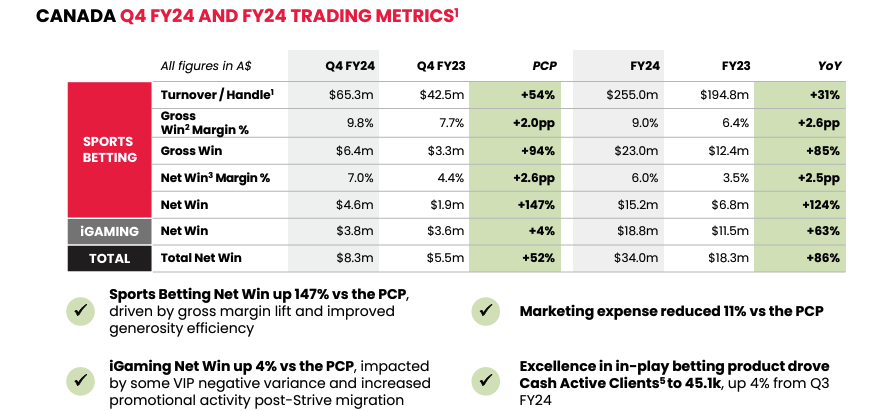
Betting win in the Canadian market was up 124% to $13.7 million CAD for the full fiscal year. For Q2 (Q4 of FY24 in Australia), the jump was even higher, at 147%. These improved upon the growth results posted for Q3 FY2024.

The Canadian growth was around 10 times as high as the company-wide trend. Across all markets, which includes Canada and the company’s home of Australia as well as the now-shuttered U.S. sportsbook operations, PointsBet’s betting net win was up 13.6% for the FY and 12.0% for the April-June 2024 period.

In Canada, sports betting handle was up 31% for the full year to $230.0 million CAD and up 54% year-over-year. From FY23 to FY24, gross win margin rose by 2.6% to 9%.

PointsBet growth outstrips Canadian market growth

Australia remains by far PointsBet’s cornerstone market, with $210.3 million CAD in sports betting net win and a betting handle of $2.4 billion CAD.

But, in an earnings call on July 30, PointsBet’s Group CEO Sam Swanell told analysts that the company is gaining market share in Canada and grew faster in Canada than the overall Canadian market in 2024.

“Our sports trading margin is consistently ahead of the broader market,” he said. “Our in-play mix of total handle remains strong at 66%. Our high sports margin and strong in-play handle percentage is a testament to our proprietary odds factory capability on the most popular North American and global sports…

Canada remains an earlier stage market with more strong growth potential.”

He noted that PointsBet saw strong engagement from users throughout the NBA and NHL playoffs, as well as around the start of the MLB season. He attributed the surge in sportsbook net win in Q2 in particular to, “the excellence of our in-play betting product… [and] significant improvement from the PCP in our trading margin and more targeted promotional spending.”

PointsBet will provide a forward-looking outlook at its audited full-year results call in August. Swanell told analysts that “Canada remains an earlier-stage market with more strong growth potential.”

iGaming affected by Strive deal

As for iGaming, where Canada is PointsBet’s only market, the FY24 net win of $17.0 million CAD was up 63.5% from the previous year. That yielded a total net win across both online gaming and online sports betting of $30.7 million CAD, good for an 85% rise.

The uptick was much smaller in Q2, just 4%. Swanell noted that was “impacted by some VIP negative variance.”

It was also a partial result of PointsBet increasing its promotional spending in the quarter “to reengage our base” after completing the Strive Gaming migration, he explained.

PointsBet struck a deal with platform provider Strive in December to use the provider’s technology to diversify its casino offerings by integrating multiple content providers onto a unified PointsBet platform. At that time,  Scott Vanderwel, CEO of PointsBet Canada, said the move would help PointsBet to elevate its online casino for users in the regulated Ontario market.

PointsBet more positive after U.S. business sale

Swanell also spoke to how the sale of PointsBet’s U.S. business to Fanatics in FY24, which was completed in April, boosted its overall full-year results.

He added that the full-year FY2024 normalized EBITDA guidance, which was previously estimated at a loss of between $3.6 million CAD and $5.4 million CAD, has been adjusted to a loss of around $1.6 million. That would represent a $42.6 million CAD improvement from the loss incurred in FY2023. The company also posted a record Q2 net cash flow of positive $6.4 million.

Swanell noted that the improved outlook has been driven by record full-year Group net win, as well as improved efficiency and productivity and further investment in core technology and product capabilities and strategic marketing investment.

“This is driving our market share growth in Australia and Canada and setting the company up for further success in FY2025 and beyond,” Swanell said.

Reignmakers and NFT marketplace closing confirmed by DraftKings

DraftKings is officially ceasing operations of its NFT business.

The Boston-based gaming giant confirmed to SBC Americas on Wednesday the shuttering of its NFT marketplace and Reignmakers, which launched in 2022 as a product allowing users to purchase and collect NFTs of a given athlete to enter into DFS-style contests. DraftKings showcased an early commitment to its NFT products by hiring brand ambassadors, including Grammy-nominated DJ Steve Aoki, to promote Reignmakers.

Now, DraftKings is taking a step back to focus on its DFS and sports betting operations.

“It has always been in DraftKings’ DNA to innovate and disrupt in order to provide the best possible gameplay experiences for our customers. Reignmakers and our NFT marketplace saw immediate success upon launch, and we are proud of what we accomplished in such a short time,” said a DraftKings spokesperson. “After careful consideration, DraftKings has decided to discontinue Reignmakers and our NFT marketplace, effective immediately, due to recent legal developments. This decision was not made lightly, and we believe it is the right course of action.”

DraftKings has closed its NFT marketplace amid legal woes concerning the product.

A Massachusetts District Court judge recently denied the company’s motion to dismiss a class action lawsuit first filed in March 2023 by plaintiff Justin Dufoe. In the complaint, Dufoe alleges DraftKings provided NFTs and tokens through the marketplace that amounted to unregistered securities. A judge determined that Dufoe’s claims had merit leading to the dismissal of DraftKings’ motion to dismiss. The suit also names CEO Jason Robins, DraftKings North America President Matt Kalish, and CTO Jason Park as defendants.

Owners of DraftKings’ NFT products will be compensated for the company’s decision to close up shop. The company is allowing customers with its digital products to return them for cash if certain conditions are met. Beginning within a week after July 30, DraftKings will allow customers to seek payments for their NFTs with amounts yet to be disclosed.

DraftKings is expected to continue dealing with its NFT-related woes as legal proceedings move forward. The company could face a similar fate as NBA Top Shot. Last month, the NFT company settled a class action suit for $4 million for illegally offering securities.

SBC unveils SBC Awards 2024 nominees ahead of SBC Summit

SBC has announced the shortlists for the SBC Awards 2024, the first ceremony to take place in Lisbon, as part of the inaugural SBC Summit.

This year’s shortlist, once again, highlights the outstanding achievements of leading operators, affiliates and suppliers across all industry verticals, including payments, marketing, platform providers and esports. The coveted awards ceremony will take place on Sept. 26 at the MEO Arena on the final day of SBC Summit.

Notable nominees for the 11th year of the SBC Awards include Betsson Group and SOFTSWISS, each garnering an impressive eight nominations, with EveryMatrix and OpenBet following closely behind with six nominations each. Additionally, Campeón GamingGenius SportsBetConstructSportradar and Soft2Bet all boast five nominations in their respective categories.

Building on the incredible success of the 2023 edition in Barcelona, this year’s awards ceremony received a record-breaking number of applications, providing ample deliberation for the independent roster of judges as they shortlisted the 39 categories.

In the Affiliate categories, both FairPlay Sports Media and Kingbet Media are nominated for the Affiliate Product Innovation and Sports Affiliate of the Year awards. Meanwhile, Mr Gamble and Slotsjudge have each been nominated for the Affiliate Product Innovation and Casino Affiliate of the Year awards. Better Collective will seek to retain its title in the Sports Affiliate of the Year category for the third consecutive year.

In the Operator awards, Betsson Group has been nominated for an impressive six out of ten categories as they strive to protect their titles for both the Marketing Campaign of the Year and Innovation in Casino & Gaming Entertainment awards.

Additionally, Betsson Group will be competing against defending champions Kaizen Gaming for the coveted Casino Operator of the Year award, bet365 for the Best Affiliate Program and Sportsbook Operator of the Year awards and seven other operators for the newly introduced Operator of the Year – Large award.

This year’s ceremony will also introduce two more operator categories. In addition to the Operator of the Year – Large award, there will be the Operator of the Year – Medium and Operator of the Year – Small awards.

In the Payment & Compliance categories, IDnow and Nuvei will return to defend their titles of Fraud & Compliance Solution of the Year and Payment Solution of the Year,  respectively. Monnet Payment SolutionsOKTOPagsmile and Pay4Fun are among the brands battling for the esteemed Payment Innovation of the Year award.

The Supplier Awards will feature 20 distinct categories, covering a wide range of verticals including casino/slots, esports, sportsbook, mobile, land-based, live betting, marketing and services, sports data and platform providers.

AmusnetPragmatic PlayPlaysonELA Games, and Pascal Gaming are among the brands nominated for the prestigious Casino/Slots Developer of the Year award. This year, to better represent the breadth of industry offerings, the award has been expanded into three new subcategories: Large, Medium and Small.

The Sportsbook Supplier of the Year category will see Digitain compete against 14 industry peers to retain the title, while OpenBet will face 15 brands in a bid to defend their Platform Provider of the Year award.

Shining a light on the future of the industry, the awards ceremony will feature four ‘Rising Star’ categories: Rising Star in CasinoRising Star in Casino Innovation / Software, Rising Star in Sports Betting Innovation / Software and the newly established Rising Star in Sports Betting awards.

In the Operator & Supplier Awards, LiveScore GroupPIN-UP GlobalPlayson, and SOFTSWISS are among the contenders for the Employer of the Year award. Meanwhile, Entain Foundation U.S. will compete against 12 industry heavyweights to hold onto the Socially Responsible Initiative of the Year award.

The complete list of shortlisted companies is available on the SBC Awards website.

Please note that a separate ticket is required for attending the ceremony. You can find the available table and ticket options here.

SkillOnNet adds 1X2 Network games to Ontario package

Global gaming brand SkillOnNet has added titles from numerous 1X2 Network studios to its slate of games in Ontario.

Games from Iron Dog Studio, Prospect Gaming, AD LUNAM and 1X2gaming, studios under the umbrella of the UK-based online casino software firm are now available in the province on SkillOnNet’s Ontario brands like PlayOJO, SlotsMagic, SpinGenie and KnightsSlots.

These include new titles and series as well as popular classics like Megaways Jack, Aztec Secrets and Book of Merlin.

SkillOnNet and 1X2 Network have an existing partnership in numerous other jurisdictions across the world and now bring that collaboration to Ontario. The deal extends both companies’ presence in the province. 1X2 Network first launched in Ontario in November 2022 through a deal with 888casino.

“1X2 Network is an iGaming pioneer whose phenomenal output over the past two decades has been an example to us all,” said SkillOnNet’s Jani Kontturi. “They’re a trusted partner, and we’re glad we can help to grow their presence in Ontario. We hope to be entering new regulated markets as partners for years to come.”

“SkillOnNet is behind some of the biggest brands in iGaming, and together our partnership makes us both a powerful force in the industry,” added 1X2 Network’s Christopher Reid. “Thanks to SkillOnNet’s tirelessly global outlook, our games are always reaching a wider audience.”

SkillOnNet adds new strands to Ontario portfolio

SkillOnNet first took several of its sites live soon after the Ontario market opened up in April 2022. In bringing its partnership with 1X2 Network to Ontario, it has added the latest strand to its growing presence in the province.

In June, the Malta-based online gaming provider struck two notable deals.

First, it landed an agreement with IGT PlayDigital to offer the operator’s portfolio of more than 3,5000 slot and table games in Ontario. Then, it extended its content partnership deal with Playtech-owned Swedish casino game studio Quickspin into the province.

In total, SkillOnNet operates more than 30 online casinos in numerous jurisdictions across the globe and also provides turnkey solutions to top brands worldwide. Its platform includes more than 3,500 slots and table games from suppliers such as Games Global, NetEnt, Yggdrasil Gaming, Evolution and Big Time Gaming.

OLG, Caesars extend Caesars Windsor agreement amid hunt for next operator

The Ontario Lottery and Gaming Corporation (OLG) has extended its Caesars Windsor casino operating agreement with Caesars Entertainment by another seven months as it continues to search for the next operator.

The OLG agreement had been set to expire in August 2025 after a previous extension but will now run until March 2026.

The crown corporation is currently conducting a competitive procurement process to select a highly qualified service provider to handle the day-to-day operations of the Windsor Casino.

“Extending the current operating agreement will ensure sufficient time to complete the procurement process and transition the day-to-day operations to the successful proponent,” said an OLG statement. “The integrity of the process is of the utmost importance to the OLG.”

New Unifor Local 444 president James Stewart, whose Unifor unit represents around 1,800 workers at the casino, said the extension removes the threat to employees that could be posed by a potential ownership change during planned bargaining talks early next year.

“It won’t impact the daily activities of the workers, but it removes the weight of a potential ownership change in the middle of bargaining,” said Stewart, per the Windsor Star. “Our contract deadline is April next year and we’ll probably start negotiations in February-March. That weight of an ownership change is now off our minds with the extension.”

Change could be afoot in Windsor

Caesars has run the famous Windsor casino since it opened 30 years ago, but things could be changing in a big way over the next year. The OLG, which owns the casino on behalf of the Government of Ontario, opened up a bidding process more than a year ago, back in April 2023. It opened the RFP stage of the process in October.

“We know the process is pretty in-depth,” Stewart added. “Lots of companies have to do a lot to bid on the service contract. I don’t know when the deadline is, but I think bids are still open for a few weeks. They still plan to announce it next year.”

The Globe and Mail reported in January, citing three gambling industry sources, that Bally’s Corporation and Mohegan Gaming and Entertainment are Caesars two contestants in a three-horse race for the rights. Mohegan operates two casinos in Niagara Falls, Ont. Bally’s Director of External Communications Tim Louie told Canadian Gaming Business that the company had no comment on the rumours.

Stewart’s predecessor as Unifor Local 444 president, Dave Cassidy, suggested that Caesars should be the favourite “based on the job they’ve done running the casino and providing quality jobs.” Caesars Windsor is thought to support more than 2,000 jobs and is a key component of Windsor’s border-city tourism industry. The OLG says the City of Windsor has received more than $95 million in payments from the casino since it opened in 1994.

Canadian Gaming Business reached out to Caesars to see if any further comment was available.

Caesars Windsor’s casino floor offers more than 2,200 slot machines, more than 80 table games, and a physical Caesars Sportsbook which was opened last year as a key post-pandemic strategic move. The accompanying resort features 750 hotel rooms, numerous restaurants and bars, and the 5,000-seat Colosseum theater which often hosts internationally renowned musical artists and shows.

OLG said it expects to announce the selected operator by spring 2025. The lottery corporation’s director of media relations, Tony Bitonti, told Canadian Gaming Business that it will not be releasing any further details or comments on the procurement process “until the selected service provider is announced.”

Could Alberta iGaming progress open door in more provinces?

Nearly three years after Canada legalised single-event sports betting, Ontario’s is still the only regulated, open commercial sports betting market in the country. That’s unlikely to be the case for too much longer.

It’s old news by this point that Alberta intends to launch its own online gaming and wagering market in the vein of Ontario in the near future. Could we see similar action start to gather pace in other provinces?

A variety of experts discussed that notion at the Canadian Gaming Summit in Toronto, as well as the size of the opportunity in Alberta. The consensus was that the influence of Wild Rose Country opening its doors could extend far beyond the province itself.

A recent Citizens JMP Securities projection suggested that Alberta’s forthcoming iGaming market could generate more than $950 million a year in revenue by the third year. That kind of return would rank it as the eighth-largest commercial gambling market in North America. While those expectations are disputed, having not one but two of Canada’s four most populous provinces open for business may change the outlook significantly.

“When you’ve got one province doing something, that is something that can be easily ignored,” said Patrick Harris of Rubicon Strategy. “When you’ve got another significant province doing it too, that tends to become a pattern.”

“With Ontario, we have precedent. With Alberta, we have pattern.”

Jared Beber, BET99

Conduct and manage issue critical?

In his address to attendees at CGS, Alberta minister Dale Nally confirmed that another particular way the province will emulate Ontario is by establishing a separate entity to conduct and manage gaming.

Nally stressed that the message he received “loud and clear” was the commercial operators would not want to come to Alberta if the right to conduct and manage was held by Alberta Gaming, Liquor and Cannabis (AGLC). That message was echoed as reported speech by multiple individuals at the summit. The Alberta legislature cleared the legal runway to allow that by passing Bill 16, which recognised that the provincial government has the authority to conduct and manage gaming in the province separately and distinctly from AGLC. 

In Ontario in May, the Ontario Superior Court dismissed a challenge filed by the Mohawk Council of Kahnawà:ke and upheld the right of iGaming Ontario (iGO) to conduct and manage iGaming in the province. The court also ruled that iGO’s chosen model was valid.

Speaking on the panel with Harris, industry expert and consultant Troy Ross suggested that ruling is “critical” to what other provinces do in the future as it sets a legal precedent that a conduct-and-manage model is Criminal Code-compliant.

“Some provinces were waiting to see how well or how poorly the Ontario model performed, and some were waiting on this legitimate legal question of is this conduct and manage model truly legal?” Ross told attendees. “It’s a game-changer, frankly. 

“I think this last domino coming down fully will have a number of other provinces saying ‘what they’re doing down there works, we should start.’”

How do other provinces feel?

As for which other provinces in Canada could follow suit, two of the most-mentioned possibilities have been British Columbia and Québec. At face value, the outlooks for those provinces look very different.

Naturally, political leaning has a big impact on the legislative direction a province chooses. It’s noteworthy that two provinces with Conservative premiers have pursued the open commercial model to date. The B.C. government, under Premier and B.C. NDP leader David Eby, has opposed Ontario’s push for international gaming liquidity to be considered. B.C. appears to want to keep gaming under government control, with the British Columbia Lottery Corporation’s PlayNow.com platform currently used in not only B.C. but also Saskatchewan and Manitoba.

In Québec, a high-profile movement to try to push La Belle Province towards commercialised gaming is afoot. The Québec Online Gaming Coalition, made up of several operators, advocates for a regulatory framework to allow competition for Loto-Québec’s online gaming and betting monopoly. The most recent word from the provincial government, under the leadership of the centre-right Coalition Avenir Québec and leader François Legault, is that there are no plans to do so. The government cited concerns around problem gambling as a major reservation.

“Two is much different than one.”

Patrick Harris, Rubicon Strategy

At a leaders panel of crown corporation presidents and CEOs at CGS, Loto-Québec’s Jean-Francois Bergeron echoed BCLC’s Pat Davis and the Atlantic Lottery Corporation’s Patrick Daigle reiterations that each lottery’s respective offering is the only “legal” online gaming product in its province.

However, Bergeron stressed that regulated competition has its benefits.

“Competition is actually really good because it forces us to be better,” Bergeron said. “Competitors are a great source of inspiration. There are great operators out there, and we even use some of them as a go-to model. As crown corporation operators, it’s certainly not up to us to defend that model, but to operate it successfully within the current legislation.”

AGLC has made similar conciliatory noises. The commission’s VP of Gaming Dan Keene told Canadian Gaming Business recently that the crown corporation supports Premier Danielle Smith exploring commercial gaming if it means lost grey-market revenues can be captured for the benefit of the province. 

The best thing for Canadians?

That revenue generation is one of three pillars of the common argument for further iGaming and betting expansion across Canada, along with greater consumer protection and greater consumer choice. As panelists at CGS noted, it’s hard to argue that hasn’t worked well for Ontario.

“I hope that inevitably we are looking at a fully regulated Canadian market which I truly and firmly believe is what is best for all Canadians,” said Beber, CEO of Quebec coalition member BET99.

“This is an industry that historically has existed in the shadows,” added PointsBet Canada CEO Scott Vanderwel, sat beside Beber. “What we’ve seen in Ontario is that it can move out of the shadows productively… It’s an industry that has a lot to give. I hope we can move this country from activity that’s happening in the shadows to activity that’s happening in the light.”

In that regard, Ontario was the precedent; advocates believe Alberta, when it happens, can be the start of a pattern. As Harris put it, “two is much different than one.”