In the latest instance of fraudulent gambling advertising in Canada, soccer star Alphonso Davies‘ family were used by an offshore, unlicensed sportsbook to try to drive clicks.
As first reported by the Edmonton Journal, an Instagram account titled Prime Spin Zone posted an advert that depicted an AI-generated likeness of Edmonton-raised Davies’ father being arrested by the Edmonton Police Service.
The ad suggests that police officers discovered a vault filled with cash, but then claims that the arrest was a misunderstanding because the money came from legal gambling winnings.
The AI-generated version of Alphonso Davies’ father encourages viewers to play at the same online casino to win money themselves. Per the Journal, clicking the link directed users to Comoros-based Oxibet, an offshore gambling site that purports to be licensed in Canada but has not been authorized by Alberta, Ontario, or any other provincial government regulator.
A similarly deepfaked version of Canadian rapper Drake also reportedly appeared in the ad.
AGLC, AiGC urge consumer caution
Canadian Gaming Business contacted Edmonton Police Service as well as Alberta Gaming, Liquor, and Cannabis (AGLC) and the Alberta iGaming Corporation (AiGC) about the ad.
“AGLC is aware of the risks posed by fraudulent online gambling advertising, including scams that use misleading or manipulated content to direct Albertans to offshore or unregistered gambling sites,” said a spokesperson for Alberta’s gaming regulator. “We encourage Albertans to be cautious when viewing online gambling advertisements and to verify that any gambling site they use is registered to operate in Alberta.”
Registered iGaming operators in Alberta are required to display the AiGC logo in marketing material and adverts, and to include references to responsible gambling and support services, such as 211 Alberta. The use of athletes in gambling advertising is also restricted to promoting an operator’s responsible gambling tools. Ontario has the same policies in place for its own online gambling market.
In a separate statement, an AiGC spokesperson confirmed they were aware of the deepfake advert and highlighted the importance of verifying sites.
“This type of illegal activity is why it’s so important for Albertans to understand the regulated market, and to be able to identify a regulated iGaming site should they choose to gamble,” AiGC added.
Canada’s fake gambling advertising problem
While Alphonso Davies is one of the more high-profile figures to be targeted, Canada is no stranger to fake casino or sportsbook advertising. The issue has been repeatedly reported for years by regulators and gambling stakeholders across Canada, including the likes of:
A popular method of fraud is to use the names, images, and likenesses of licensed gambling operators or prominent individuals to give the illusion of reputability to offshore, unlicensed sites. Brick-and-mortar casino operator Great Canadian Entertainment, for instance, keeps a list of all uncovered instances of its name or the names of its properties being used to advertise online gambling, which the company does not offer in any form.
Even Alphonso Davies has been caught up before. In June 2023, TSN journalist Rick Westhead reported that Alphonso Davies’ agent Nick Huoseh told a gambling company to remove an Instagram advertisement that featured Davies without his consent, and said that Davies’ image was “routinely used” without permission.
Image: lev radin / Shutterstock.com
Scams are becoming more sophisticated, too. That 2023 ad just used a photo of Davies; the latest one involves an AI-generated deepfake of his father speaking to the camera.
Back in 2025, a similar incident targeted Alberta’s River Cree Resort & Casino, a licensed brick-and-mortar casino that does not currently offer online gambling (although it has since registered to do so in Alberta’s new regulated iGaming market). That social media advert used a digitally altered video of former CityNews journalist Baily Nitti to promote an unlicensed online betting site.
“To see yourself on that, being used in a way where your voice is saying something you never said is scary,” Nitti told CityNewsat the time. “AI is crazy, I know that, but I never realized I would be part of something like this.”
What can be done about fake gambling ads?
AGLC said in its statement to Canadian Gaming Business that it reviews incidents like this on a case-by-case basis and may refer matters to law enforcement for follow-up.
Still, actually tackling the issue effectively is difficult, to say the least. Great Canadian Entertainment EVP Chuck Keeling told Canadian Gaming Business last year that it is akin to “a game of Whac-A-Mole”.
“If one is forced down, another pops up,” said Keeling. “It’s a never-ending cycle … If they can rip off a brand like ours to give themselves an air of legitimacy, why would they not?”
Keeling said at the time that tech companies such as Meta and Google need to be more diligent as the “gatekeepers” of the content of their sites.
“For the past four years, land-based casinos across Canada have been targeted by scammers who use images of their venues to direct users to offshore online platforms,” wrote Brewer. “As a result, my Instagram feed is now flooded with sponsored ads for real money operators based offshore, none of whom hold licenses in Ontario [or, now, Alberta] …
“We have a problem with Meta. And we invite them to do better.”
TheAfrican Gaming Forum will bring together senior stakeholders from across the continent to examine how Africa’s gaming industry can grow sustainably as regulation, taxation, and market structures evolve.
Taking place alongside SBC Summit on Wednesday, Sept. 30 at the Myriad Hotel in Lisbon, the invite-only African Gaming Forum will feature a full day of discussions focused on the challenges and opportunities facing both established and emerging jurisdictions.
With dedicated sessions on Ghana, Kenya, Nigeria, South Africa, and Ethiopia, alongside broader discussions on regulation and expansion, the agenda will give attendees a closer look at how different markets are developing and what that means for operators looking to grow across the region.
“The African gaming industry is developing at an incredible pace, and we wanted to create a dedicated space at SBC Summit where the people driving that growth can come together,” said SBC founder and CEO Rasmus Sojmark.
“Africa is not one market. Each jurisdiction is developing under different regulatory, commercial and cultural conditions, and that means the challenges and opportunities vary significantly from country to country. The African Gaming Forum is designed to reflect that reality, giving delegates the chance to hear directly from the people working in those markets and understand what growth looks like on the ground.”
What’s on the African Gaming Forum agenda?
The African Gaming Forum will open with an overall look at regulation across the continent in the session ‘GRAF Regulator Panel: African Gaming Under the Microscope‘. Hosted by event partner Gaming Regulators Africa Forum (GRAF), the panel will feature Lungile Dukwana (CEO, National Gambling Board, South Africa), Moruntshi Kemorwale (Chief Executive Officer, Gambling Authority Botswana), and Vusi Mtsweni (Chief Executive Officer, Mpumalanga Economic Regulator), with Mabutho Zwane (CEO, Eastern Cape Gambling Board and President, GRAF) moderating. The discussion will examine how regulators and operators can develop frameworks that encourage innovation and market growth while strengthening compliance, player protection, and responses to unregulated activity.
The region’s leading executives will then address the continent’s biggest challenges during the ‘CEO Panel: Leading the Way – Scaling the Opportunity in Africa‘ session. Regional experts Christopher Coyne (CEO, 888Africa), JeremiahMaangi (Founder & CEO, iGaming AFRIKA), AlexandrePaque (CEO, Elephant Bet), RonnieWhelan (CEO, Kingmakers) and PeterEmolemoKesitilwe (CEO, African iGaming Alliance) will examine how operators can capitalize on Africa’s young, mobile-first audience, market-entry strategy, and how to navigate cultural and regulatory differences between markets. The session will also explore the shift towards iCasino and how greater regulatory alignment across multiple jurisdictions could influence future expansion.
Major markets breakdown
Ghana will then take centre stage in the panel ‘A New Entry to the Big 4: Gaming in Ghana Continues Apace‘, examining the market’s rapid growth and regulatory development. Featuring experts Akomea Kwaku Ohemeng Agyei (CEO, Mybet Africa), Kobby Boateng (President, Ghana Association of Sports Betting Operators), Moritz Honig (CEO, Betfox) and Emmanuel Siisi Quainoo (Acting Commissioner, Gaming Commission of Ghana), the session will explore whether Ghana can continue its upward trajectory and what further regulatory development could mean for operators entering or expanding in the market.
The conversation will then zone in on Kenya’s changing regulatory landscape in the session ‘A Whole New World: Kenya and the Gambling Control Act‘. Featuring experts Marcel Elfersy (CEO, B2 Tech), Jason Gibson (CPO, SportPesa), Sab Jhooti (CEO, Bongo Bongo), Peter Maina Karimi (Director General, Kenya’s Gaming Regulatory Authority), Vusi Mtsweni (CEO, Mpumalanga Economic Regulator), and John Mutua (CEO, Association of Gaming Operators Kenya), the session will examine how the new Gambling Control Act could reshape one of Africa’s largest gaming markets, including what operators need to know about compliance, responsible gambling, and future growth.
Alongside the conference program, the African Gaming Forum will feature dedicated networking opportunities throughout the day, giving attendees the chance to continue discussions and connect directly with operators, regulators and industry associations from across the continent.
The African Gaming Forum is being delivered in partnership with organizations embedded across the continent, including iGaming AFRIKA, Gaming Regulators Africa Forum (GRAF), and the Ghana Association of Sports Betting Operators (GHASBO). Together, the partners bring regional media reach, regulatory expertise, and operator representation to the Forum, helping ensure discussions reflect the realities of individual African markets
Attendance is invite-only, with applicants required to hold a valid SBC Summit or Affiliate Leaders Summit pass to be considered.
Taking place during SBC Summit on Tuesday, 29 Sept. and Wednesday, Sept. 30, at Sala Tejo, MEO Arena, the Academies will combine expert-led sessions, live demonstrations, case studies, AMAs, and workshops, moving beyond traditional conference education to focus on active participation and skills attendees can apply within their own roles.
Delegates can access their chosen Tech Academy by purchasing the relevant Academy add-on on SBC Connect, the official event app. Each Academy focuses on a different area shaping the global betting and gaming industry.
As part of SBC Summit’s CPD-accredited educational program, Academy attendance will also contribute towards delegates’ Continuing Professional Development.
“SBC Summit’s conference agenda is a fantastic place to educate yourself on current and future industry developments, but the Tech Academies give delegates the opportunity to take that learning a step further,” said SBC founder and CEO Rasmus Sojmark. “The Academy format allows us to get more specific, dig into the details and create the kind of collaboration, knowledge exchange and active participation that is rarely found at industry events.
“Attendees won’t just leave with a better understanding of their chosen subject; they’ll leave with skills and strategies they can actually put into practice.”
AI Academy
The AI Academy, sponsored by CreateFuture and BetConstruct AI, will explore where artificial intelligence is creating genuine value across betting and gaming, as well as its current limitations and the areas where human oversight remains essential.
Topics will range from sports data and autonomous AI agents to AI-enabled fraud, with attendees also learning how to build and refine tools that can support their day-to-day roles.
The Player Experience Academy, powered by Soft2Bet, will examine how operators can create more engaging and personalized player journeys while balancing retention, player protection, and commercial sustainability.
Subjects will include behavioural design, gamification and rewards, player segmentation, and how responsible engagement strategies can be adapted across different markets and regulatory environments.
The Digital Marketing & CRM Academy will focus on the decisions behind effective modern marketing, from campaign planning and platform selection to creator partnerships and budget allocation.
Attendees will explore changing audience behaviours, how brands can balance global strategy with local relevance, and where marketing investment can deliver the greatest commercial return.
Moving from potential to practical application, the Web3 and Crypto Academywill look at where blockchain, crypto, and digital assets are already delivering value for betting and gaming businesses.
Alongside the opportunities surrounding payments and transparency, the Academy will address the regulatory realities of adoption and how Web3 technology can be introduced alongside existing platforms.
Across the four SBC Summit Tech Academies, attendees will hear from leading figures including:
Behshad Behzadi (CPO, CTO & Chief AI Officer, Sportradar)
Andrew Cochrane (CCO, Soft2Bet)
Stephen Denver (GTM, OpenAI)
James Fox (Senior Industry Manager, Google)
Dinis Guarda (CEO & Founder, Ztudium)
Lluis Mora (Chief Security Officer, Entain)
Francesco Postiglione (CEO, Casumo)
Alex Savage (Gaming Client Solutions Manager, Meta)
and many others
Each SBC Summit Tech Academy add-on is priced at €249 and gives attendees access to three hands-on masterclasses covering trading, casino and responsible marketing. Attendance at the Tech Academies also requires an SBC Summit ticket, with Expo, Conference, Networking, Business, and VIP Passes available depending on attendees’ needs.
Taking place Sep.t 29 to Oct. 1 at Feira Internacional de Lisboa and the MEO Arena, SBC Summit will bring together more than 40,000 industry professionals for three days of conference content, exhibition, and networking.
As Canada’s regulated iGaming market continues to develop, the continued presence of offshore operators poses a persistent risk to player protection and market integrity. Cosmin Mesenschi, Editor in Chief at CryptoGamble, shares with Canadian Gaming Business the findings of the publication’s testing of offshore crypto casinos and what their short lifespans, lack of accountability, and continued targeting of Canadian players reveal about the risks of an unregulated market operating alongside Canada’s provincial frameworks.
Between December 2023 and April 2026, CryptoGamble tested offshore crypto casinos by depositing its own money, playing, and withdrawing, with every session recorded on livestream. Twenty-nine of the operators it tested no longer exist.
The median lifespan of those 29, measured from incorporation to the point the site stopped serving players, was 10.8 months. Sixteen of them did not reach their first birthday. Twenty-three did not reach their second.
Every one of the 29 accepted Canadian players. Nine named Canada as a primary or main target market. One, Spinsala, recruited Canadian streamers as promotional partners before payments stopped and the site went dark without notice.
This is the churn rate of the market operating alongside Ontario’s regulated framework and, from this year, Alberta’s.
How they ended
CryptoGamble classified each closure by what the operator told players before shutting down:
Went dark with no notice: 21 of 29. In several cases signups closed first, then support stopped responding, then the domain went down.
Closed with advance notice or an orderly handover: 8 of 29. This group includes four acquisitions where the buyer honoured balances.
Three in four of these operators ended without telling anyone. Some communicated nothing to players while continuing to brief affiliate partners, in one case telling affiliates that certain markets were closing weeks before the entire site shut down. Affiliates knew. Players did not.
A recurring variant involves a token launch. In two cases, the operator raised money from a community shortly before or after the site’s decline, the token collapsed, and the people behind it stopped responding. Player balances and investor funds went the same way.
There is no mechanism in any of this for a player to recover a balance. No segregated funds, no complaints body with jurisdiction, no successor liability when a brand is abandoned or quietly sold. The account simply stops loading.
Ontario is not acknowledged, let alone respected
The 29 are a subset of a far larger tracked market. Of the 141 crypto casinos CryptoGamble currently tracks and ranks, only 14 name Ontario anywhere in their restricted countries list. Roughly nine in ten make no reference to the province at all. Their terms neither exclude Ontario players nor acknowledge that a regulated Ontario market exists.
The operators that do carve out Ontario are, with few exceptions, the recognizable brands running under Curaçao licences. In CryptoGamble’s database, a Curaçao-licensed casino is roughly three times more likely to name Ontario in its restrictions than an Anjouan-licensed one. That pattern tracks scale and legal exposure rather than licensing standards. An operator large enough to have something to lose in Canada writes Ontario into its terms. The rest do not bother.
For provincial regulators, the practical reading is that the enforcement problem is not concentrated among a handful of large offshore brands. It sits with a long tail of small, short-lived operators that have made no assessment of Canadian law at all, and that will not exist long enough to be pursued.
Nothing visible predicted the collapse
The uncomfortable finding in this dataset is that these operators showed no outward signs of distress before they went.
They were not casinos that had started refusing withdrawals. In testing conducted months before their closures, the large majority processed cashouts without obstruction. They had licences. They had functioning support. Externally they were indistinguishable from the operators still trading today.
The three that did not complete a withdrawal in testing failed for reasons unconnected to solvency. Two held balances behind wagering requirements attached to the deposit that our testers judged impractical to clear. The third, Destinyx, requested identity documents that its own published terms did not require at that threshold. Our testers declined and forfeited the balance. That operator was gone roughly seven months after incorporation.
This matters for player education. A completed withdrawal is a liquidity test at one moment in time. It is not a solvency test, not a governance test, and not a test of whether the company will exist next quarter. Players and affiliates routinely treat it as all three, because it is the only check available to them from the outside.
Licensing jurisdiction predicted nothing either
We expected the licence to separate the dead from the living. It did not.
Nineteen of the 29 held an Anjouan licence, which is 66% of the group. Anjouan also accounts for 56% of the offshore casinos in CryptoGamble’s database that are still operating today. At this sample size, that difference is noise. Seven of the dead held a Curaçao licence under the old or the new regime. One held a Tobique licence.
The absence of a signal is the finding. Within the offshore licensing tier, there was no jurisdiction a player could check and no credential they could rely on that distinguished a casino with years ahead of it from one with months. Licensing in these jurisdictions is a registration, not a supervisory relationship, and it produces no information a player can use.
What follows for the regulated market
Brand identity is too unstable to blacklist against. Operators in CryptoGamble’s records have closed and reappeared under new names. A player searching a brand finds a clean history because the history belonged to a name that no longer exists. Ownership and corporate records are the only durable unit of identification here. Brand names are not.
The platform layer is where accountability disappears. Nineteen of these 29 brands ran on white-label platforms, meaning the entity a player contracts with, the entity holding the licence, and the entity running the platform are frequently three companies in three jurisdictions. When the brand vanishes, establishing which of the three held the player’s money is usually impossible.
Player-facing warnings should target duration, not payment. Messaging built on the premise that offshore sites will not pay is not what this data shows, and players who have withdrawn successfully will discount it. The demonstrable risk is that the operator holding their balance has a median life expectancy of under a year, no obligation to warn them, and no successor to pursue.
SBC Summit 2026 will explore how the gambling industry is putting digital assets and blockchain technology into practice with the introduction of a dedicated Crypto & Blockchain conference track.
Taking place on Thursday, Oct. 1, 2026, at the Feira Internacional de Lisboa, the Crypto & Blockchain track will bring together operators, payments leaders, fintech specialists, blockchain professionals, and Web3 experts to examine where these technologies are delivering real-world value, the challenges surrounding their adoption, and what comes next for their use across the industry.
Throughout the day, sessions will explore how operators can safely integrate crypto payments, the technologies enabling faster and more secure transactions, and what the wider industry can learn from crypto brands about acquisition, engagement and loyalty.
“For a long time, conversations around crypto and blockchain were dominated by what the technology might eventually make possible. We are now at a point where the industry can have a much more practical conversation about where it actually works,” said SBC Founder and CEO Rasmus Sojmark.
“Faster payments and new approaches to engagement are exciting, but adoption also brings questions around compliance, security and regulation that operators cannot ignore. We want this track to look at both sides: where the genuine opportunities lie and what needs to happen for businesses to take advantage of them responsibly.”
SBC Summit’s Crypto & Blockchain panel agenda
The Crypto & Blockchain track will open by examining how regulated operators can safely integrate crypto and stablecoins into their payment ecosystems in the session ‘Blockchain Banking for Gambling Operators.’ Experts Lissele Pratt (founder, Capitalixe), Domenico Roberto Paradisi (Head of Payments, PressEnter Group), Ian Sherrington (CEO, Crownstar), Julian Goffin (co-founder and CEO, Alunafi), Martha Brincat (Chief Regulatory Officer, Malta Gambling Authority), and moderator Bruce Porter Jr. (CEO, GlobalBoost) will explore how operators can unlock the benefits of digital assets, while navigating AML requirements, transaction monitoring, security, and player trust.
The balance between transaction speed and regulatory safeguards will take centre stage during the session ‘Speed, Security & Conversion for Crypto Gambling.’ Industry leaders Igor Shelamov (Chief Payments Officer/COO, VeliBC), Nick Fitt (CEO, Defynet), Alex Codina (Head of Payments, Godzilla), and moderator Jean-Michel Azzopardi (Blockchain Architect) will examine how advances in blockchain settlement can support faster deposits and withdrawals while ensuring robust verification, AML safeguards, and regulatory compliance.
Extending beyond technology, the session ‘What iGaming Can Learn from Crypto Marketing ‘iill examine what the wider iGaming industry can learn from the crypto sector’s approach to customer acquisition, engagement and loyalty.Valentina Diaco (strategic business and iGaming advisor) and Becky Liggero (lead gaming industry video reporter, writer, interviewer, and content creator, CoinGeek) will examine how crypto brands have built engaged communities and achieved rapid growth without relying on large marketing budgets, and which of those strategies can realistically be applied by traditional operators.
Other sessions across the day will examine what makes crypto iGaming ventures attractive to investors today during ‘Fundraising 101: Crypto iGaming‘, while ‘Web3 in Gambling: Risks & Rewards‘ will consider where Web3 can create new opportunities for operators and players, and whether the potential rewards outweigh the complexities of adoption.
Networking opportunities on tap
As well as the Crypto & Blockchain agenda, attendees looking to continue the conversation beyond the conference can take advantage of a series of networking opportunities located on the show floor throughout the week.
The Fintech Show Floor Tour will connect operators with leading blockchain and crypto technology providers to discover their latest solutions.
The Payments Speed Networking will give attendees the opportunity to make a dozen targeted introductions within a single hour.
Smart Connect will facilitate prequalified meetings between crypto and blockchain specialists and senior operator representatives.
Exhibitors interested in taking part in the Fintech Show Floor Tour can contact the sales team at [email protected]. Operators can reserve their place on their preferred tour.
About SBC Summit 2026
Taking place Sept. 29 to Oct. 1, 2026, SBC Summit will welcome 40,000 industry professionals to the Feira Internacional de Lisboa (FIL) and MEO Arena for three days of networking, exhibition, and education.
Access to SBC Summit’s conference is included with Conference, Business and VIP Passes.Delegates wishing to attend the conference sessions and compliance-focused networking initiatives will require a Business or VIP Pass.
In Quebec, online gambling remains a government-run monopoly under Loto-Québec. But the calls for that to change are getting louder; no longer just an industry issue, iGaming has emerged as an election campaign point.
Ahead of the provincial vote on Oct. 5, the leaders of two challenging (and polls-leading) political parties found common ground on one idea in particular: that it may be time for Quebec to follow Ontario and Alberta by welcoming commercial iGaming.
One of several proposals detailed by Quebec Liberal Party leader Charles Milliard on Sept. 9 was to give the provincial alcohol and gambling regulator, Régie des alcools, des courses et des jeux (RACJ), the responsibility of licensing and overseeing all Quebec online gambling activity.
That seems to advocate for an Ontario-like and Alberta-like iGaming model, wherein approved operators are formally allowed to compete with the government’s platform. Milliard said that change, among many others unrelated to gaming, would help protect Quebecers and raise approximately $1.7bn in recurring savings.
The Liberal leader stressed that under the proposed new Quebec online gambling model:
All Quebec online gambling sites would need to seek a license from the provincial regulator
There would be strict rules on advertising, addiction prevention, and protecting minors
A new independent, industry-funded organization would be dedicated to gambling addiction prevention and support
Parti Quebecois agrees with Liberals’ iGaming idea
A Léger poll published on Sept. 14 determined that the Liberals are polling second in the race ahead of the election, with 23% of voting intentions. That is ahead of the governing Coalition Avenir Québec (CAQ) party, now led by Premier Christine Fréchette, which has slipped to third with 21%.
In first place is the Parti Québécois (PQ), at 29%.
And the PQ’s own leader, Paul St-Pierre Plamondon said in an interview with Radio-Canada on Sept. 9 that he supports the Liberals’ “brilliant” plan for regulated Quebec online gambling.
“Mr. Milliard says — and he’s right, I’ve done the research — online sports betting in Quebec is a Wild West,” Plamondon said, as quoted by The Canadian Press. “American companies arrive, then advertise, and are not regulated.
“Ontario decided to clean up and collect a tax on these activities, and it raised an additional $300m. It’s an excellent idea that may fly under the radar because it’s a bit original, but imagine if we take $300m and invest it in homelessness, for children who are hungry at school, for learning disabilities. We could have an immediate impact.”
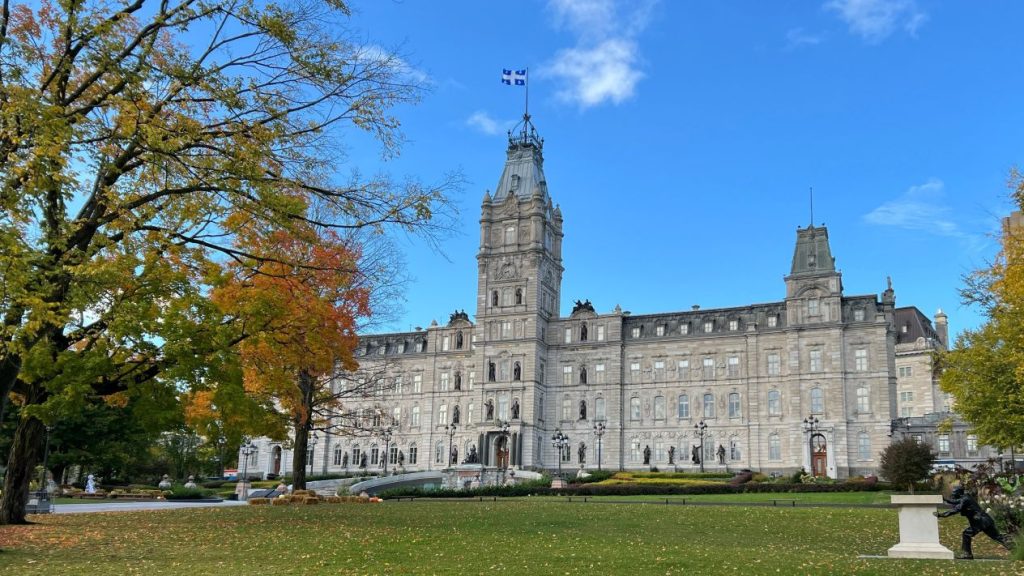
The Quebec Parliament building in Quebec City. Image: Ronsmith / Shutterstock
Politicians’ support follows iGaming coalition recommendations
The QOGC is a Quebec online gambling lobbying group comprising online casino supplier Games Global, technology firm and investment partner Apricot Investments, and several privately held iGaming operators that are licensed and operational in both Ontario and Alberta:
Bet99
Betway
DraftKings
Entain (co-owner of BetMGM and owner of Sports Interaction and others)
FanDuel parent Flutter
Rush Street Interactive (owner of BetRivers)
In a statement published on Sept. 10, the QOGC said it welcomes the “commitment” by the Quebec Liberals and PQ to recognize and regulate private iGaming platforms.
“The positions taken by the various political parties demonstrate that a broad consensus is emerging in Quebec in favour of establishing clear rules that must apply equally to both Loto-Québec and private companies offering online gaming,” said coalition spokesperson Ariane Gauthier. “The members of the Quebec Online Gaming Coalition look forward to working together with government authorities and stakeholders to turn these commitments into reality.”
Former Loto-Québec chair, CGA back expansion plan
Several of the QOGC’s members are also enlisted with the Canadian Gaming Association (CGA), which supports the idea of expanding Quebec online gambling, as it did in Ontario and Alberta.
“The Canadian Gaming Association has long urged more provinces to use the tools available to them — namely online gaming regulation — to address the uneven playing field created by unregulated offshore operators and the uncertainty around whether they provide adequate player protections,” the CGA wrote in a statement on Sept. 15.
The CGA noted that former Loto-Québec ChairHelene Fortin also posted her support for the idea of establishing a regulated commercial iGaming model on LinkedIn, stressing the need for the province to modernize its online gambling approach to better protect consumers.
“The Quebec Liberal Party and the Parti Québécois have both endorsed stronger online gaming regulation,” added the CGA. “Alongside Fortin, they have arrived at the right conclusion … The CGA and its members would welcome the opportunity to participate in consultations on the design of Québec’s regulated online market and how it can better protect consumers.”
Loto-Québec monopoly under scrutiny
Quebec is Canada’s second most populous province. It has about nine million residents, compared to 16 million Ontarians and five million Albertans. Its size ostensibly positions it to become one of North America’s largest regulated markets.
The biggest arguments made for expanding Quebec online gambling (or iGaming in any province) are capturing more revenue and protecting players by bringing existing grey-market activity under provincial regulation.
In February, the QOGC claimed that around 2,000 websites currently offer Quebec online gambling despite Loto-Québec’s theoretical monopoly. “Why limit the regulation of online gaming to Loto-Québec sites alone, when the offering available on the Internet is much broader?” asked Gauthier at that time.
Image: Michael Vi / Shutterstock.com
In its new public communication, the QOGC cited 2025 data from market research firm Blask that suggested that Loto-Québec captures only 17% of Quebec online gambling activity. Research presented by iGaming lobbyists at SBC Summit Canada in May suggested it was higher, but still only 27%. In comparison, in Ontario, that figure is reputedly around 90% after four years of regulated iGaming, while Alberta is aiming for at least 75% by 2028.
Incidentally, Milliard’s estimate of $300m in savings by 2028 through regulating Quebec online gambling is the same amount the QOGC said is currently being lost in annual tax revenue by not allowing competition to Loto-Québec.
“Loto-Québec’s monopoly no longer ensures control over online gaming, and it is high time for the government to bring order to the situation,” added the QOGC’s Sept. 10 statement.
Canadian Gaming Business reached out to Loto-Québec for comment for this story and was told that the crown corporation would not comment on any electoral proposals.
Loto-Québec’s Head of Media Relations Renaud Dugas stated in February that the QOGC is seeking “to legalize what’s illegal and further develop a market that only benefits foreign companies — not players.”
Prediction markets controls also on Liberals’ agenda
Meanwhile, Quebec Liberal leader Milliard is also concerned with the spread of prediction markets, which have exploded in popularity as a sports betting equivalent in the U.S., and on which federal Canadian regulators clarified their stance last month.
Milliard’s proposals noted that his potential government would ask the RACJ and the Autorité des marchés financiers (Quebec’s financial regulator) “to fill the regulatory gap surrounding prediction markets, which are currently accessible in Quebec without any regulatory framework.”
In line with federal regulators’ rules, sports, political, and many other event contracts are supposed to be unavailable to Canadians. U.S. prediction markets giant Polymarket said earlier this summer that it had blocked access in Quebec.
In late August, Loto-Québec used federal regulators’ statement on prediction markets to “reiterate that in Quebec, there is no ambiguity: the only 100% legal casino and sports betting site is lotoquebec.com.”
What are the most popular online casino slot games in Canada, according to bet365?
In its monthly Gaming Insights and Performance report, the British iGaming operatortracks player trends and game performance in online slots on its casino platform across 22 of its operational iCasino markets worldwide, including three core Canadian segments:
Ontario
Alberta
Overall Canada
The reports use an algorithm that takes into account metrics such as revenue, stakes, sessions and engagement across around 7,500 online slots titles on its casino platform. It only takes into account slot games, not other categories like table games or live dealer.
Which were the most popular slots in August?
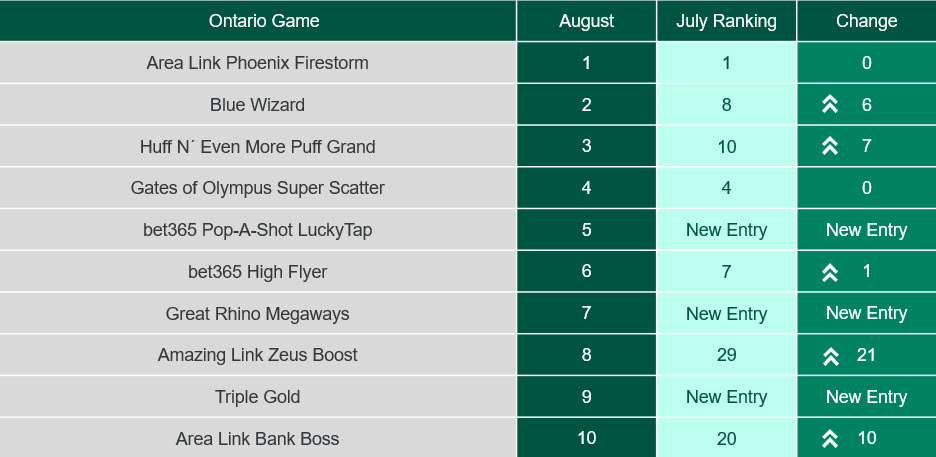
Area Link Phoenix Firestorm tops Ontario for 3rd straight month
For the third month in a row, Area Link Phoenix Firestorm from Area Vegas and Games Global was the top-performing online slot game on bet365 in Ontario.
Beneath it, two games rose several spots to complete the podium: Playtech’s Blue Wizard climbed six places to finish No. 2 and Light & Wonder’s Huff N’ Even More Puff Grand jumped seven spots to finish third. The latter of those games also ranked in the top nine online slots in all three of bet365’s U.S. online casino markets in August.
There were three new entries to the Ontario top 10 in August:
bet365 Pop-A-Shot LuckyTap from Design Works Gaming at No. 5
Pragmatic Play’s Great Rhino Megaways at No. 7
IGT’s Triple Gold at No. 9
Meanwhile, SpinPlay Games’ Amazing Link Zeus Boost was the biggest mover, climbing 21 positions from No. 29 to No. 8.
Pragmatic Play unseats IGT in Alberta’s second month
A recent addition to bet365’s monthly slot reports is Alberta, which launched its regulated iGaming market on July 13, meaning the August chart reflects the first full month of business in the province.
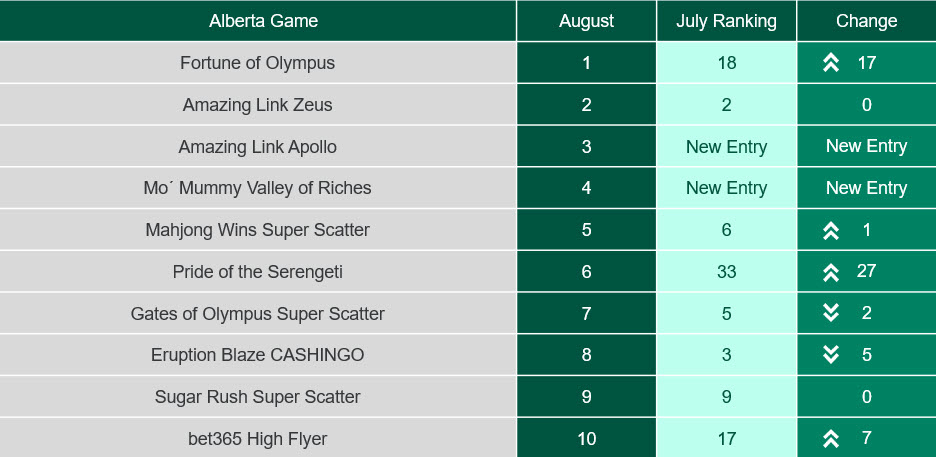
After IGT’s Cleopatra Keno ranked top in the early weeks, that title vanished from the charts in August and was replaced in the top spot by Pragmatic Play’s Fortune of Olympus. That game climbed 17 places from 18th in the inaugural Alberta slot rankings.
Unsurprisingly given Alberta’s youth as a regulated market, there was a lot of change between July and August as more licensed online casino sites went live and players continued to explore the new platforms available to them.
bet365 exclusives perform well in Alberta
While Amazing Link Zeus held firm at number two, the third- and fourth-ranked slots in Alberta in August were both new entries: Amazing Link Apollo and Aristocrat’s Mo’ Mummy Valley of Riches.
The biggest mover among the pre-existing games on the chart was bet365’s in-house-developed Pride of the Serengeti, which soared 27 positions to No. 6. Another exclusive, bet365 High Flyer, came in 10th.
As well as the chart itself, bet365 noted that it added content from one of its supplier partners, Incentive Games, to its Alberta online casino slate in August after the supplier secured a license in the province.
Canada players enjoy popular casino franchises
As well as its regulated operations in Alberta and Ontario, bet365 operates in the grey market in other provinces across Canada.
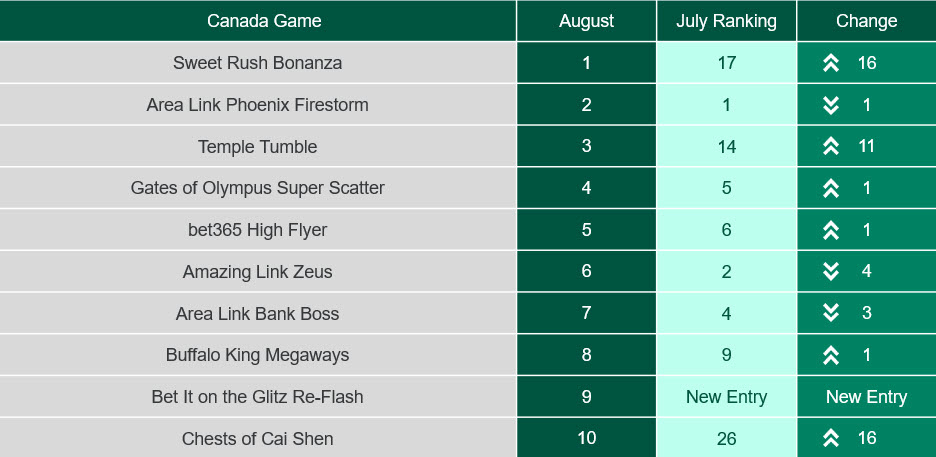
One of the most prominently featured suppliers across all of its Canadian rankings is Pragmatic Play. That firm’s Sweet Rush Bonanza was the top-performing slot in the Canada chart, rising 16 places from No. 17 to displace the Ontario-topping Area Link Phoenix Firestorm. bet365 noted that Sweet Rush Bonanza combines elements of two of the supplier’s biggest franchises — Sweet Bonanza and Sugar Rush.
Meanwhile, Pragmatic Play’s Gates of Olympus Super Scatter ranked fourth in the Canada chart; it finished in the same position in the Ontario rankings and came seventh in Alberta.
Elsewhere in the Canada chart, Relax Gaming’s Temple Tumble jumped 11 places to finish No. 3 and bet365’s High Flyer moved up to No. 5.
Major online casino franchises Area Link, Gates of Olympus, Amazing Link, and Buffalo Kings all had titles place strongly in the top eight. bet365 said that, overall, Canada continues to be particularly receptive to new content and extensions of proven franchises.
bet365 was also one of several major operators that offered some insight to Canadian Gaming Business on what sports and teams Albertans have been betting on during the early weeks of the province’s market.
Sports and esports live data and odds provider BETER can now work with licensed iGaming operators in Ontario.
The company announced on Sept. 14 that it has received a Gaming-Related Supplier Registration from the Alcohol and Gaming Commission of Ontario (AGCO), marking its entry into the Canadian market.
BETER executives described Canadian market entry via Ontario as an important milestone in its wider North American expansion strategy.
“Ontario is an important step in building BETER’s North American business and a significant part of our global growth strategy,” said CEO Gal Ehrlich. “Our exclusive content gives operators something they cannot easily find elsewhere, and that differentiation is helping us expand into new regulated markets.
“Canada offers significant potential, and Ontario gives us a strong foundation from which to build a lasting presence across the country.”
What is BETER?
BETER specializes in delivering 24/7 live streaming, real-time data, and odds for sports and esports events. It said it provides that information for more than 740,000 sports and esports events annually, offering up to 50 markets per event.
Its esports portfolio includes ESportsBattle eLeagues, including:
eBasketball
eFootball
eHockey
eTennis
Ehrlich told SBCat SBC Summit Americas earlier this year that it plans to add both eAmerican Football and eBaseball before the end of 2026.
Its sports portfolio includes the likes of the Ukrainian Setka Cup table tennis series and the international BSKT Cup basketball league. It works with leading sports integrity organizations such as the International Betting Integrity Association (IBIA) on betting monitoring.
Ontario registration allows BETER to provide licensed operators in that province with real-time data and odds and related services for its sports and esports portfolio.
BETER intends to enter Alberta too
BETER’s existing operator partners include the likes of bet365. It has already been approved to supply its services in 10 U.S. states since first launching in New Jersey in 2025:
Arizona
Colorado
Florida
Illinois
Indiana
Iowa
Kentucky
New Jersey
North Carolina
Virginia
BETER is also pursuing approval from Alberta Gaming, Liquor, and Cannabis (AGLC) to enter that province in the near future.
“As we continue expanding across Canada, our focus will remain on sustainable growth, strong regulatory relationships, and maintaining the trust of our partners and stakeholders,” added Chief Legal Officer Valeriia Tarchynska.
Ehrlich told SBC earlier this year that the North American market could account for around 25% of the company’s total revenue in the near future.
Want to discover the latest developments in player engagement on digital platforms? Get yourself to the Digital Marketing & CRM Academy at SBC Summit Lisbon on Tuesday, Sept. 29. Get yourself an Education+ pass by visiting https://sbcevents.com/sbc-summit/player-experience-academy/
SBC Summitwill move beyond the hype surrounding Web3 and crypto to explore their practical applications across payments, transparency, security and player trust through the dedicated Web3 & Crypto Academy.
Part of SBC Summit’s premium Education+program, the Web3 & Crypto Academy will bring together Web3 and crypto specialists, technology experts and industry leaders to examine where Web3 is delivering genuine value, how it can strengthen trust and transparency, and what businesses need to effectively adopt it.
Taking place on Wednesday, September 30, at Sala Tejo, MEO Arena, the Academy is designed for professionals looking to develop practical skills and build a roadmap for Web3 and crypto adoption. Throughout the day, delegates will take part in expert-led workshops, case studies, live demonstrations, fireside chats, panels and presentations covering everything from the integration of crypto payments to blockchain’s role in strengthening player confidence.
“In an industry as competitive as ours, it’s often the small things that have the biggest impact. Web3 and crypto can offer that advantage, whether it’s speeding up payments, expanding offerings or building greater player trust,” said Rasmus Sojmark, Founder and CEO of SBC.
“What’s so unique about this Academy is that it moves beyond discussing potential. It’s about showing attendees where Web3 and crypto payments can add real value and giving them the practical knowledge to start applying it within their own businesses.”
The Academy will open with a look at the current relationship between crypto, blockchain and the gambling industry. The presentation ‘Crypto, Blockchain & Gambling: Where Are We Now?’ will see Simit Naik (Web3 Specialist, Teronade Group) examine where Web3 is delivering value today and the role crypto, blockchain and hybrid models could play in the future of the industry.
Attention will then turn to crypto payments in the session ‘Crypto Payments in Regulated Markets: Hype or Reality?’ Experts Anthony Day (Marketing Director, VeChain), Dinis Guarda (CEO & Founder, Ztudium), Aaron Sanchez (Director of Industry Engagement, MiCA), Dereck Hoogenkamp (Chairman, Yalla Limited) and moderator Udo Seckelmann (Head of Gambling & Crypto, Bichara e Motta Avogados) will explore how operators are integrating crypto and stablecoins alongside traditional payment methods and what this could mean for payments in regulated markets.
Delegates will then see blockchain verification in action through the case study and live demonstration ‘Provably Fair: Can Players Really Verify Every Outcome?’Ulle Skottling (CEO, DeGaming) will compare random number generator models with on-chain verification, demonstrating how blockchain could offer players greater visibility over gaming outcomes.
The Academy will conclude with the workshop ‘Building Hybrid Gambling Platforms: Where Web2 Meets Web3’, showing attendees how Web3 technology can be incorporated into existing gambling platforms. Gene Deyev (Co-Founder & CEO, Stobox) and Brett Calapp (CEO & Co-Founder, Turnt Gaming) will use real-world examples of crypto payments, on-chain verification and digital assets to demonstrate what a hybrid approach can look like in practice.
The Academy will also feature the fireside chat ‘Trust on the Chain: Does Blockchain Really Make Gaming Fair?’, taking a closer look at the relationship between blockchain, fairness and player trust, as well as the opportunities and limitations of using on-chain verification in gaming.
Access to the Web3 & Crypto Academy is available exclusively with an Education+ Pass.
Available as a €249 add-on to all SBC Summit and Affiliate Leaders Summit ticket types, the Education+ Pass provides access to one Academy of your choice, including AI, digital marketing & CRM, player experience and Web3 and crypto.
As the new NFL season begins, the Minnesota Vikings have signed BetMGMas the team’s official sports betting and online casino partner in Canada.
In a partnership which both parties hope will boost their appeal, BetMGM gets the rights to use Minnesota Vikings team and player marks across its betting, casino, and marketing activities in Ontario and Alberta. BetMGM has also launched an exclusive Vikings-branded casino game in both provinces.
BetMGM Sportsbook and Casino has operated in Ontario’s regulated iGaming market since 2022 and in Alberta’s since the market launch date of July 13, 2026.
Canadian engagement important to Vikings
In contrast, neither online sports betting nor online casino is legal in Minnesota, despite repeated efforts to change that landscape. The most recent legislation attempting to authorize online sports wagering in Minnesota stalled less than three weeks after it was introduced in March 2026, as it failed to advance out of its first committee.
While betting on the Minnesota Vikings is not legal in their home state, the team’s Chief Marketing Officer, Martin Nance, suggested that collaborating with one of the most popular gaming brands in Canada will help the Vikings better connect with their existing Canadian fans.
Minnesota borders western Ontario, with the two regions mostly separated by lakes and rivers, including a section of Lake Superior close to the city of Thunder Bay, Ont.
“As we continue to deepen our connection with Vikings fans across Canada, we’re proud to welcome BetMGM as the team’s official sports betting and online casino partner in Canada,” said Nance. “Their commitment to innovation and fan engagement aligns well with our organization, and we’re excited to create memorable experiences that celebrate Vikings football and connect with Canadian fans in new and meaningful ways.”
BetMGM launches exclusive Vikings casino game
As part of the deal, BetMGM has introduced an exclusive new Minnesota Vikings game on its casino platform in Alberta and Ontario called Vikings Big Kick LuckyTap.
Created by one of BetMGM’s prominent game developer partners, Design Works Gaming, the game allows players to win jackpots by successfully kicking a football through the goalposts at a facsimile of the Minnesota Vikings’ U.S. Bank stadium.
“Vikings fans bring a level of passion and loyalty that extends well beyond game day,” said BetMGM Chief Revenue Officer Matt Prevost. “As the home of one of the largest collections of sports-themed casino content in North America, BetMGM is uniquely positioned to combine sports fandom with iGaming.
“We are eager to start football season off strong with another fantastic partnership, especially as we expand our reach in Canada to Alberta.”
Sportsbooks upgrade for NFL season
Like most major sportsbooks, BetMGM introduced a slate of new features and upgrades to mark the start of the new football season.
In BetMGM’s case, those included:
Expanded mid-game cash-out features
‘BetDefense’ first-quarter player injury protection (although this is unavailable in Alberta and Ontario)
Exclusive bonuses and special odds tied to NFL Thursday night football games