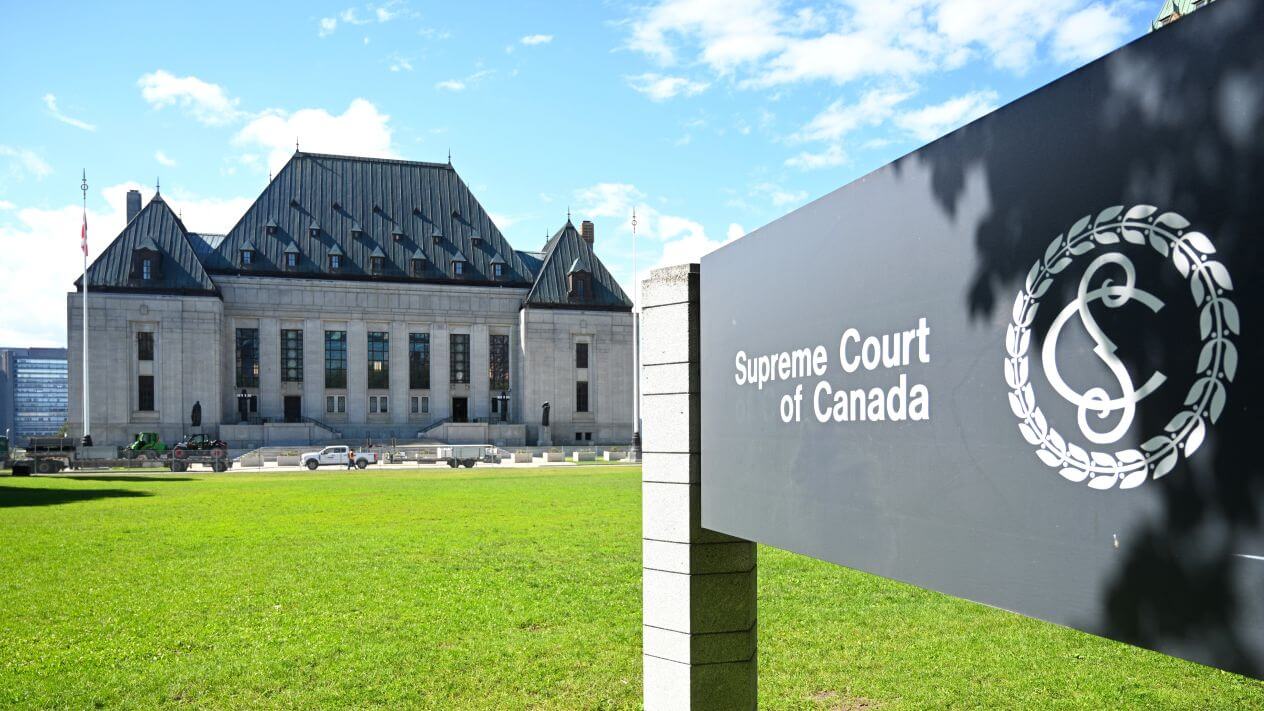
The question of whether or not Ontario can legally allow online gamblers to compete with players in other countries officially reached the Supreme Court of Canada this week.
Judges at Canada’s highest court spent almost three hours on Wednesday, Oct. 7 listening to both sides of the argument and will take the ‘Atlantic Lottery Corporation, et al. v. Attorney General of Ontario‘ case under advisement.
No ruling was made during the hearing, and it may be some time before a decision arrives.
What is the Canadian Supreme Court iGaming case about?
The question being considered is whether it would be allowable under the Criminal Code of Canada to take peer-to-peer iGaming across international borders. Currently, players of games such as P2P online poker in Ontario can only play against other Ontario-based users, thereby significantly limiting the player pools and prizes on offer, as well as curbing the appeal to players and operators alike.
The Ontario Court of Appeal issued a 4-1 majority opinion in November 2025 determining that expanding peer-to-peer Ontario iGaming in that manner would be legal.
Several provincial lottery crown corporations then appealed the decision to the Supreme Court.
On one side of the argument is the pro-liquidity crowd:
- The government of Ontario (and now also Alberta, which joined the case as an intervenor)
- The Canadian Gaming Association (CGA)
- PokerStars and FanDuel parent Flutter Entertainment
- GGPoker owner NSUS Group
Joshua Hunter, counsel for the Attorney General of Ontario, told the judges that the Criminal Code’s concern with relation to gaming is not about connecting with other countries but instead ensuring a province does not intrude on other provinces’ rights to conduct and manage gaming within their borders.
“[The Criminal Code] makes it clear that anything outside Canada is not prohibited at all, unless Parliament expressly says it is.”
Joshua Hunter, counsel for Ontario
Adam Goldenberg, counsel for the CGA, echoed that notion.
“Ontario is not precluded by anything from acting outside the borders of Canada,” he said. “What has been presented to you is a scheme in which everything that happens in Ontario would be conducted and managed by the province.”
Lotteries argue against ‘dramatic expansion’ of iGaming
On the other side of the coin are the appealing lotteries of numerous provinces that, unlike Ontario and Alberta, have not established their own commercial regulated online gambling markets:
- Atlantic Lottery Corporation (ALC)
- British Columbia Lottery Corporation (BCLC)
- Loto-Quebec
- Manitoba Liquor and Lotteries (MBLL)
Those crown corporations argue that international Ontario iGaming player pooling would violate the Criminal Code. Countering the Ontario lawyers’ reading, counsel for the appellants told the Supreme Court judges that the Ontario court “erred” in its interpretation of the law.
“The decision relied on a lack of express prohibition of international play,” said Matthew Milne-Smith, a lawyer for the appealing lotteries. “With respect, this is backwards.”
“Everything that is not expressly permitted is prohibited, and both the text and the history of the relevant provisions support this conclusion.”
Matthew Milne-Smith, counsel for the appealing lotteries
Given that they retain the monopoly on authorized online gambling in their respective jurisdictions, the appealing lotteries voiced concerns about what might follow if the Supreme Court upholds the Ontario court’s decision and allows expanded Ontario iGaming.
While online poker and daily fantasy sports have been used as the clearest and most relevant examples in today’s gaming, the eventual decision would theoretically apply to any peer-to-peer gaming product that may be launched in the future.
“This court should not approve a dramatic expansion of online gaming to encompass foreign gamblers based on hand-waving about how it’s going to happen in practice,” added Milne-Smith.
Ontario maintains it would legally conduct and manage
A centrepoint of the legal fight is what Ontario’s proposed model actually constitutes. The Criminal Code allows a provincial government to “conduct and manage” a gaming scheme “in that province.” What does “in that province” actually encompass?
Backed by the CGA, Ontario asserts that it would conduct and manage gaming activity hosted on the province’s licensed sites that may choose to take part in international liquidity, as iGaming Ontario already does for the province’s regulated market. Players in other countries would be subject to those regions’ regulations, and Ontario would sign agreements with those jurisdictions that lay out the shared rules and parameters of the games.
“Where we disagree [with the lotteries] is on whether, in saying ‘in that province or in the other province’, Parliament was trying to put Ontario in a box or was it trying to keep it out of the other provinces’ turf,” noted Hunter. “We say it’s the latter.”

Another counsel for Ontario, Ananthan Sinnadurai, stressed to the judges that Ontario’s model would not give other jurisdictions any authority over Ontario iGaming.
“We choose who we partner with, we still run the system in this province, and, fundamentally, we’re conducting and overseeing the lottery that Ontarians experience…” he said. “By linking them with international schemes, we’re not taking the scheme outside of this province. It’s still strictly within this province because all that’s happening is iGaming will permit pooled liquidity with others.”
“By linking them with international schemes, we’re not taking the scheme outside of this province.”
Ananthan Sinnadurai, counsel for Ontario
However, one of the more critical judges, Justice Malcolm Rowe, called Ontario’s explanation “word salad.”
“You’re saying, in effect, you’re controlling it through contractual means, but that doesn’t mean manage and conduct within the meaning of the act,” Rowe responded. “It’s playing with words.”
Inside Ontario or outside Ontario?
The one holdout in the Ontario court verdict last year was Justice Katherine van Rensburg, who countered that the proposed model would be illegal because elements of the gambling operation would not be conducted and managed by Ontario.
That argument was picked up on Wednesday by the lotteries’ lawyers.
“If it’s one game involving, to use a hypothetical, players from Malta, you could not be saying you are conducting and managing it at that point ‘in the province’,” said another counsel for the lotteries, Chanakya Sethi.
“The legislation isn’t crystal clear, and the tie goes to the runner.”
Justice Mahmud Jamal
Disputing the lotteries’ argument about the Criminal Code’s language, Justice Mahmud Jamal likened Ontario’s proposal to a two-sided telephone call.
“If I’m playing poker in Ontario but I’m playing with somebody overseas, maybe it’s taking place here and there, like a telephone call,” the judge mused. “And [the Criminal Code] doesn’t say ‘exclusively in Ontario’; it says ‘in Ontario’ … The legislation isn’t crystal clear, and the tie goes to the runner.”
Advertising debate deemed a sideshow
Throughout the hearing, counsel for the lotteries made repeated reference to a frequent complaint of their clients: That advertising by licensed Ontario iGaming operators has bled into other provinces, where those platforms and activities have not been authorized at the provincial government level.
Milne-Smith argued that, by extension, Ontario has infringed upon other provinces’ decision not to authorize and regulate commercial iGaming.
Lawyers for Ontario and the CGA countered that such a complaint is irrelevant to the court question at hand.
“My friends are saying some of the operators are doing some things they don’t like, and that’s upsetting the authorities in their jurisdictions,” said Sinnadurai. “But it has nothing to do with the issue before this court.”
More than one judge agreed.
“I’m here to figure out what this statute says is legally permissible,” said Justice Rowe. “Your client may be encroaching on what your friend’s client thinks is his territory. That’s not our business.”
In meantime, iGaming provinces can link arms
The question of international liquidity will take some time to resolve.
In the meantime, lawyers and judges acknowledged that the Criminal Code’s language allows two consenting provinces to join arms and share peer-to-peer gaming liquidity between them.
“Canadians outside of Ontario will be entitled to participate if Ontario enters into an agreement with their province, which is what the Criminal Code requires,” said Sinnadurai. If no such agreement is struck, that cannot happen.
Incidentally, officials from both iGaming Ontario and the Alberta iGaming Corporation publicly confirmed that discussions are ongoing about doing just that. AiGC CEO Dan Keene said at SBC Summit Canada in May that Canada’s two regulated commercial iGaming markets were working on a Memorandum of Understanding to pool their players.