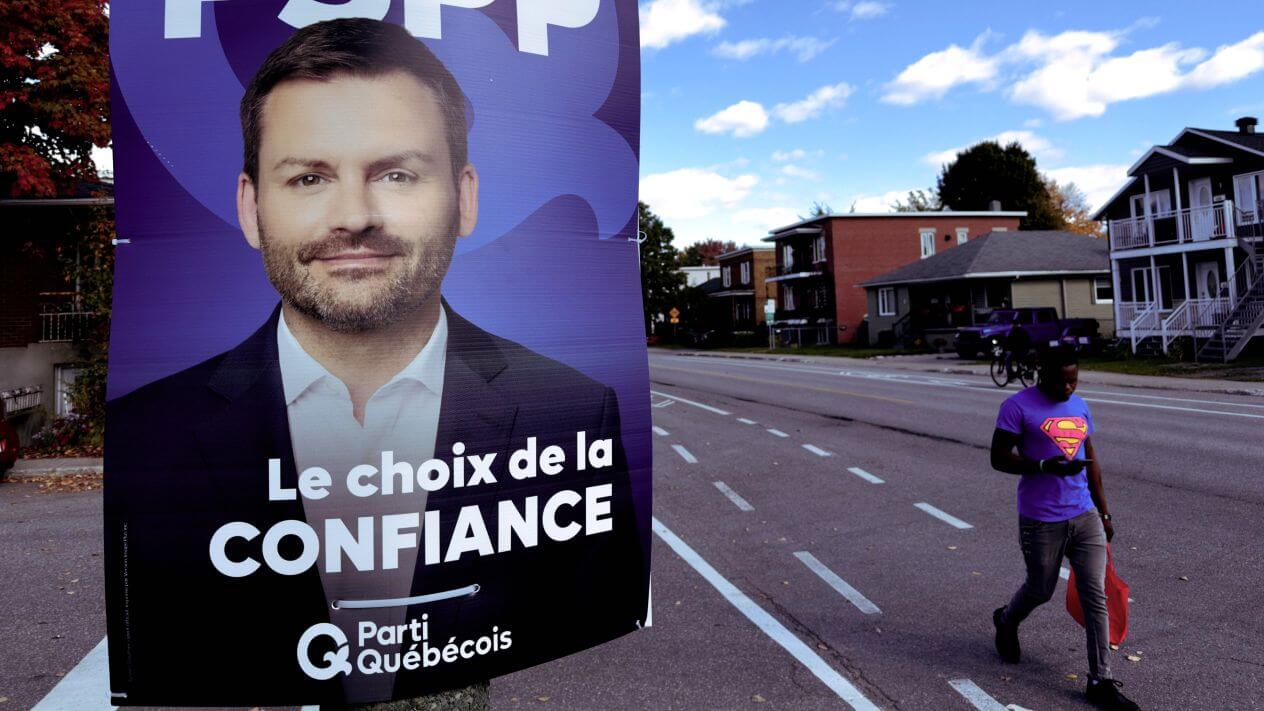
Parti Québécois (PQ) will form a minority government after winning the Quebec election on Oct. 5, and that could lead to a sea change in how the province conducts online gambling.
The sovereignist PQ won 59 of the Quebec legislature’s 127 seats, just five fewer than needed for a majority government, while the Quebec Liberal Party won 40. The ruling party before the election, Coalition Avenir Québec, was wiped off the map completely as it failed to earn a single seat.
The wholesale transformation of Quebec’s political landscape could have huge implications for Canadian iGaming.
New governing party, official opposition agree on iGaming
PQ leader and Premier-elect Paul St-Pierre Plamondon and the leader of the official opposition, Liberal leader Charles Milliard, both expressed support in the lead-up to the Quebec election for regulating commercial online gambling in broadly similar fashion to Ontario and Alberta.
Milliard’s written Quebec election commitment included expanding the mandate of the provincial gaming regulator to license and oversee all online gambling platforms operating in the province. Plamondon described that as “an excellent idea” in public comments.
“Mr. Milliard says — and he’s right, I’ve done the research — online sports betting in Quebec is a Wild West,” Plamondon said, as quoted by The Canadian Press.
“American companies arrive, then advertise, and are not regulated. Ontario decided to clean up and collect a tax on these activities, and it raised an additional $300m. It’s an excellent idea that may fly under the radar because it’s a bit original, but imagine if we take $300m and invest it in homelessness, for children who are hungry at school, for learning disabilities.
“We could have an immediate impact.”

How Plamondon’s PQ will go about forming their minority government remains to be seen. Plamondon said he plans to meet with each party leader in the coming weeks, seeking collaboration on various topics. In the meantime, both the incoming Premier and the leader of the opposition are in favour of abandoning the province’s current model, wherein the government-run Loto-Québec has a notional monopoly on online gambling.
Canadian Gaming Business reached out to the Parti Québécois for this story, but did not hear back.
Industry believes wheels are moving
Lobbyists in favour of expanding Quebec iGaming have presented estimates suggesting that roughly 75% of existing iGaming activity in the province is done on unregulated sites that the government has not formally authorized to do business.
A notably loud voice has been the Quebec Online Gaming Coalition, the members of which include several renowned iGaming operators:
- Bet99
- Betway
- DraftKings
- BetMGM co-parent Entain
- FanDuel owner Flutter Entertainment
- BetRivers parent Rush Street Interactive
The coalition has been urging Quebec to overhaul its approach to online gambling for years, and estimates that the provincial government is missing out on more than $300m in annual tax revenue by not licensing and regulating competition for Loto-Québec.
Its spokesperson, Ariane Gauthier, told Canadian Gaming Business by phone after the Quebec election that there is a strong consensus” on expanding iGaming.
“Millliard said the Liberal Party would be ready to collaborate on regulation of private platforms,” Gauthier noted. “It’s something that is currently being discussed as an option and I think it’s possible that we will see steps and things moving in the next in the next month or so.”
Canadian Gaming Association expects slow progress
As for what the first steps could be in light of the Quebec election result, both Gauthier and Canadian Gaming Association (CGA) SVP of Policy and Communications Amanda Brewer noted that Quebec currently does not have an independent regulator for iGaming.
For that reason and more, the CGA does not expect things to move quickly, but Brewer told Canadian Gaming Business that the CGA “has long encouraged more provinces to use online gaming regulation to level the playing field against unregulated offshore operators.”
“With the Parti Québécois having won a minority government, there is now hope that with the support of another party, the province may be able to move forward with stronger online regulation,” Brewer added. “The CGA and its members welcome the opportunity to contribute to consultations on the design of Québec’s regulated online market and how it can better protect consumers.”
Coalition sees ‘large consensus’ on Quebec iGaming
Gauthier said she would meet with governments and stakeholders this week after the Quebec election and that the coalition hopes to have “a nuanced and constructive discussion” about how to proceed in a way that suits all. She and the Brewer also pointed to recent comments from former Loto-Québec Chair Helen Fortin, who outlined the case for expanding iGaming in the province beyond the crown corporation.
“Even from Loto-Québec’s side, people have started to think, ‘let’s put aside opposition between private and public offering and consider all operators the same and regulate them appropriately’,” Gauthier added.
“A large consensus is emerging in Quebec. There are opinions about iGaming or the Ontario model, but the most important thing to look at is how we are doing in Quebec. Are we doing a good job to regulate online gaming with a monopoly such as the one Loto-Quebec has? The answer is clearly no. I think people acknowledge that the current system is not optimal or appropriate for online gaming.
“The Quebec Online Gaming Coalition is saying: ‘Put your rules in place, recognize us, and allow us to fully operate in Quebec, and we’ll contribute to the government’s finance.'”
Canadian Gaming Business also reached out to Loto-Québec for this story, but did not hear back.