Search
Choose a style
Dark
Light

Are affordability checks coming to Canadian gaming?

For years, affordability checks have been like a boogie man for most markets. It lurks as a threat but it has yet to manifest into something operators and regulators have ever had to actually confront.

That is starting to change, though. The UK Gambling Commission began a pilot program on affordability checks in August of last year. The government assures the program will implement a “light touch” in regards to assessing whether players or gambling responsibly or not, but for many the concept at all is a non-starter.

For now, the pilot is looking at users with £500 in deposits a month, but the plan is to drop the number to £150 next month.

In North America, the idea of affordability checks still feels unlikely, but these developments at least raise the question of whether or not Canada will consider them in the future.

Privacy and politics pose challenges

During a presentation as part of SBC’s Player Protection Day, Vixio’s Gaming Compliance Managing Editor Joe Ewens said it is an inevitability, but also conceded that the changes are far from imminent.

“Some [customers] don’t like the idea of gambling operators being able to look into their personal finances. Also on a political front, in some jurisdictions, it’s crossed a political and ethical boundary around privacy and the right for people to spend their money as they wish,” he observed.

“So while we see the concept growing, it’s certain to remain a politically charged area for gambling regulation.”

“In theory, affordability checks are a potentially effective safer gambling tool, but they require a level of engagement from players.”

In the meantime, it is not as though the issue of affordability isn’t top of mind for Canadian regulators.

There are currently measures in place in Ontario, for example, requiring operators to monitor customer behaviour and intervene when certain behavioural signs indicate there could be an issue. Focusing on markers of harm and behavioural triggers as opposed to pure financials is the way several jurisdictions have tried to address the problem so as to avoid the burden of affordability checks.

“We have already seen both third-party providers and operators themselves develop and implement monitoring systems that enable operators to evaluate the behavior of players and intervene based on behavioral triggers,” observed Vixio Chief Analyst James Kilsby.

“It’s been an obligation in the UK and several other European markets for several years but I do think what we are seeing as part of the trend is that it is becoming more common for regulations to directly mandate monitoring and intervention.”

Ontario enforces monitoring standards

The Alcohol and Gaming Commission of Ontario (AGCO) is certainly paying attention to what operators are doing on that front. They may not be deploying new programs and initiatives, but they are taking a particularly strong stance on enforcement.

In the U.S., VIP programs have largely gone unquestioned, but in Ontario, operators like PointsBet and Apollo Entertainment have paid six-figure fines for failing to meet the monitoring standards set forth in current regulations.

In many ways, these responses stem from the same motivation driving the affordability programs in the UK.

“We want to tackle cases where customers have been able to gamble large amounts without any checks or support, where it was later identified that this led to significant harm,” UK Gambling Commission Director of Major Policy Projects Helen Rhodes said of the program.

“But we are proceeding cautiously to test whether and how financial risk assessments could be introduced in a way that supports high-spending customers in financial difficulties but also supports a frictionless customer journey for the vast majority of customers.”

Effects on customers worth considering

This friction is the primary reason operators fear that affordability checks could run counter to their intended purpose.

In a 2023 survey conducted by SBC in tandem with IDnow, operators confirmed that customer friction is already a huge issue, particularly when it comes to sensitive information. More than half of respondents said the biggest drop-off in the onboarding process came when potential users were asked to submit documents related to personal financial information.

“In theory, affordability checks are a potentially effective safer gambling tool, but they require a level of engagement from players. For those bettors unwilling to provide documents or who are wary of allowing a credit reference check, the chance to sign up with black market operators will become an attractive option,” SBC Content Director Ted Menmuir noted at the time.

In Canada, consumer credit reports already play a role for operators when it comes to compliance. In order to be in line with the Financial Transactions Reports Analysis Centre of Canada (FINTRAC), operators utilize thin credit reports from agencies like TransUnion or Equifax to verify customer identities. For now, these checks fall into the “soft” category and do not impact someone’s credit score.

“Some [customers] don’t like the idea of gambling operators being able to look into their personal finances.”

The UK program looks at elements of someone’s finances like bankruptcies and personal debt, which would qualify as a “hard” credit check in Canada. In other words, such an inquiry wouldn’t just be perceived by many users as invasive, it would potentially also have a negative effect on their credit score.
Improbable, but not impossible?

With so many fundamental differences in how credit is determined across the two countries, it would arguably be difficult to transplant the UK pilot program across the pond.

However, it would be naive to assume that it is impossible. As we have seen with advertising, there are lessons to learn from older markets. But, we’ve also seen that Ontario is an example of a group being proactive about player spending. Perhaps this particular boogie man’s bark might just be worse than its bite.

This article first appeared in the January 2025 issue of Canadian Gaming Business magazine.
NorthStar Gaming forecasts big annual profit jump

NorthStar Gaming said the final quarter of the Canadian fiscal year completed its best-ever year.

The company’s preliminary results released on Tuesday suggest that Northstar Bets‘ total wagers for Q4 will reach around $303 million, a 42% jump on Q4 2023-24. Gross gaming revenue is expected to rise 31.6% to around $10 million and the company’s gross margin is forecasted to increase by 76% to $4.4 million.

For the full year, wagers are expected to be up 51% to $980 million and revenue is expected to climb to $34 million, also a rise of 51%. Gross margin is anticipated to be up 76% for the year as well as the quarter.

“We capped off a great year with the best quarter in the company’s history,” said Chairman and CEO Michael Moskowitz. “Much of our focus in 2024 was on product innovation and simplifying the customer experience, and we are seeing the results through the growth of our business. Record gross margins demonstrate the ability of our model to deliver operating leverage as the business scales.”

NorthStar said it will file its full, audited Q4 and FY24 results by the end of April.

NorthStar CEO promises “aggressive growth”

Moskowitz said the company is excited to move forward in 2025 “with strong momentum at our backs.”

NorthStar announced it late January that it has entered into a credit agreement providing for loans of up to $43.4 million, which it expects to use to strengthen its balance sheet and enable it to accelerate its growth initiatives.

Moskowitz added that NorthStar has the funding in place to reach profitability “based on the current business platform.”

“We intend to pursue aggressive growth and introduce our premium iGaming platform to more Canadians, a strategy which we expect will continue to deliver strong year-over-year growth each quarter while maintaining effective control of costs,” he said.

At the company’s last update in early December, Moskowitz told investors that the company sees a great deal of profitability in its position as a smaller, niche operator in Canada.

NorthStar operates out of Toronto and offers one Ontario-facing website and another elsewhere in Canada that is owned and operated by the Conseil des Abénakis de Wôlinak and licensed by the Kahnawake Gaming Commission.

The company’s strong growth has been fueled by several recent developments, including further funding from technology partner Playtech last year and the launch of Sports Insights 2.0, its upgraded sports content vertical. NorthStar also doubled its casino game selection since the start of 2024.

As for what 2025 may bring, Moskowitz has been clear in the past that the company intends to be part of the regulated Alberta iGaming market, slated to open its doors in the second half of 2025.

World Curling and FeedConstruct partner up on data and fan engagement

Sports data and streaming provider FeedConstruct has partnered with World Curling in a deal which will give it exclusive international betting rights to the organization’s various events.

World Curling operates the Pan-Continental Curling Championships, European Curling Championships, Women’s and Men’s World Curling Championships and the World Mixed Doubles Curling Championship.

Leveraging FeedConstruct’s expertise, World Curling will be able to focus on integrity and fair play from these broadcast events while also increasing the fan engagement experience in a new and data-rich manner.

“We’re thrilled to partner with the World Curling to bring the excitement of curling to a broader audience,” said FeedConstruct CEO Narek Harutyunyan. “Through this partnership, we’re committed to enhancing fans’ connection to the sport. By covering exclusive international betting rights, we aim to deliver an immersive experience that highlights the thrill of each championship, while supporting the highest standards of integrity in sports.”

“We are excited to begin our partnership with FeedConstruct,” added World Curling Commercial Strategy Lead, James Beatt. “World Curling have been looking at new ways to engage fans around the world and we see this as an important stepping stone in the process. I look forward to working with Narek and the FeedConstruct team.”

The deal comes on the heels of FeedConstruct’s recent partnership with Altenar which enhanced the latter’s proprietary platform with real-time sports data and pre-game and in-game betting odds to deliver a modern and engaging sports betting experience.

Saskatchewan regulator warns residents not to click online casino ads

Lotteries and Gaming Saskatchewan (LGS)  is warning provincial residents not to click on social media adverts for online casinos, citing fears of scammers using fake ads to steal people’s credit card numbers and other financial information.

The warning from the province’s gaming regulator comes amid wider fears of fraudulent marketing masquerading as legal and licensed online casinos across Canada.

“If you see a Facebook or other social media ad for an online version of Dakota Dunes Casino, Casino Regina or any other land-based casino in Saskatchewan, don’t click on it,” reads a public notice from LGS.

LGS Vice President of Gaming Steve Tunison emphasized that none of Saskatchewan’s land-based casinos have a legitimate online version.

“People who see these types of ads on their social media channels are strongly advised not to click on them,” added Tunison. “Saskatchewan people who wish to gamble online can do so safely and securely on PlayNow.com, which is the only legal online gaming platform in our province.

“Scam ads are an ongoing issue for land-based casinos across North America, including Casinos Regina and Moose Jaw and casinos operated by the Saskatchewan Indian Gaming Authority (SIGA). The scammers illegally use the logos, images, and branding of these casinos, stolen from the casinos’ websites, to create the fake ads.”

Other provinces seeing similar issues

The LGS warning comes two weeks after reports that fraudulent ads used altered news footage and the name of Alberta’s River Cree Resort & Casino to try to attract clicks.

Alberta RMCP Cpl. Troy Savinkoff warned that the issue is believed to be widespread and likely targets other casinos. Scam ads have also been reporting to be targeting players in Manitoba, Québec, New Brunswick and Nova Scotia. Last year, both Manitoba Liquor & Lotteries (MBLL) and Alberta Gaming, Liquor, and Cannabis (AGLC) warned players about social media ads implying that land-based venues are offering iGaming.

Canadian Gaming Association (CGA) President Paul Burns wrote on LinkedIn as far back as last spring that “virtually every land-based casino brand in the country has had its brand highjacked to promote fraudulent online sites in the past several months.”

Major Canadian casino operator Great Canadian Entertainment keeps a list on its website of known fraudulent advertising attempts concerning its properties across Canada, and notes at least five different Great Canadian casinos have been targeted since the start of 2025.

Blueprint Gaming adds another Ontario partner in with Rush Street Interactive

Blueprint Gaming has strengthened its presence in the Canadian market with a new partnership with Rush Street Interactive (RSI) in Ontario.

This collaboration will see the UK slots developer’s portfolio of top-performing games such as the Megaways series integrated into RSI’s BetRivers Casino platform in province. The supplier’s branded games will also go live with BetRivers, including Rick and Morty: Strike Back and The Lost Boys.

Blueprint says the agreement highlights its continued expansion into regulated markets and its commitment to growing its footprint in Canada and reflects its broader strategy to strengthen its global position.

“The popularity of Blueprint slots continues to grow across Canada and the Americas, and so we are delighted to go live with an industry renowned operator in the region,” said Samuel Haggblom, director of key accounts at Blueprint Gaming. “This exciting deal pays further testament to how our games can resonate with players in multiple markets worldwide and we look forward to seeing the response from BetRivers players.”

Part of the Merkur Group, Blueprint Gaming has been licensed and live in the regulated Ontarian market since the province opened its doors in April 2022. By that point, it already had a partnership in the province with Ontario Lottery and Gaming (OLG). The company’s Director of Marketing and Key Relationships Jo Purvis spoke to SBC last year about why its tailored and branded content translates well in Canada.

RSI adds Blueprint to suite of BetRivers partners

“Blueprint Gaming boasts a growing collection of exciting titles, and we are thrilled to be working with them to bring these games to our BetRivers players in Ontario,” added RSI CEO Richard Schwartz. “We are happy to partner with Blueprint Gaming and look forward to watching this collaboration flourish.”

For RSI, this latest deal follows some significant updates in recent months.

In the U.S., it debuted the BetRivers online poker platform in Pennsylvania in October 2024 and brought its BetRivers Sportsbook to Washington State just last week.

In Ontario, Blueprint is RSI’s latest online casino partner. In August, it extended its multi-jurisdictional sportsbook partnership with Kambi across their shared markets in the Americas, including Ontario. The following month, RSI launched Playtech’s gaming content on the BetRivers platform in Ontario and other key North American markets.

Canadian lotteries take offshore operator Bodog to Manitoba court

Manitoba Liquor & Lotteries (MBLL) has filed an injunction application to prevent unlicensed gambling site Bodog from operating in the province.

The application, filed with the Manitoba Court of King’s Bench on behalf of the Canadian Lottery Coalition (CLC), is seeking a court order to ban the Caribbean-based operator from doing business or advertising its services in Manitoba.

The 30-page application, obtained by Canadian Gaming Business, is dated Jan. 28, 2025 and names Bodog operator Il Nido Ltd. and its Canadian trademark owner Sanctum IP Holdings Ltd. as defendants.

A court date is currently scheduled for March 5, 2025.

Bodog ‘false and misleading,’ says coalition

The injunction application alleges that the real-money bodog.eu and “free play” bodog.net platforms are breaking laws by violating MBLL’s authority over gambling. MBLL’s PlayNow.com is the sole platform authorized by provincial law to offer online gaming in the province.

In the text of the filing, the lotteries accuse Bodog of “false and misleading” advertising by marketing itself as a “trusted” online gaming operator across Canada, and asserts that Bodog’s solicitation of Manitoban customers is “illegal.” It also states that the “sole purpose” of the free-play version of the site is to direct players to the real-money gambling site.

The application adds that, in the CLC’s eyes, Bodog’s continued operation in Manitoba causes real harm to MBLL by threatening its business and revenues.

The CLC alleges that the operator is in violation of the federal Criminal Code, Trademarks Act and Competition Act, as well as three pieces of provincial legislation. It also writes that the coalition contacted Bodog in both February and June of 2023 demanding that it block Manitoba users, but that the operator “has refused to cease its illegal operations in Manitoba.”

First-of-its-kind action by CLC

CLC membership includes the Atlantic Lottery Corporation (ALC), the British Columbia Lottery Corporation (BCLC), the Saskatchewan Indian Gaming Authority (SIGA) and Loto-Québec in addition to MBLL.

The CLC’s Executive Director Will Hill told CGB that this injunction is the first of its kind from either MBLL or the coalition. He noted that the CLC and its members “remain committed to the idea of addressing unlawful gambling through all available means.”

“It fits within a broader set of activities undertaken since the coalition was first formed, always with the same overarching goals in mind: namely, to curtail illegal online gambling across Canada, to create a safer online gaming landscape for Canadians and to protect Canadians against the wide array of illegal sites that operate with no federal or provincial regulatory oversight and aren’t bound by anti-money laundering legislation,” Hill added.

Hill reaffirmed that the CLC “is committed to the idea of addressing unlawful gambling through all available means on a pan-national basis.”

Bodog disappeared from Nova Scotia last fall

Bodog shares a history of operational ties with Bovada, which has been the subject of numerous cease-and-desist letters from U.S. state regulators.

Bodog.eu’s website says it “accepts players from all across Canada, except for those residing in the province[s] of Quebec and Nova Scotia.”

Despite implying that it offers its wares in Ontario, Bodog does not have a license from the Alcohol and Gaming Commission of Ontario (AGCO) to operate in Canada’s only regulated commercial online gaming market. CGB also reached out to the AGCO as well as other non-CLC member lotteries for comment.

As alluded to by its own website, the Antigua and Barbuda-based brand has been dark in Quebec for several years and last September, it quietly took itself offline in Nova Scotia, where the only licensed online gaming offerings are provided by the multi-provincial ALC.

Hill added that the CLC was encouraged by Bodog blocking access in Nova Scotia. “That story is not unique to Atlantic Canada, which is why the CLC is committed to the idea of addressing unlawful gambling through all available means on a pan-national basis,” he concluded.

CGB also reached out to Bodog seeking comment for this story but had not received a response at the time of writing.

Half of Ontario Super Bowl viewers will bet on game

It’s Super Bowl season again, and almost half of Ontarians who plan to watch Sunday’s Big Game will be betting on it too.

A survey conducted by Leger for the Responsible Gambling Council (RGC) suggested that 63% of Ontarians plan to watch the Kansas City Chiefs square off against the Philadelphia Eagles.

However, less than half of the viewers (48%) intend to place at least one bet on it. That is up from 41% last year but is down from a high of 54% in 2023, which marked the first Super Bowl since Ontario opened up its saturated commercial online gambling market.

The propensity to bet on the Super Bowl skews towards older generations. The report found that Ontario sports bettors over 45 are more likely to bet on the game (52%) than those aged 18-44 (45%). White viewers are significantly more likely to bet on Super Bowl LIX (54%) than Ontarians who are Black, Indigenous or people of colour (42%).

Betting increases excitement for many

The online survey of 1,147 Ontario adults, conducted between Nov. 22 and Dec. 6, 2024, found that half (50%) of those who plan to bet will use a legal sportsbook website or app to do so, which is up from 44% in 2024 and 41% in 2023. As many as 15% will bet using several sportsbooks.

Less than half of bettors plan to wager more than $100 or place more than one bet the game. The majority (86%) of those who will bet on the game noted that they will be drinking alcohol when they do.

As for why people will be betting, nearly half (47%) of those who will wager on the Super Bowl say betting adds to the game’s excitement. Around one-fifth (22%) bet because they believe they are knowledgeable about the teams and players, because they feel confident about their chances of winning (20%) or because their favourite team or player is playing (18%).

Two-thirds (67%) of all respondents believe their sports knowledge gives them an edge in predicting outcomes, a proportion which is higher for men between 18 and 44 (70%) but which is down from the overall rate of 74% last year.

Ads prompt Ontarians to wager

The survey also assessed some wider trends when it comes to how Ontarians gamble.

Leger found that more than one-third of all respondents (35%) placed a bet in the last 12 months after seeing a gambling ad online or on TV. That proportion is greater among populations that the RGC identifies as at risk for problem gambling, including people under 44 years of age (42%) and BIPOC Ontarians (44%).

In addition, 36% report having bet more than they can afford to lose in the last 12 months. That is the same proportion of respondents who say they sometimes feel anger or frustration at losing a bet, who feel stress or anxiety around betting or who problem with gambling. It’s also significantly higher than the proportion of people who use spending limit tools (23%) or use personalized spending reports or take a cooling off period (20%).

The report found that one-third of those who will bet on the Super Bowl don’t plan on using any features to help them manage their betting (33%).

EveryMatrix supplies sportsbook odds feed to LeoVegas

LeoVegas Group has entered into a partnership with EveryMatrix’s OddsMatrix as it continues to build out its own proprietary sportsbook platform.

The operator will integrate OddsMatrix’s odds feed and other technology in a move that LeoVegas says will help it to expand its market coverage and pricing models across multiple territories, sports, markets and events.

OddsMatrix’s feed will be customized for LeoVegas’ specific requirements and is expected to enable the provider to offer optimized pricing, increased uptime and an enhanced user experience.

LeoVegas is live in numerous North American markets and operates as both a licensed online casino and a licensed online sportsbook in Ontario.

“We’re delighted to be partnering with such a household name as LeoVegas Group, particularly at such an important moment for the brand as it expands its operations across the world and transitions to a new proprietary sportsbook,” said EveryMatrix Americas President Erik Nyman. “Our odds feed has consistently proven to be a valuable addition for Tier-1 operators, and we’re committed to doing exactly that with LeoVegas.”

EveryMatrix delivers its scalable and modular iGaming software, solutions, content and services for casino, sports betting, payments and affiliate management to global Tier 1 operators and newer brands. It serves 300+ B2B customers worldwide.

Last year, it extended its existing partnership with DraftKings into Canada’s most populous province, supplying the gaming giant with content from its in-house studios via its SlotMatrix proprietary B2B online casino offering.

EveryMatrix also works with other operators in North America, including BetMGM, Caesars Digital, Golden Nugget Online Gaming, and Rush Street Interactive.

AGLC says casino changes have helped cut regulatory red tape

Alberta Gaming, Liquor and Cannabis (AGLC) said it reduced regulatory red tape by 51% between 2019 and 2024, making it less expensive for both present and potential gaming companies to operate in the province.

In a statement, AGLC said it has removed nearly 2,500 policies that impacted casinos, including relaxing rules on table games. Those measures, it estimates, provided $2.4 million in cost savings for licensees. It also expanded online raffle opportunities to include virtual sales outside of venues, which has resulted in an estimated $42 million in additional revenue for charities.

Overall, the government agency said that its red tape reduction work yielded more than $89 million in cost savings and revenue generation across the gaming, liquor and cannabis industries.

“This achievement highlights Alberta’s position as a national leader in reducing red tape and fostering a business-friendly environment,” said Minister of Service Alberta and Red Tape Reduction Dale Nally. “By cutting unnecessary regulatory burdens, we’re empowering industries to grow, innovate, and contribute to Alberta’s economy. This is just one example of our government’s commitment to supporting businesses, creating jobs, and ensuring Alberta remains a competitive and thriving place to do business.”

Canadian Gaming Business reached out to AGLC for more information and specifics about the gaming cost savings but had not heard back at the time of writing.

Alberta iGaming a matter of when in 2025, not if?

CGB also asked Nally’s office if they can provide an update on the minister’s online gaming review and when Alberta’s eagerly awaited iGaming market may launch. The minister’s office said that it can’t offer an update at this time but promised more updates on Alberta’s iGaming strategy later this year.

Nally suggested at the Global Gaming Expo last fall that he wanted to have the market up and running in time for the 2025 event in October. PointsBet CEO Sam Swanell said on an investor call just last week that believes “the expectation is still clearly NFL season this year, so you talk about September or around that timeline.”

Nally’s office pumped the brakes on its plans to open a commercial regulated online gambling market in order to due their due diligence and consult further with stakeholders. The minister has reiterated that the province will pursue an open-market model similar to Ontario’s.

For the meantime, AGLC continues as the operator of the only licensed online gambling site in the province, Play Alberta. The platform already had more than 313,000 registered player accounts by the time it launched its first ever mobile app in October.

Data provided to CGB by H2 Gambling Capital suggests that Play Alberta held down around 28% of all online sports betting and online casino gaming in the province in 2024. AGLC itself has reported that it holds 45% of the market.

Chelsea FC’s marketing deal with Roobet faces Canada — but not Ontario

Chelsea FC may not be the force it once was on the pitch in the English Premier League, but it is still a huge brand name in the world of soccer.

The five-time EPL winner and two-time UEFA Champions League winner announced last week that it has welcomed Roobet as its Official Regional Betting Partner for Canada and Latin America.

The club said the multi-year partnership will help the crypto casino expand its brand visibility and reach and enhance its users’ experience with promotional content and exclusive campaigns. From Chelsea’s perspective, it will leverage the team’s strong fanbase in the Americas to build “a wide array of digital, social and logistical assets” and provide a valuable opportunity to engage new audiences in its key markets.

“There is a huge passion for sport and entertainment across the 32 territories for the partnership, which gives the club and Roobet an incredible opportunity to drive significant growth and value through tailored content and exclusive offers for fans and users,” said Chelsea’s Chief Revenue Officer Casper Stylsvig.

Chelsea says yes to Canada, but no to Ontario

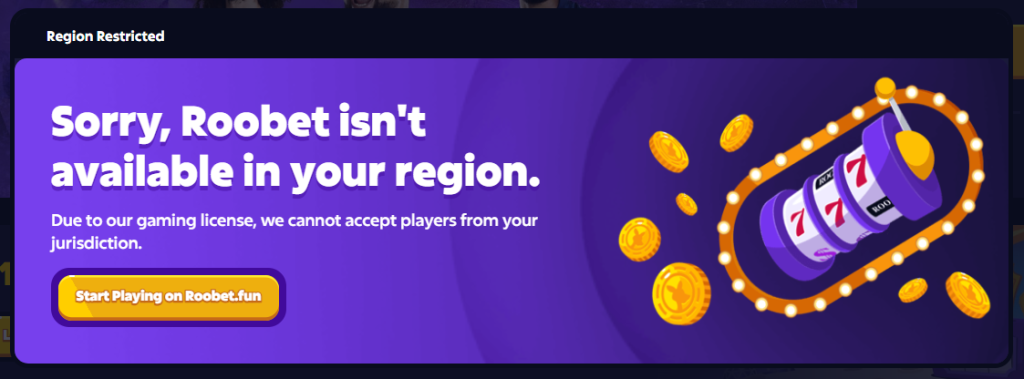
Roobet.com is a brand name of Raw Entertainment B.V., a business registered out of Curaçao. Like multiple other online casino brands whose parent companies reside in the Caribbean, it is not licensed to operate in Ontario.

Trying to access the brand’s website from the province results in this:


As a result, while Roobet’s partnership with Chelsea is billed as facing Canada, both parties confirm it does not encompass the country’s largest province or only commercial online gaming market.

A spokesperson at Chelsea FC told Canadian Gaming Business that the partnership does not extend to Ontario, and the Roobet web site “clearly reflects Ontario is a blocked region.” Even outside of Ontario, many of the game suppliers that work with Roobet are georestricted throughout Canada.

A Roobet spokesperson confirmed to CGB that the deal, which allows the operator to create branded content with Chelsea, “will only be relevant to regions where Roobet has the appropriate licensing to operate.”

“At this time Roobet does not have any intentions or specific content planned for Ontario, as it’s not a market we participate in,” the spokesperson added. “If this changes, we’ll announce that when the timing is right.”