Loto-Québec reported a new annual revenue record of more than $3bn for the 2025-26 fiscal year, but its chief executive acknowledged that the crown corporation needs to improve its iGaming position as calls continue for Québec to allow commercial gambling operators to do business.
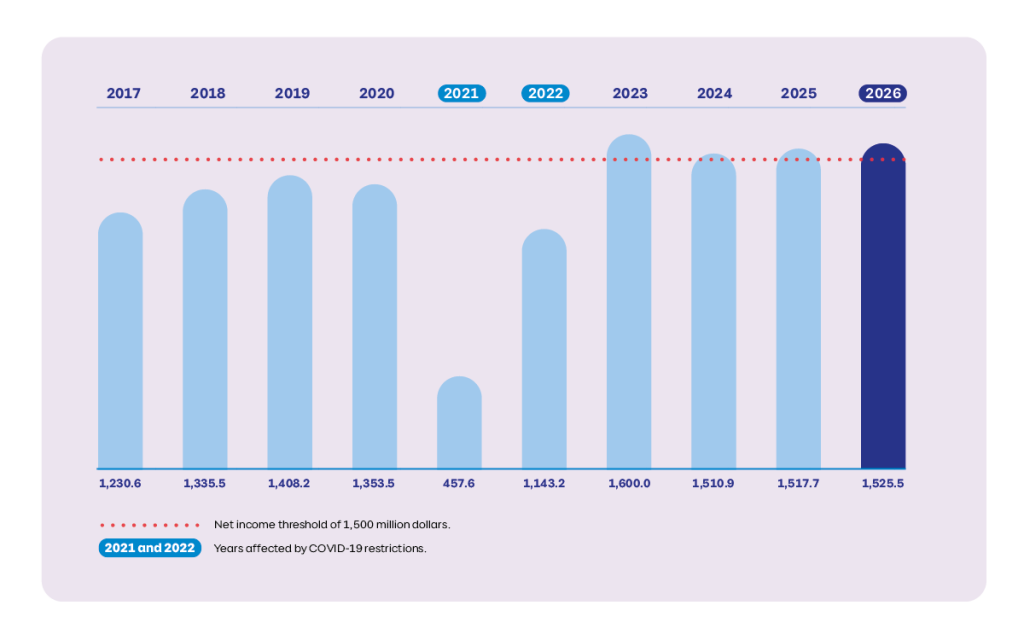
The provincial lottery said in a press release on Tuesday that it broke the $3bn barrier in sales for the first time ever in the last fiscal year, reaching $3.09bn. That record total revenue yielded an annual dividend to the province of $1.52bn, the highest since 2023.
President and CEO Jean-François Bergeron said the “excellent” results demonstrate Loto-Québec’s ability to maintain a trajectory of growth while generating significant financial benefits for the province.
While the total revenue number was a small increase to more than $3bn, the net income figure has been flat since the all-time record it reported in the COVID-19 pandemic rebound year of 2023.
How does Loto-Québec make its revenues?
The provincial lottery corporation breaks down its revenue results into three categories:
- Physical casinos and gaming halls
- Lottery gaming
- Gaming establishments, which includes sports betting, video lottery terminals (VLTs), bingo and Kinzo gaming offered outside its gaming halls
The casinos and gaming halls sector continues to produce the highest proportion of Loto-Québec’s total revenue. For the 2025-26 fiscal year, the crown corporation’s revenues by segment were:
- Casino and gaming halls: $1.30bn
- Lottery games: $995.6m
- Gaming establishments: $814.5m
The casino and gaming halls revenue was up more than 8% over the 2024-25 fiscal year, but gaming establishments revenue was flat and lottery was down 0.5%.
Bergeron said that he is confident that Loto-Québec revenue will increase further next year and beyond, boosted by ongoing projects such as the expansion of the convention centre at the Lac-Leamy casino resort in Gatineau and a new gaming hall that is slated to open in the city of Saguenay in 2027.
He also revealed to La Presse that Loto-Québec wants to begin allowing users of self-service checkouts in retail stores and supermarkets to buy lottery tickets at the checkout, which he said would be the first initiative of its kind in Canada. That new offering will be trialled at some locations this summer.
Bergeron says Loto-Québec must improve at iGaming
Bergeron has been bullish in the past about Loto-Québec’s online gambling offering, and he suggested in March that its gains in iGaming have offset flat performance in some of its land-based gaming operations.
However, he admitted in Loto-Québec’s latest annual report that the crown corporation must work to expand and improve its digital products.
“We have continued to enhance our offerings by leveraging the synergy between our various channels,” wrote the CEO. “We have upgraded our online gaming site and mobile apps, and expanded our in-store offerings, particularly by focusing on a variety of entertainment options that encourage social interaction.
“It is essential that Loto-Québec strengthen its presence in the online gaming sector, including sports betting, to ensure better oversight and guarantee that profits benefit the people of Québec. We prioritize a responsible approach aimed at capturing the market rather than stimulating growth.”
SBC Summit Canada hears fresh calls for open Québec market
Meanwhile, online gambling operators, stakeholders, and lobbyists continue to call upon Québec to follow in the footsteps of Ontario and Alberta by opening a regulated commercial iGaming market.
Continuing to lead that charge is the Québec Online Gaming Coalition (QOGC), a group consisting of:
- DraftKings
- FanDuel owner Flutter
- BetMGM co-parent and Sports Interaction owner Entain
- Super Group brand Betway
- BetRivers owner Rush Street Interactive
- Canadian operator Bet99
- Prominent gaming supplier Games Global
- Apricot Investments
In February, the QOGC issued a press release in which it said it had briefed the provincial Ministry of Finance on the revenue potential that it believes regulated commercial online gambling would bring. The coalition claimed that La Belle Province is losing out on around $300m in tax revenue each year by not allowing any competition to Loto-Québec’s online gaming platform, as scores of unregulated and untaxable websites currently operate in the province.
QOGC spokesperson Ariane Gauthier has repeatedly stated that Loto-Québec’s results amount to flat performance that holds the province back from its true online gaming potential.
Last month, Gauthier spoke alongside TRM Public Affairs President Troy Ross and Rubicon Strategy President Patrick Harris on a panel at SBC Summit Canada 2026 in Toronto. They repeated their call for Québec to legalize commercial iGaming.
Ross presented research data that suggests that Loto-Québec currently captures just 27% of all online gambling activity in the province, with 73% going to the unregulated market. Ross’ firm estimated that equates to $2.3bn in lost gross gaming revenue and $563.3m in uncaptured government revenue.