Search
Choose a style
Dark
Light

OLG, Caesars extend Caesars Windsor agreement amid hunt for next operator

The Ontario Lottery and Gaming Corporation (OLG) has extended its Caesars Windsor casino operating agreement with Caesars Entertainment by another seven months as it continues to search for the next operator.

The OLG agreement had been set to expire in August 2025 after a previous extension but will now run until March 2026.

The crown corporation is currently conducting a competitive procurement process to select a highly qualified service provider to handle the day-to-day operations of the Windsor Casino.

“Extending the current operating agreement will ensure sufficient time to complete the procurement process and transition the day-to-day operations to the successful proponent,” said an OLG statement. “The integrity of the process is of the utmost importance to the OLG.”

New Unifor Local 444 president James Stewart, whose Unifor unit represents around 1,800 workers at the casino, said the extension removes the threat to employees that could be posed by a potential ownership change during planned bargaining talks early next year.

“It won’t impact the daily activities of the workers, but it removes the weight of a potential ownership change in the middle of bargaining,” said Stewart, per the Windsor Star. “Our contract deadline is April next year and we’ll probably start negotiations in February-March. That weight of an ownership change is now off our minds with the extension.”

Change could be afoot in Windsor

Caesars has run the famous Windsor casino since it opened 30 years ago, but things could be changing in a big way over the next year. The OLG, which owns the casino on behalf of the Government of Ontario, opened up a bidding process more than a year ago, back in April 2023. It opened the RFP stage of the process in October.

“We know the process is pretty in-depth,” Stewart added. “Lots of companies have to do a lot to bid on the service contract. I don’t know when the deadline is, but I think bids are still open for a few weeks. They still plan to announce it next year.”

The Globe and Mail reported in January, citing three gambling industry sources, that Bally’s Corporation and Mohegan Gaming and Entertainment are Caesars two contestants in a three-horse race for the rights. Mohegan operates two casinos in Niagara Falls, Ont. Bally’s Director of External Communications Tim Louie told Canadian Gaming Business that the company had no comment on the rumours.

Stewart’s predecessor as Unifor Local 444 president, Dave Cassidy, suggested that Caesars should be the favourite “based on the job they’ve done running the casino and providing quality jobs.” Caesars Windsor is thought to support more than 2,000 jobs and is a key component of Windsor’s border-city tourism industry. The OLG says the City of Windsor has received more than $95 million in payments from the casino since it opened in 1994.

Canadian Gaming Business reached out to Caesars to see if any further comment was available.

Caesars Windsor’s casino floor offers more than 2,200 slot machines, more than 80 table games, and a physical Caesars Sportsbook which was opened last year as a key post-pandemic strategic move. The accompanying resort features 750 hotel rooms, numerous restaurants and bars, and the 5,000-seat Colosseum theater which often hosts internationally renowned musical artists and shows.

OLG said it expects to announce the selected operator by spring 2025. The lottery corporation’s director of media relations, Tony Bitonti, told Canadian Gaming Business that it will not be releasing any further details or comments on the procurement process “until the selected service provider is announced.”
Could Alberta iGaming progress open door in more provinces?

Nearly three years after Canada legalised single-event sports betting, Ontario’s is still the only regulated, open commercial sports betting market in the country. That’s unlikely to be the case for too much longer.

It’s old news by this point that Alberta intends to launch its own online gaming and wagering market in the vein of Ontario in the near future. Could we see similar action start to gather pace in other provinces?

A variety of experts discussed that notion at the Canadian Gaming Summit in Toronto, as well as the size of the opportunity in Alberta. The consensus was that the influence of Wild Rose Country opening its doors could extend far beyond the province itself.

A recent Citizens JMP Securities projection suggested that Alberta’s forthcoming iGaming market could generate more than $950 million a year in revenue by the third year. That kind of return would rank it as the eighth-largest commercial gambling market in North America. While those expectations are disputed, having not one but two of Canada’s four most populous provinces open for business may change the outlook significantly.

“When you’ve got one province doing something, that is something that can be easily ignored,” said Patrick Harris of Rubicon Strategy. “When you’ve got another significant province doing it too, that tends to become a pattern.”

“With Ontario, we have precedent. With Alberta, we have pattern.”

Jared Beber, BET99

Conduct and manage issue critical?

In his address to attendees at CGS, Alberta minister Dale Nally confirmed that another particular way the province will emulate Ontario is by establishing a separate entity to conduct and manage gaming.

Nally stressed that the message he received “loud and clear” was the commercial operators would not want to come to Alberta if the right to conduct and manage was held by Alberta Gaming, Liquor and Cannabis (AGLC). That message was echoed as reported speech by multiple individuals at the summit. The Alberta legislature cleared the legal runway to allow that by passing Bill 16, which recognised that the provincial government has the authority to conduct and manage gaming in the province separately and distinctly from AGLC. 

In Ontario in May, the Ontario Superior Court dismissed a challenge filed by the Mohawk Council of Kahnawà:ke and upheld the right of iGaming Ontario (iGO) to conduct and manage iGaming in the province. The court also ruled that iGO’s chosen model was valid.

Speaking on the panel with Harris, industry expert and consultant Troy Ross suggested that ruling is “critical” to what other provinces do in the future as it sets a legal precedent that a conduct-and-manage model is Criminal Code-compliant.

“Some provinces were waiting to see how well or how poorly the Ontario model performed, and some were waiting on this legitimate legal question of is this conduct and manage model truly legal?” Ross told attendees. “It’s a game-changer, frankly. 

“I think this last domino coming down fully will have a number of other provinces saying ‘what they’re doing down there works, we should start.’”

How do other provinces feel?

As for which other provinces in Canada could follow suit, two of the most-mentioned possibilities have been British Columbia and Québec. At face value, the outlooks for those provinces look very different.

Naturally, political leaning has a big impact on the legislative direction a province chooses. It’s noteworthy that two provinces with Conservative premiers have pursued the open commercial model to date. The B.C. government, under Premier and B.C. NDP leader David Eby, has opposed Ontario’s push for international gaming liquidity to be considered. B.C. appears to want to keep gaming under government control, with the British Columbia Lottery Corporation’s PlayNow.com platform currently used in not only B.C. but also Saskatchewan and Manitoba.

In Québec, a high-profile movement to try to push La Belle Province towards commercialised gaming is afoot. The Québec Online Gaming Coalition, made up of several operators, advocates for a regulatory framework to allow competition for Loto-Québec’s online gaming and betting monopoly. The most recent word from the provincial government, under the leadership of the centre-right Coalition Avenir Québec and leader François Legault, is that there are no plans to do so. The government cited concerns around problem gambling as a major reservation.

“Two is much different than one.”

Patrick Harris, Rubicon Strategy

At a leaders panel of crown corporation presidents and CEOs at CGS, Loto-Québec’s Jean-Francois Bergeron echoed BCLC’s Pat Davis and the Atlantic Lottery Corporation’s Patrick Daigle reiterations that each lottery’s respective offering is the only “legal” online gaming product in its province.

However, Bergeron stressed that regulated competition has its benefits.

“Competition is actually really good because it forces us to be better,” Bergeron said. “Competitors are a great source of inspiration. There are great operators out there, and we even use some of them as a go-to model. As crown corporation operators, it’s certainly not up to us to defend that model, but to operate it successfully within the current legislation.”

AGLC has made similar conciliatory noises. The commission’s VP of Gaming Dan Keene told Canadian Gaming Business recently that the crown corporation supports Premier Danielle Smith exploring commercial gaming if it means lost grey-market revenues can be captured for the benefit of the province. 

The best thing for Canadians?

That revenue generation is one of three pillars of the common argument for further iGaming and betting expansion across Canada, along with greater consumer protection and greater consumer choice. As panelists at CGS noted, it’s hard to argue that hasn’t worked well for Ontario.

“I hope that inevitably we are looking at a fully regulated Canadian market which I truly and firmly believe is what is best for all Canadians,” said Beber, CEO of Quebec coalition member BET99.

“This is an industry that historically has existed in the shadows,” added PointsBet Canada CEO Scott Vanderwel, sat beside Beber. “What we’ve seen in Ontario is that it can move out of the shadows productively… It’s an industry that has a lot to give. I hope we can move this country from activity that’s happening in the shadows to activity that’s happening in the light.”

In that regard, Ontario was the precedent; advocates believe Alberta, when it happens, can be the start of a pattern. As Harris put it, “two is much different than one.”

Forestell and Gertner to strengthen AGCO board of directors

The Alcohol and Gaming Commission of Ontario (AGCO) is filling holes in key positions.

The AGCO has announced the reappointment of Dave Forestell as Chair of its board of directors for a three-year term. Forestell, who was first appointed to the role in July 2023, has been a member of the AGCO’s board for six years. Forestell was named Chair following the resignation of previous incumbent Lalit Aggarwal. Forestell has since relinquished his position as Chair of iGaming Ontario.

Forestell is continuing to lead the AGCO’s board as the current VP of External Relations (Canada) for TC Energy. The Western University grad also holds a leadership role at the Ontario College of Art and Design University as a member of the Board of Governors.

AGCO adds more to roster

The commission has also tapped Alan Gertner as a new director for a two-year team.

The Arcana founder joins the AGCO with experience in gaming as a former Vice Chair at iGaming Ontario. Gertner, a graduate of the Richard Ivey School of Business at Western University, also co-founded Tokyo Smoke. The publicly traded cannabis company was acquired by Canopy Growth Corp in 2018 for roughly $250 million. Canopy would divest its investment in Tokyo Smoke by selling it to OEG Retail Cannabis last year.

Gertner has also spent time at Google and Oliver Wyman in New York. He will also maintain his role as a Director at the Mabin School in Toronto while with the AGCO.

IGT Gaming and Everi sold to Apollo Funds in $6B all-cash deal

A new holding company established by Apollo Global Management has agreed to acquire Everi and IGT’s Gaming & Digital business in an all-cash deal valued at $6.3 billion.

IGT and Everi are being acquired by Apollo Funds following a strategic review by IGT earlier this year. The review led IGT to enter into a definitive agreement to combine its Global Gaming and PlayDigital businesses with Everi. As part of the deal, IGT planned to separate its Global Gaming and PlayDigital segments into a taxable spin-off to shareholders. Now, Apollo Funds has acquired IGT Gaming and Everi with plans to transition the two entities into privately owned companies once the transaction is closed.

“With the Apollo Funds, we have found a partner that recognizes the strength of IGT Gaming, the value of our talent, and our position in the industry,” said IGT CEO Vince Sadusky. “This transaction will allow IGT Gaming to continue to invest in and enhance its growing core segments while providing customers with a more comprehensive portfolio of offerings.”

As part of the deal, Everi stockholders are receiving $14.25 per share with IGT set to receive $4 billion of gross cash proceeds for its former Gaming segment. IGT plans to use most of the fresh injection of capital to repay debt and return value to shareholders.

De Agostini S.p.A, IGT’s majority shareholder, will continue to invest in the company despite the sale to Apollo Funds.

De Agostini plans to make a minority equity investment in the combined business once the transaction is closed. Apollo Funds and IGT expect the deal to close by Q4 2025 with Everi delisting from the New York Stock Exchange. IGT will also be changing its name and stock ticker symbol as a lottery business upon a completed sale.

The transaction is not expected to face scrutiny from IGT leadership with a special committee from its board of directors approving the deal. The transaction has also been unanimously approved by all members of Everi’s board of directors.

Stagnant results for IGT

IGT is offloading its Gaming and Digital business amid flat revenue results.

The London-based company generated $1.07 billion in revenue in Q1 2024, a 1% increase year-over-year. The results in Q1 were led by IGT’s Global Lottery business, which reported $661 million in revenue. By comparison, lottery revenue reached $624 million in Q1 2023.

IGT’s Gaming and Digital business closed Q1 2024 with $406 million in revenue, down from $436 million for the same period last year. Before IGT’s agreement with Apollo Funds, the company projected total full-year revenue in FY2024 to reach at least $4.4 billion.

Pollard Banknote extends deal with multiple Canadian lotteries

Pollard Banknote has signed a five-year extension to continue providing its services to multiple Canadian lottery corporations.

The company has extended its Instant Ticket Printing Services Agreement with the Interprovincial Lottery Corporation (ILC), ensuring that it will continue to provide instant tickets, game design, and related services through December 31, 2028. The contract has an option to renew for an additional five years.

The ILC is a nationwide lottery organization with five members: the Atlantic Lottery Corporation, Loto-Québec, the Ontario Lottery and Gaming Corporation (OLG), the Western Canada Lottery Corporation (WCLC) and the British Columbia Lottery Corporation (BCLC).

Pollard Banknote and the ILC have worked together for the past 35 years to deliver regional-specific strategies and top-selling national games to players across all 10 provinces and three territories. Pollard Banknote and ILC recently launched the latest iteration of its Jackpot family of games as the lotteries continue to bolster their digital operations.

“We look forward to continuing our strong partnership with Pollard Banknote,” said ILC Director of National Games, Sarah Price. “Their expertise and experience in the industry has allowed us to bring exciting new concepts and instant games to the Canadian market. The contract extension will allow us to continue to deliver innovative and creative games that players love and that will generate revenue for the vital programs the lotteries support throughout Canada and their respective provinces.”

“Pollard Banknote is thrilled to have the opportunity to extend our partnership with the ILC,” said Brad Thompson, VP of sales and marketing at Pollard Banknote. “We are excited to continue providing innovative products that stand out at retail and extend the play experience into the digital landscape, with the ultimate goal of maximizing revenue for good causes across Canada.”

As well as every Canadian lottery corporation, Pollard Banknote is a partner of more than 60 lotteries worldwide. It not only provides instant ticket products and games but also a full suite of digital offerings including player engagement solutions and strategic marketing and management services.


Eilers-Fantini: IGT top supplier in Canada, Playtech surges in live dealer

Eilers-Fantini’s latest Canada report shows that International Game Technology (IGT) is still the king of slots across multiple provinces.

In the July 2024 report published by Eilers & Krejcik Gaming, IGT led all other suppliers with an 18.3% share of the overall gross gaming revenue generated by game providers across the country. That was down slightly from the 19.3% it captured in June’s report but comfortably ahead of Evolution’s 13.6%.

South of the border, Evolution regained the top spot from IGT, which briefly seized the lead in June.

In Canada, Pragmatic Play was third with 11.9% while Light & Wonder in fourth ticked up slightly from 10.6% in June to 11.0% in July.

In terms of individual games,  IGT’s Cash Eruption game held onto its ranking as the top-performing game in Canada, holding a 2.0% share of the total theoretical win. The company’s Cleopatra title secured second place, giving IGT the top two games for another month. Evolution’s Live Dealer Roulette completed the podium in third. A third IGT game, Blackjack, was both the top-performing table game and the fourth and final title to grab 1% of overall GGR.

Meanwhile, Pragmatic Play’s Sweet Bonanza 1000 and Gates of Olympus 1000 were the two best-performing new games in the July report. The New Slot ranks featured nine previously unranked games including top performers such as IGT’s Powerbucks Bounty O Bucks and new titles from Light & Wonder, Inspired and Wazdan.

Evolution still top live dealer, table game supplier

While IGT wears the overall crown and also ranks as the top slot supplier, Evolution leads all others in GGR in both the live casino and table games segments. It holds more than two-thirds of the total GGR among live casino suppliers, while its 36.6% of table games GGR is slightly ahead of IGT’s 32.0%.

However, its overall share of 13.6% was its lowest since January.

Second place in the live casino segment went to Playtech, which has been a notable mover in recent months. Playtech now represents 19.7% of GGR within live casino , nearly double its share from four months ago.

Eilers-Fantini’s monthly supplier tracker monitors nine online casino sites across five provinces.

World wide web inventor to keynote at SBC Summit 2024

Sir Tim Berners-Lee, the inventor of the World Wide Web, will speak at the SBC Summit 2024 as part of a fireside discussion.

The fireside discussion, focusing on how his vision of a globally connected network of computers has revolutionised the way we share information, is set for the Super Stage at Feira Internacional de Lisboa’s MEO Arena on Sept. 24 from 11:45 to 12:30.

Berners-Lee invented the World Wide Web in 1989 during his tenure as a software engineer at CERN, the renowned particle physics lab near Geneva, Switzerland. He saw the unrealized potential of millions of computers linked via the Internet and conceived the Web as a global platform for sharing information.

“Our events have always been about exploring what lies ahead, beyond the current landscape. As event organizers, our goal is not only to provide attendees with access to products and services and facilitate networking but also to educate and inspire innovation, pushing their offerings to the next level. Sir Tim embodies this ethos perfectly — he’s a shining example of someone who recognised potential and transformed lives in unimaginable ways,” said SBC CEO and Founder Rasmus Sojmark.

Access to the Super Stage is available to all SBC Summit attendees, whether they hold a full event or an expo-only pass. In addition to attracting 25,000 attendees, the event will feature 600 global brands showcasing their products and insights from over 450 speakers, including industry C-levels, thought leaders and experts from various fields.

iGaming Ontario’s Q2 2024 numbers show online casino towers over rest

The latest Ontario market report from iGaming Ontario shows that, while both online sports betting and iGaming continue to post healthy year-over-year growth, it is online casino gaming leading the way.

Commercial online casino offerings yielded around three times more revenue than online sports betting in Ontario during the Q2 2024 period from April 1 to June 30, according to numbers published on Wednesday

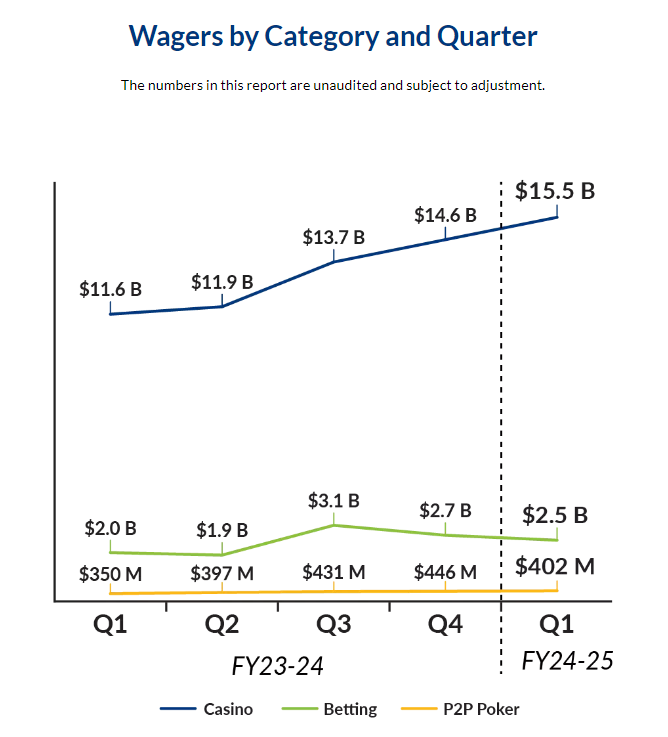
The Ontario commercial iGaming and sports betting Q2 2024 (Q1 of iGO’s fiscal year) data indicates that casino games, including slots, live and computer-based table games and peer-to-peer bingo, accounted for 84% (nearly $15.5 billion) of total wagering handle and 73% ($529 million) of gaming revenue.

Betting, including sports, esports, prop bets, novelty bets and exchange betting, accounted for $2.5 billion (14%) of total wagers, up from around $2 billion this time last year but down slightly from $2.7 billion in Q4 2023. Sports wagering yielded $181 million of gaming revenue, 25% of the Q1 2024 total.

Peer-to-peer poker made up $402 million of total handle and $16 million of gaming revenue.

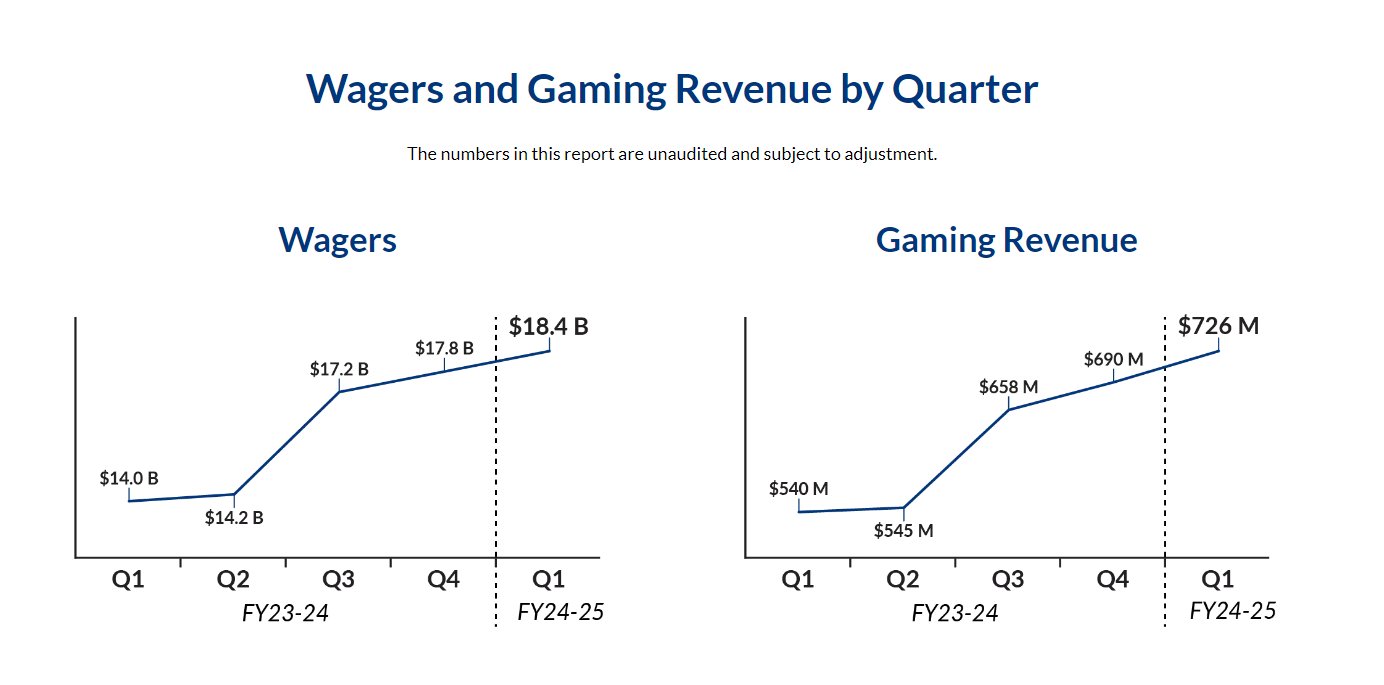
Overall betting and gaming handle increased to $18.4 billion. That total sum, which does not include promotional wagers, is up 31% from a year earlier and 3.4% from the previous quarter. Total gaming revenue rose to $726 million, representing similar rises of 34% YoY and 5.2% QoQ.

Biggest growth comes in player account numbers

While online casino and sports betting handles and revenues posted strong growth, the biggest yearly gains were seen in the number of player accounts in the province.

The number of active player accounts more than doubled year-over-year, surging from around 920,000 to 1.9 million. iGO stressed that this does not mean 1.9 million Ontarians were playing, as many residents likely have accounts on more than one commercial operator.

Average monthly spend per active player account was also significantly higher at $284, up 44% from $197 last year.

“With 50 regulated operators and a one-third increase in wagering and revenue figures over the first quarter of last year, Ontarians who choose to gamble are finding many enjoyable options in our open regulated iGaming market,” said iGO Executive Director Martha Otton. “The revenue generated by Ontario’s competitive iGaming market contributes directly to provincial priorities such as infrastructure, healthcare, and education.”

Ontario approaching year-five targets after just two years

In iGO’s last quarterly report, it noted that Ontario online gambling sites generated $2.4 billion in revenue from $63 billion in wagers in the market’s second year, year-over-year jumps of 71.4% and 78%, respectively.

Wednesday’s release also comes just over a month after data published by iGO and Deloitte suggested that Ontario’s commercial iGaming market is performing far better than had been projected.

Commercial online gaming and betting in the province has so far generated more than $4 billion in economic value for the province and created around 15,000 jobs.

It all means that after little more than two years, Ontario’s market is already approaching longer-term targets.

As well as the two-year total of around $4.3 billion in GDP approaching Deloitte’s initial year-10 GDP forecast of $4.7 billion, Ontario commercial iGaming market has hit or nearly reached many of Deloitte’s year-five projections in just its second year. Government revenues (94% of the five-year projection in two years), direct jobs sustained (120%), total full-time jobs sustained (92%) and GDP contributions (93%) are all “outpacing initial expectations.”

Otton noted in that June report that while, “year over year, it’s unrealistic to expect that we’ll see growth of over 70%… to be frank, we’re not seeing the leveling off yet.”

Letter to the Editor: Are provincial lotteries flourishing or floundering?

The Spring Edition of Canadian Gaming Business magazine contained the following inaccurate statement: “With Ontario enjoying the success in its private sector model, other provinces are flourishing with the provincial lottery corporations continuing to be the sole legal provider of online gaming.”

The assertion that provincial lottery corporations are the “sole legal provider(s) of online gaming” is highly debatable. It is no surprise that some provincial lottery corporations take this view. The fact is, there is no Canadian case law that has ever found offshore iGaming companies that accept play in Canada to be acting illegally. The lotteries may hold that opinion, but it is just that, an opinion with no evidence to support that claim.

As for the assertion that lotteries are “flourishing”, the Canadian Gaming Association (CGA) recently retained H2 Gambling Capital to research sports betting in Canada. Their report concluded that lotteries capture only 11% of sports betting. Another analysis conducted by Yield Sec found that lottery corporations have captured about 14% of the total online market, while other independent research suggests that lotteries have approximately 20% to 25%. 

Lottery corporations in Canada have historically enjoyed a monopoly on all gambling products. Yet no monopoly could claim to be “flourishing” with a paltry 11-25% market share… floundering may be the more appropriate description.

Troy Ross, TRM Public Affairs

Do you have a letter to the editor? Have your say and write to us at [email protected]

Slots influencer Brian Christopher talks Flip the Switch and BetMGM partnership

Fliptheswitch.com is the first “player portal” for the whole of gaming, according to its founder Brian Christopher.

“[Fliptheswitch.com is] where all players can come together and learn everything factual about playing in casinos, online and sports betting,” Christopher told Jessica Welman, editor of Canadian Gaming Business, at the recent Canadian Gaming Summit in Toronto. “There’s so much misinformation out there on how casinos work, so we’re there to demystify everything, put people at ease, and answer all their questions.”

Last month, BetMGM announced that it had entered an exclusive partnership making Christopher a brand ambassador. He will appear in content across the firm’s livestreams on its social media channels and feature in future marketing campaigns.

“I get to join the ranks of some of the biggest stars out there who really speak for and in my case get to play for BetMGM. I’m going to be promoting them, their casino, their sportsbook, and just having a lot of fun showing my fans how to play all those different games they have,” he said.

He added that he believes iGaming will “explode” in the coming years as more states legalize online casino and as a result, he now has the opportunity to “put everyone at ease” by walking people through the steps on how to play online slots.

Christopher is the face of Brian Christopher Slots and runs three YouTube channels showcasing him playing different slots and casino games as well as going live three times a week, both in casinos and playing online.

“What I’ve found is a lot of our fans that watch us, they’re not necessarily slot players. A lot of them are just poker players, or maybe they’re not gamblers at all or maybe they don’t have the money to gamble so they want to watch me,” he said.

“We literally cover everybody and they’re not just tuning in for the gambling side, it’s for a community they are coming out for too and they love the conversation. That’s why I love the love livestreams too because you can have a conversation with people. And from the manufacturer’s side too they can get immediate feedback on how people are liking and reacting to their games in the chat.”

Whenever people produce gambling content it sparks a debate surrounding responsible gambling and the ethics of promoting slots to an audience. On the topic, Christopher emphasized that since the start he has been transparent about his wins and losses.

“From day one of me starting this I would put at the end of my videos my profit or loss, I don’t hide anything,” Christopher explained. “You’ll never catch me in a casino filming something and then discarding the video. I show everything, all my wins and especially all my losses, and we lose a lot more than we win. I can go five days in a row of videos where it’s just lose, lose, lose. I have to show that because I want people to know that I’m not special and I lose like everybody else. I do not want to be responsible for people just watching winning videos thinking they can do the same thing so we try to be very smart about that.”

Christopher has also been a vocal supporter of anti-smoking campaigns and has provided testimony in New Jersey on the topic. He chastised companies like Caesars, Bally’s and Boyd which have all recently chosen not to investigate whether consumers want a smoke-free environment in casinos.

“I’m like you won’t even research to find out what your people want, shame on you. I’m so against that. People want smoke-free gaming, and I’m even hearing that from smokers. People don’t smoke in their own houses, they don’t want to breathe it in non-stop. It makes no sense that 100% should have to breathe it in when only 11% smokes,” added Christopher.

He advocates for casinos to provide smoking patios outside for smokers which he says will have the added benefit of allowing players to take a break which can have positive responsible gambling implications.

Watch the full SBC Media interview with Brian Christopher above.