Search
Choose a style
Dark
Light

Fanatics Casino launches in Ontario; sports betting and Alberta entry to follow in 2027

Three weeks after Fanatics Betting & Gaming (FBG) was approved to launch online gambling in Ontario’s regulated iGaming market, Fanatics Casino officially hit the market on Tuesday, Sept. 1.

Canadian Gaming Business reported on Aug. 11 that FBG received licenses that day from the Alcohol and Gaming Commission of Ontario (AGCO) for its casino platform. Fanatics Casino soft-launched without fanfare on Tuesday and began taking wagers as the 50th active operator in the province, including all licensed commercial brands and the government-owned Ontario Lottery and Gaming (OLG).

The operator’s President of Gaming Conor Grant told Canadian Gaming Business in an interview on Tuesday that it will follow up in 2027 by adding sports betting in Ontario and by entering Alberta’s iGaming market.

Why is Fanatics starting with only casino in Ontario?

Although Fanatics has its roots in sports apparel and merchandise and boasts several Canadian sports partners on that side of its business, sports betting is not included in the company’s Ontario iGaming rollout. Grant told Canadian Gaming Business on Tuesday that is partly a reflection of Ontario’s market, but confirmed that the plan is to introduce Fanatics Sportsbook to the province in 2027.

“It’s going to take us a little bit of time to get up to speed where we want to be, but this has been a target market for us for a while,” Grant said in an interview via Zoom. “We’re two-and-a-half years into our journey in the U.S. and we’ve been the fastest-growing there, so Ontario was a natural extension for us. This is our first foray into an international market. We’re treating it as an international market and not a 51st state.

“There were a couple of factors in the decision to lead with casino. The market is predominantly casino, it’s very heavily skewed in that region, and we also knew we could get casino live much quicker. The other big element is that, like other U.S. operators, we’ve been getting into the prediction market space and working out what is going on there. But we will absolutely follow [in Ontario] in 2027 with our sportsbook proposition.”
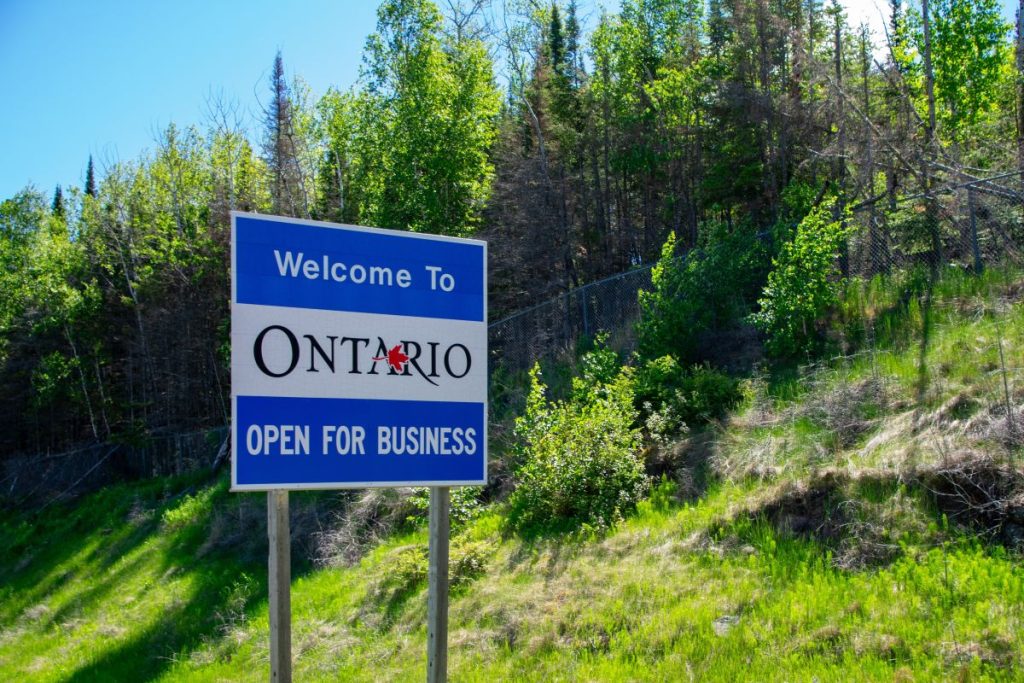
A 'Welcome to Ontario' sign against a backdrop of trees and a grassy slope
Image: Shutterstock

To Grant’s point, Fanatics Casino enters an Ontario market where almost 90% of all online gambling handle and 80% of gross gaming revenue comes through online casino. In July 2026, Ontarians wagered $8.78bn on iCasino alone on iGaming Ontario platforms, an all-time monthly record.

Fanatics Betting & Gaming plans to launch in Alberta in 2027

Fanatics Casino already operates in four U.S. states: Michigan, New Jersey, Pennsylvania, and West Virginia. Fanatics Sportsbook is live in 24 U.S. jurisdictions, while the newer Fanatics Markets venture operates in a total of 23 U.S. states in which it does not offer state-regulated sports betting or casino gaming.

Ontario is now the first international market for the Fanatics Betting & Gaming brand. A spokesperson echoed Grant’s comments by telling Canadian Gaming Business that “sports betting is not in our immediate plans and will come second.”

Adding sports betting in that province isn’t the only further Canadian expansion on the agenda for 2027.

Although Alberta opened its own regulated iGaming market on July 13, Fanatics Betting & Gaming is not listed as a registrant with Alberta Gaming, Liquor, and Cannabis (AGLC) as of the time of writing. However, Grant told Canadian Gaming Business that Alberta is firmly in the plan.

“Alberta is on the roadmap,” he added. “It’ll be 2027. We will land in Alberta; it’s just going to take us a little bit of time.

“Success in Ontario will be creating and landing a really strong proposition in Ontario that resonates with the players first. We feel our broader proposition of the Fanatics ecosystem will resonate in the Canadian market. It’s about getting a product that’s really competitive, and as we head into the new year, that’s when you’ll see us trying to land a proposition that will resonate with Canadian casino players.

“If we do that, and then we drive awareness, success will follow.”

Casino focus, sports roots

Fanatics Casino platform has launched with a curated game portfolio of hundreds of games across live dealer, slots, and table games from leading suppliers including Evolution, IGT, and Playtech.

While FBG has only taken its casino app live in Ontario at first, Grant believes the operator will still reap the benefits of Fanatics’ sports roots.

The parent company has a stacked roster of Canada-facing sports league and team partners, including status as the official team jersey provider for the NHL and all of the league’s teams, including its various Canadian franchises. Other apparel and merch partners include the likes of Major League Baseball and the Toronto Blue Jays, the NBA’s Toronto Raptors, as well as Canada Basketball, Canada Soccer, and Hockey Canada.

“Ontario is a super competitive market, but it’s a very appealing market, and we think we’ve got something a little bit different in our proposition,” Grant added. “Not only our brand, but our overall ecosystem. Fanatics has heritage in the market already through its sponsorship of the NHL and the Blue Jays. Our brand has a presence there from a merchandising perspective.

“So, this was a logical step for us, and we think our proposition will resonate with the Canadian players.”

Even within its casino platform, Fanatics has some sports ties. It holds an exclusive casino gaming deal with the WWE and launched its first proprietary game under the wrestling brand in March. Grant said that Fanatics will continue to explore proprietary content and intellectual property rights (IP) deals in Ontario and beyond.

Fanatics will also begin ramping up its casino marketing in Canada over the coming months. In the U.S., the company works with celebrities including Patrick Schwarzenegger and Taraji P. Henson to advertise its casino product. Grant suggested that as Fanatics Casino gets a foothold in the Ontario market, “who we use and how we do that will be very targeted to who resonates in the Canadian market.”

Fanatics confident of taking ‘significant’ market share

Fanatics had held back from entering the Canadian online gambling market until now, despite its rapid growth in the U.S. since acquiring PointsBet USA in 2023. Now, it will compete with dozens of others, including major American-market brands such as:

  • Bally Bet
  • bet365
  • BetMGM
  • BetRivers
  • Caesars
  • DraftKings
  • FanDuel
  • Hard Rock Bet

Unlike those nine operators, Fanatics has opted to limit itself to just online casino in Ontario for now.
Image: Adam McCullough / Shutterstock.com

Fanatics Casino is also one of several new high-profile arrivals in the Ontario market in recent weeks. Sports streaming company DAZN launched its DAZN Bet sportsbook and casino in the province on June 30 and Hard Rock Bet went live with both verticals on July 22.

Asked what success in Ontario would look like, Grant said that the operator’s leaders are confident of carving out a slice of the pie.

“Fundamentally, we think we’ve built a proposition that is resonating with consumers. We see that in how we acquire and retain them. We have been the fastest-growing brand in the U.S. in the last 12 to 18 months, so we felt now is the right time to bring that to a different market. Canada felt like a logical extension.

“It is competitive, but so are some of the U.S. states we operate in. Casino is very competitive and we’ve gone in and taken significant share in those states. We think we can do the same in the Canadian market.

“We don’t come to play eighth or ninth in the market. We want to be a top operator. It’s going to take time, and we respect a lot of the incumbents in the market, but we’ve shown in Michigan and Pennsylvania that we can aggressively win and take market share in very short periods of time.”
Las Vegas dollar deal attracted 120,000 Canadians, says Circa casino owner

The owner of several downtown Las Vegas casinos said that a dollar exchange promotion designed to appeal to Canadians attracted more than 120,000 visitors from the country in a few months.

Circa Resort and Casino owner Derek Stevens unveiled the ‘At Par’ initiative in January, wherein Canadian dollars were treated as if they were U.S. dollars across select gaming, hotel, and beverage offerings at his three Vegas casinos north of the Strip near Fremont Street:

  • Circa Resort and Casino
  • The D Las Vegas
  • Golden Gate Hotel & Casino

In a video posted to X on Monday, Stevens said the promotion, which allowed Canadian guests at Circa and the other venues to get US$1 in value for every C$1 spent instead of the true exchange rate of 72 cents, was an emphatic success. The offer ended on Aug. 31.

“During this summer, we had 120,000 Canadians that came through our properties,” Stevens said. “… That’s up 80% from last year, so Canadians came through in a real big way.”

Hotel bookings doubled thanks to ‘At Par’

The slot element of the Circa promotion, which allowed Canadian guests to redeem a slot play voucher worth up to US$500 at the $1-for-$1 rate, resulted in US$20m worth of play.

Stevens added that more than 8,000 room bookings also came in as a result of the promotion, which is more than double the visitation the three hotels would usually see.

“There were many nights along Fremont Street where it felt completely taken over by Canadians, and we loved every minute of it,” he added. “… I’m here to say thank you to all the Canadians who came to Las Vegas and stayed at one of our properties. We really appreciate it.”

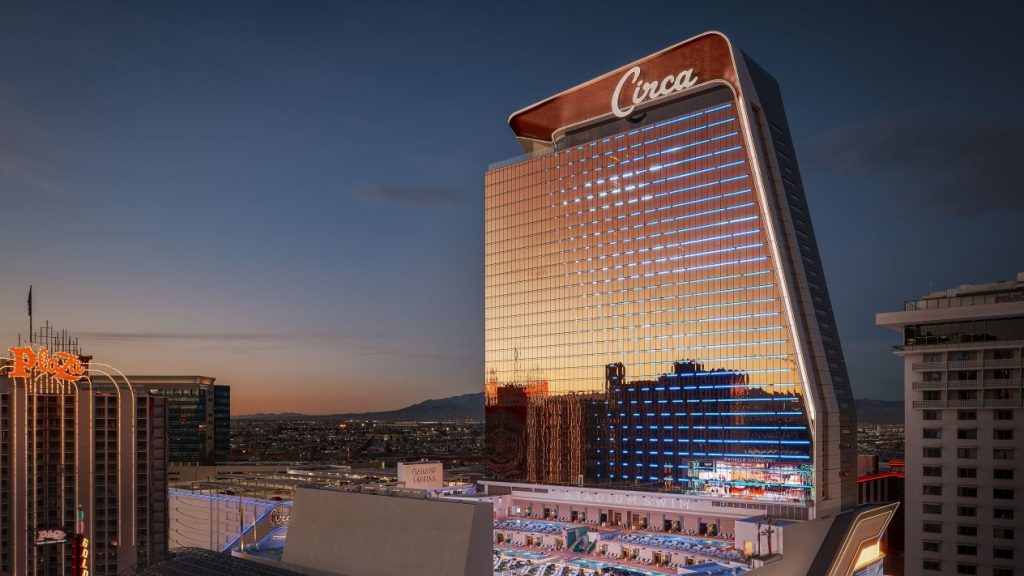
The Circa Resort & Casino in Las Vegas, Nevada
Image: Circa Resort & Casino

Vegas tries to entice Canadians amid U.S. tensions

Circa owner Stevens introduced the ‘At Par’ initiative at the start of this year amid widely reported declining Canadian visitation to Vegas.

The Las Vegas Convention and Visitors Authority (LVCVA) estimated late last year that there was a roughly 24% decline in visitors from Canada, historically Vegas’ largest international market, between January and November 2025. Major Canadian airlines such as Air Canada and WestJet reported steep drops in traffic from Canadian airports to Vegas, down 22% and 28% in 2025, respectively. Reported data suggests those declines have continued into 2026.

“Tourism has slowed down, some of it has to do with the cost of flights, the exchange rate,” Stevens told Canadian Gaming Business in January. “We miss Canadians. Even if we get a few people, we just want to make sure all Canadians know that we miss you and we want you back.”

LVCVA leaders visited Canada in 2025 to discuss ways to rectify relationships and entice Canadian tourists back to the resort city. In March of this year, the LVCVA board of directors approved a three-year marketing agreement and additional funding worth just short of US$3.5m that is aimed at boosting tourism to Nevada’s gaming hub, with a focus on Canada.

This all comes amid ongoing tensions between Canada and President Donald Trump’s administration, which Stevens referenced on Monday.

“Although our leaders of our countries are still going at it, that hasn’t changed, I did want to let everybody know that I really appreciate the Canadians that did come and visit with us, and tell you thank you, and tell you that you’re welcome here,” Stevens added in the Aug. 31 video.

Government extends Saskatchewan Indian Gaming Authority’s exclusive online gambling rights

The Saskatchewan Indian Gaming Authority (SIGA) will continue as the only entity authorized to offer online gambling in the province for the next few years.

The Government of Saskatchewan announced on Monday that it and the Federation of Sovereign Indigenous Nations (FSIN) amended their Gaming Framework Agreement (GFA) to extend SIGA’s iGaming exclusivity until September 2029.

First Nations gaming operator SIGA has run Saskatchewan’s only authorized online gambling platform, PlayNow, since it launched in the province in November 2022. PlayNow is operational in several provinces using the platform, technology, and brand provided by the British Columbia Lottery Corporation (BCLC).

SIGA also operates seven brick-and-mortar casinos:

  • Bear Claw Casino
  • Dakota Dunes Resort & Casino
  • Northern Lights Casino
  • Gold Eagle Casino
  • Gold Horse Casino
  • Living Sky Casino
  • Painted Hand Casino

“Our government has built a successful gaming industry in Saskatchewan in partnership with the FSIN through good-faith negotiation and incremental change,” said Minister Responsible for Lotteries and Gaming Saskatchewan (LGS) Jeremy Harrison.

“Through the GFA and its various amendments, the gaming sector provides significant First Nations employment and supports economic development on- and off-reserve, while funding education, housing and many other priorities. Revenue-sharing arrangements agreed to in the GFA mean that both the province and First Nations in Saskatchewan have a vested interest in the success of the gaming sector.”

SIGA’s PlayNow revenue grew 38% in 2025-26

SIGA is an entirely non-profit gaming operator. Through the revenue-sharing agreement between FSIN and the province, 50% of all profits raised by SIGA’s online gaming operations are divided among the province’s First Nations and the other half of the profits go to Saskatchewan’s General Revenue Fund.  

In its 2025-26 annual report, published in late June, SIGA noted that it posted record profits for the fourth year in a row. From the $418m it made in gross revenue in the 12 months that ended March 31, 2026, it returned $167m in net profit to the province.

SIGA’s 2025-26 gross revenue was 11% higher than last year’s previous record total, and its profit to the province rose 14%. PlayNow yielded more than $31m in gross gaming revenue, 23% ahead of 2024-25, and SIGA’s net iGaming revenue jumped 38% to $12.4m.

SIGA said at that time that it now has more than 59,000 registered users on the platform. In Monday’s government release, the province noted that PlayNow has been steadily growing in profitability, “despite heavy competition from illegal platforms.”

The provincial government has made roughly $70m from SIGA’s operations since it first launched.

Saskatchewan unveils gaming centre pilot project

As well as the news of the extension of SIGA’s iGaming exclusivity, the Saskatchewan government announced a new gaming centre pilot project in the province on Monday.

The approved plan will establish a gaming centre on Flying Dust First Nation that will host up to 49 slot machines as part of a much larger commercial development proposed by the First Nation that includes designs for a strip mall, hotel, and conference centre.

“We were building a hotel and some other things, and a gaming room was just an idea that we could maybe utilize to bring people, and attract them to the region,” Flying Dust First Nation Chief Tyson Bear said, as quoted by CTV News. “I’m going to be probably breaking ground in about three weeks.”

Bear added to local media it will likely take six months to construct the building.

“The project will be an important part of a new hotel development that will better serve the people of Meadow Lake and northwest Saskatchewan,” said FSIN Chief Bobby Cameron. “Importantly, the benefits of this growth will extend beyond the host community, with the First Nations’ share of gaming profits distributed equitably among Saskatchewan First Nations throughout Treaty 4, 5, 6, 8, and 10 territories.”

The new slots would take SIGA’s total slot machine allocation across all of its venues to 2,619.

Ontario iGaming market sets several new all-time records in $9.9bn July

July 2026 was a month of records for the regulated Ontario iGaming market, with new all-time monthly high marks in several metrics including total cash wagers and the number of active player accounts.

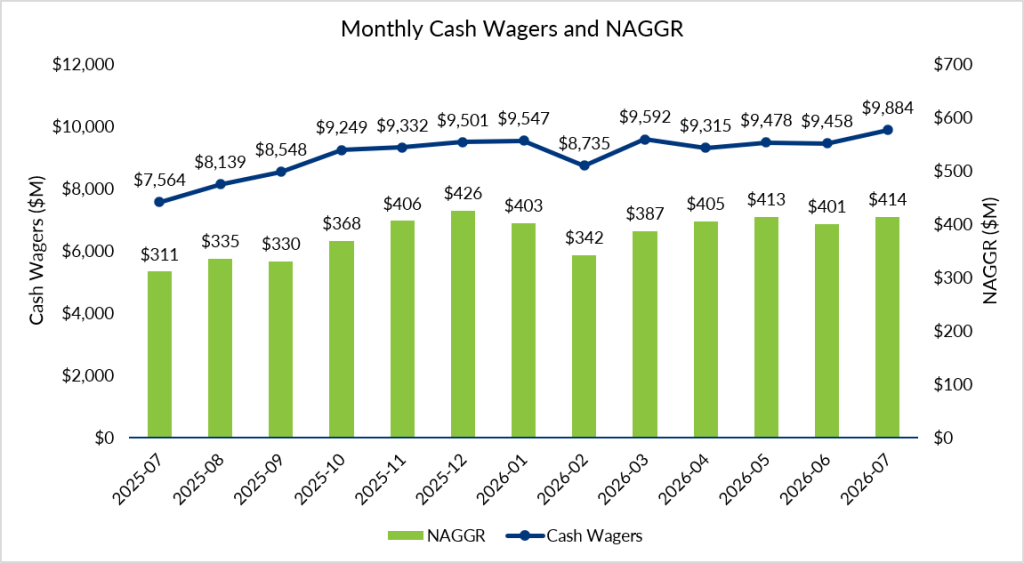
Most prominently, iGaming Ontario (iGO) reported that Ontarians wagered $9.88bn in the 31 days of the month, almost $300m more than the previous record of $9.59bn that was set this March.

That is not only the biggest single month of online gambling activity since the province opened its market in April 2022, but it also represents a yearly increase of almost 31% over July 2025.

GGR just misses the high mark

Operators’ total winnings came close to setting another record, as non-adjusted gross gaming revenue for July came in at $413.6m. That was the second-highest monthly total ever, behind only the $426m that operators made last December.

July’s total revenue figure was up 33% year over year, and it was the fourth consecutive month in which GGR beat the $400m mark.

Given Ontario’s 20% tax rate on operators’ revenue, the province made roughly $83m in tax revenue from Ontario iGaming in July, and reaped around $553m in tax revenue from $2.76bn in total non-adjusted gross gaming revenue through the first seven months of 2026.

New operators boost record number of active accounts

The number of monthly active player accounts was also the highest it has ever been, at close to 1.37 million. That was 44% more than the 948,000 Ontario iGaming accounts that were active in July 2025, and a 3.5% month-over-month increase.

As of the time of writing, the commercial Ontario iGaming market hosts 48 licensed operators running a total of 83 sites. The July active account numbers were likely boosted by the arrival of two recognizable names who launched Ontario iGaming for the first time this summer:

While the number of active accounts rose, the average revenue produced per account fell 7.6% year over year to $303. That was the lowest average revenue total since February 2026’s $262.

Ever-growing online casino posts handle, revenue records

Continuing the long-established pattern in Ontario’s market, online casino made up the vast majority of both handle and revenue and set new all-time monthly records in both metrics.

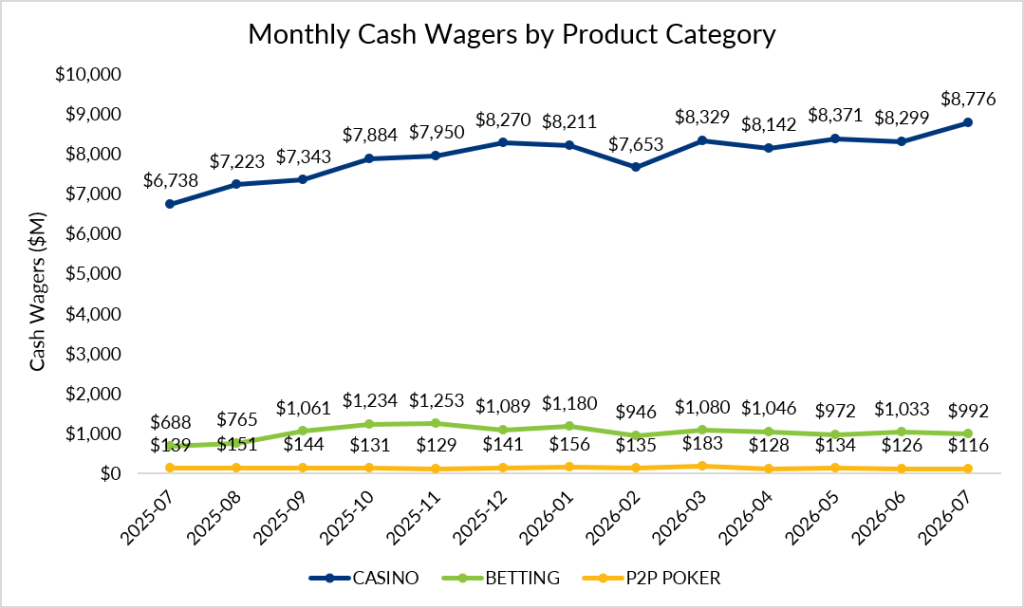
Total cash wagers on iCasino rose 30% year over year to $8.78bn, comfortably clear of the previous high of $8.37bn reported in May. That constituted a massive 89% of the total July handle.

Online sports betting accounted for $992m in cash wagers as the total dipped below $1bn again during the typical sumer slowdown month of July. June’s spike in sports betting activity was likely boosted by the early stages of the 2026 FIFA World Cup, including the Canadian national team’s first four games of the tournament; Canada were eliminated in a 3-0 defeat to Morocco in the round of 16 on July 4.

The total sports betting spend was 44% ahead of July 2025, when there was no World Cup action.

On the revenue side, online casino produced an all-time high of $330.4m in GGR, up 31% from July 2025 and again beating May 2026’s previous record. That was 80% of the total gross gaming revenue produced in July.

Sports betting revenue for July was $77.8m, which was 47% ahead of July 2025 but the lowest monthly total since March 2026. Online sports wagering accounted for just 10% of handle and 19% of operators’ GGR in July.

Peer-to-peer poker remains a tiny sliver of Ontario iGaming, representing just 1% of total handle and overall GGR. Online poker handle and revenue both fell by more than 10% year over year.

Year to date, Ontario iGaming revenue stands at around $2.7bn, up 26% from January to July 2025. Since the market opened in April, operators have now made just short of $13bn in gross gaming revenue, of which almost $10bn has come from online casino. That revenue total has yielded around $2.6bn in tax proceeds for the provincial government.

iGO’s Ontario iGaming numbers do not include any activity on the government-owned Ontario Lottery and Gaming (OLG) platform. OLG reports its numbers separately, and only annually.

SBC reveals the gaming leaders honoured in SBC Hall of Fame’s Class of 2026

SBC has announced the five individuals whose achievements and influence have earned them a place in the SBC Hall of Fame class of 2026.

The ceremony will be held on Monday, Sept. 28, 2026, at 3:30 p.m. local time at Palácio Estoril Hotel in Lisbon, as part of the SBC Leaders Summit. That invite-only event for key industry C-levels takes place the day before the full SBC Summit 2026 opens.

Now marking its 10th year, the SBC Hall of Fame was launched in 2016 as the Sports Betting Hall of Fame, at a time when the industry looked very different from the one it recognizes today. A decade on, this year’s induction celebrates five figures whose careers have helped shape the global betting and gaming industry as it now stands.

The 2026 SBC Hall of Fame inductees

The five industry leaders honoured this year are:

  • Khalid Ali (CEO, International Betting Integrity Association)
  • Karen Marcela Sierra-Hughes (Vice President of Latin America, Caribbean & Spain, Gaming Laboratories International)
  • David Natroshvili (Founder, Spribe)
  • Jason Robins (Co-Founder and CEO, DraftKings)
  • Mor Weizer (CEO, Playtech)

“When I look at this year’s five inductees, what strikes me is how much ground they cover between them,” said SBC founder and CEO Rasmus Sojmark. “Entrepreneurship, technology, integrity, regulation, operator leadership. You don’t often get that in one room. Celebrating them in Lisbon isn’t just about five great careers. It’s a chance to recognize how far our industry has come, and the people who got us here.”

Robins will also speak during SBC Summit 2026 on a high-profile keynote session alongside Michael Jordan and Sportradar founder and CEO Carsten Koerl.

Who else is in the SBC Hall of Fame?

This year’s SBC Hall of Fame inductees join a distinguished group of past honorees, including 2025 inductees Esmeralda Britton (president, Junta de Protección Social in Costa Rica), Chad Millman (co-founder, The Action Network), Scotty Schettler (former director, Race & Sports, Stardust), and Shelley White (former CEO, Responsible Gambling Council).

Among the Hall of Fame’s past inductees are some of the most recognizable figures in the industry including John Anderson (former CEO, 888 Holdings PLC), Victor Chandler (founder, BetVictor), Chris Christie (former governor of New Jersey), Denise Coates (founder & CEO, Bet365), Fred Done (Founder, Betfred), Carsten Koerl (founder & CEO, Sportradar), Pontus Lindwall (CEO & founder, Betsson AB) and Norbert Teufelberger (co-founder, Bwin).

What is SBC Leaders Summit?

The SBC Leaders Summit brings together more than 500 C-level executives for the industry’s most exclusive gathering of its kind.

By day, attendees take part in closed-door networking, presentations, panel discussions and regional and regulatory roundtables. By evening, the setting shifts to Estoril itself, with a cocktail reception, gala dinner, poker tournament and after-party at Casino Estoril, the historic venue that inspired Ian Fleming’s Casino Royale.

Attendees also receive full access to SBC Summit and the Affiliate Leaders Summit, running from Sept. 29 to Oct. 1 at FIL and MEO Arena.

BetRivers follows strong Alberta start with exclusive Gateway Casinos deal

BetRivers got off to a fast start in Alberta, and Rush Street Interactive (RSI) has moved to secure another advantage in the province’s new iGaming market by partnering with one of Canada’s biggest brick-and-mortar casino companies.

RSI announced on Wednesday that it has signed an exclusive partnership with Gateway Casinos & Entertainment that it describes as currently the only one of its kind in Alberta.

BetRivers, which was one of 22 online gambling sites to launch on day one in Alberta on July 13, will pair up with Gateway’s Edmonton entertainment destinations:

  • Grand Villa Casino in the city’s ICE District
  • Starlight Casino inside West Edmonton Mall

Gateway casinos to host BetRivers-branded events

A Gateway spokesperson told Canadian Gaming Business that BetRivers’ online gambling offerings and Gateway’s land-based gaming experiences will complement one another and allow each brand to reach a broader range of customers.

In particular, the two companies will collaborate on unique promotions and events starting this summer, including bringing BetRivers brand ambassadors, such as Canadian broadcaster Dan O’Toole and World Series of Poker (WSOP) record-holder Phil Hellmuth, to host events at Gateway properties.

Exclusive experiences will also be on offer through the partnership, such as VIP dinners, special events, and other promotions designed to drive traffic across both BetRivers and Gateway’s brick-and-mortar properties. 

The official partnership follows BetRivers’ marketing stunt at West Edmonton Mall around the time of the operator’s Alberta launch in July. The operator said it set a new Guinness World Record for the world’s largest slot machine after O’Toole and BetRivers unveiled a 16-foot-tall gold slot machine in the mall. The ‘BetRivers Gold Rush Experience’ allows adult passers-by to spin it for the chance of winning prizes.

Alberta casinos get in on the iGaming act

Meanwhile, the deal also broadens Gateway’s horizons.

Operational for almost 35 years, Gateway Casinos & Entertainment has 31 gaming properties in British Columbia, Ontario, and Alberta. Its proprietary gaming brands across the country include:

  • Grand Villa Casino
  • Cascades Casino
  • Starlight Casino
  • Playtime Casino

Gateway has no online gambling operations of its own. While some other Alberta brick-and-mortar operators like PURE Casino Entertainment and River Cree Resort & Casino are extending their own brands into online gambling with new iGaming platforms, Gateway will instead lean on BetRivers as a partner and affiliated brand.

“Gateway has called Alberta home for more than two decades, with our Edmonton properties sitting at the centre of the city’s entertainment scene. Now, through our partnership with BetRivers, that experience doesn’t stop at our doors,” said the company’s CEO Tolek Strukoff. “Whether in person or online, Albertans can enjoy three great places to play.”

BetRivers hits the ground running in Alberta

BetRivers is live with online casino and online sports betting in both Alberta and Ontario’s regulated markets. It was one of the first registered Alberta operators to begin pre-registering customers in early 2026 and went live in the province on day one of the new regulated iGaming market on July 13.

Schwartz said on a recent earnings call that its early weeks in Alberta outperformed its initial rollout in Ontario in 2022 in terms of sign-ups and active users, when adjusting for Alberta’s significantly smaller population. Now, it has an avenue through which to connect to a brick-and-mortar leader and a pre-existing land-based casino customer base.

“Alberta is a market we’ve been preparing for, and our partnership with Gateway lets us welcome players in a way no one else can,” said RSI CEO Richard Schwartz. “By pairing our best-in-class platform with two of Edmonton’s landmark entertainment destinations, we’re giving Albertans more ways to play, more reasons to visit, and more to look forward to as we grow in the province.”

BetRivers also offers online gambling in numerous U.S. states and has several partnerships with land-based casinos and tribal gaming entities south of the border, including online market-access deals and branded retail sportsbooks in various locations.

Now, it has its first affiliation with a brick-and-mortar casino in Canada.

Canadian financial regulators say they won’t allow sports prediction markets

Don’t expect to see sports prediction markets take Canada by storm in the same way that they exploded in prominence in the U.S.

Federal Canadian regulators issued a staff notice on Thursday that clarified their position that sports prediction markets should not be allowed under the securities or derivatives legislation that governs financial trading.

The Canadian Securities Administrators (CSA) and the Canadian Investment Regulatory Organization (CIRO) posted the public notice to explicitly state their views on sports event contracts “in light of growing interest in prediction markets in Canada.”

CSA staff’s view is that Event Contracts based on sports and entertainment events or outcomes should not be regulated within securities and derivatives legislation.

CIRO staff do not consider it appropriate to facilitate or approve an application by their dealer members to trade these types of Event Contracts.

The CSA and CIRO

The regulators added that while yes-no binary event contracts may fall within the broad federal definitions of securities or derivatives in general, certain categories “are outside the scope of that framework, or are otherwise excluded.” As well as sports and entertainment, the agencies are assessing whether other prediction markets categories should be excluded.

The CSA is the council of Canadian provincial securities regulators and the body that coordinates regulation for financial markets in the country. CIRO is the national self-regulatory organization that oversees investment dealers, mutual fund dealers, and trading activity, and has the authority to approve companies to allow Canadians to access prediction markets for trading.

CGA: Sports betting belongs to the provinces

In a statement on Thursday, the Canadian Gaming Association (CGA) commended the CSA and CIRO for clarifying their stance and drawing “a clear and sensible line” in the sand between what is and is not allowed.

Key context here is that the Criminal Code of Canada gives provincial governments the right to regulate gambling products, including sports betting. Ontario and Alberta have opted to open up their gambling markets by licensing commercial operators, while the other provinces maintain that their respective government-owned and operated platform is the only legal one in their jurisdiction.

“The CGA has long held that sports wagering, in whatever form it takes, should be offered only through provincial gaming regulators, and that the framework governing a product should be determined by what it does, not by what it is called,” added the CGA statement. “Today’s guidance affirms that principle, as CSA and CIRO have drawn a clear and sensible line: the distinction between a sports contract and a sports bet should not be reduced to semantics.”

“Sports wagering is sports betting, whatever the platform, and it belongs within the framework that provinces have built specifically to regulate it.”

CGA President and CEO Paul Burns

In its own statement on Thursday, one provincial government gaming operator, Loto-Québec, used the prediction markets notice as an opportunity to stress that while the popularity of sports event contracts has grown significantly in North America, “this form of betting is not legal in Québec.”

The CGA’s statement added that Canada’s gaming industry and provincial gaming regulators have built a network of consumer safeguards and player protections over the years. Veteran gaming lawyer Ron Segev told Canadian Gaming Business that aspect should not be overlooked, and opined that the federal financial regulators are not equipped to mitigate and combat gambling harms.

“I think it’s good and important that they came out with this reminder to the industry and I agree with their position,” said Segev, a founding partner at Segev LLP and a member of the firm’s Securities Practice Group. “We see the public harm that can arise by conflating gambling with investing or offering gambling-style products without proper responsible gambling measures and policies in place.

“The CSA and CIRO know they are not the correct agencies to deal with these public harm issues (as relates to gambling) but are the right agencies to protect investors (as relates to hyper-short-term binary options). I think they have the right bums in the right seats on this one.”

Companies like Kalshi and Wealthsimple are strictly limited

To date, only two CIRO dealer member firms have received approval from that regulator to facilitate access to prediction markets: Wealthsimple and Interactive Brokers Canada.

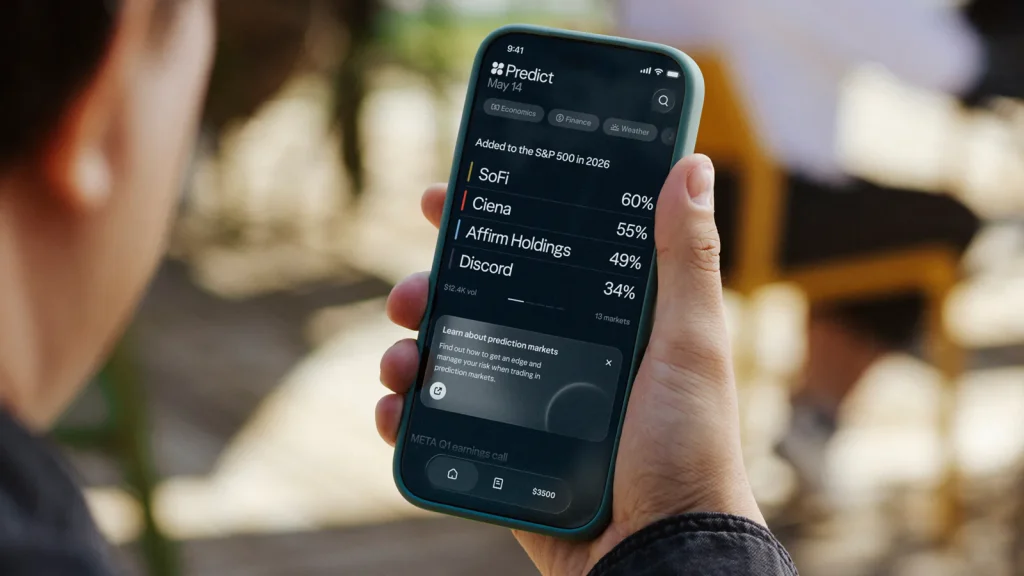
Wealthsimple unveiled a partnership with Kalshi in June and launched a new Wealthsimple Predict platform that hosts approximately 4,000 of Kalshi’s event contracts.

The Wealthsimple Predict app. Image: Wealthsimple

However, that product looks very different from what’s on offer on numerous federally approved platforms including Kalshi’s own site in the U.S. That’s because CIRO’s rules lay out various terms and conditions. Notably, these include restrictions such as:

  • Only allowing prediction markets that take 30 days or longer to resolve.
  • Only allowing select categories for trading, namely environmental forecasts, financial markets, and economic indicators. As well as sports and entertainment, other categories including election contracts are forbidden on CIRO-authorized platforms.
  • Stipulating that all contracts that meet those requirements must be traded on and cleared through certain U.S. Commodity Futures Trading Commission-regulated exchanges and clearinghouses.

Now, the CSA and CIRO have gone beyond CIRO’s existing terms of service for members by formally stating their joint view that sports and entertainment prediction markets should not be classified as securities or derivatives products in general.

CSA and CIRO warn everyone to play by the rules

This is not the first public notice that the CSA and CIRO have issued addressing prediction markets in recent times.

In early April, a few days after announcing Wealthsimple’s CIRO approval, the two entities released a joint statement in which they stressed that while CIRO approval allows companies to facilitate Canadian access to event contracts, no prediction market has been recognized as an exchange, registered as a dealer, or exempted from those requirements by the CSA.

“CIRO’s position is clear: prediction-market products are not entitled to enter Canadian markets simply because they exist elsewhere,” a CIRO spokesperson told Canadian Gaming Business in June.

The regulators warned in April that “failure to comply with applicable requirements under Canadian securities and derivatives laws may lead to enforcement action.”

Canadian regulators have held prediction markets operators to account in the past for breaking the rules on event contracts. Most notably, Polymarket settled with the CSA member Ontario Securities Commission in 2025 after the company admitted it violated Ontario’s version of the Binary Options Ban, which prohibits the advertising, offering, selling or trading of short-term yes/no event contracts.

Polymarket was banned from operating in Ontario for two years as part of the settlement. It has remained active in other parts of Canada, although it quietly updated its terms of service in July to state that it no longer allowed access from Alberta, British Columbia, or Quebec, as well as Ontario.

Wealthsimple wants sports contracts allowed

The CSA and CIRO’s statement on sports prediction markets comes just a few weeks after Wealthsimple seemed to argue that sports contracts should be allowed on its platform.

In an Aug. 4 whitepaper, Wealthsimple executives called for the 30-day rule for binary options to be lifted, and argued that moving prediction markets on sports outcomes under gaming legislation and regulation would be “unworkable”.

“We believe it is appropriate for bilateral sports betting, where a gaming operator sets the odds and takes the other side of the bet, to be regulated under gaming laws, while sports event contracts that are traded and cleared by regulated derivatives market intermediaries to be regulated under securities laws,” wrote Wealthsimple.

Ontario, NorthStar Gaming agree to $80K fine for alleged AML violations related to high-risk player

Ontario’s gambling regulator fined iGaming operator NorthStar Gaming, alleging the company failed to stop a high-risk player from gambling on its platform despite apparent money laundering risks.

The Alcohol and Gaming Commission of Ontario (AGCO) this week agreed to an $80,000 monetary settlement with NorthStar Gaming, writing that the operator did not comply with provincial anti-money laundering (AML) requirements.

Canadian Gaming Business reached out to NorthStar Gaming for comment and received a statement from the company:

“We take our AML obligations seriously and we accept responsibility for the matters identified in this Order,” said Corey Goodman, CEO of NorthStar. “The conduct at issue is confined to a specific period that is now behind us. We have invested significantly in our compliance program since then and we are committed to meeting the highest standards expected of us as a licensed internet gaming operator in Ontario.”

What NorthStar allegedly did to violate Ontario rules

According to information from the AGCO, NorthStar Gaming allowed a player whom it should have flagged as high-risk to deposit more than $189,000 over more than a year. Enhanced Due Diligence (EDD) rules require players tagged as such to undergo funds verification and additional scrutiny after $25,000 in deposits.

The player in question opened a NorthStar Gaming account in March 2024 and reached that threshold within a month. By June 2025, the player reached $189,395, and NorthStar finally responded to an AGCO inquiry by banning them.

It turned out police charged the person in connection with Project Outsource, a “joint law enforcement effort targeting criminal activity, including extortion and violence, in the towing industry.”

Anti-money laundering controls must be more than policies on paper,” AGCO Registrar and CEO Dr. Karin Schnarr said in a statement that anti-money laundering controls “must be more than policies on paper.”

“When risk indicators are triggered, operators are required to take active steps to help protect Ontario’s regulated gaming sector from being misused for criminal activity,” she added. “The AGCO will continue to hold operators accountable when they do not meet these important public-protection obligations.”

NorthStar Gaming has 15 days to appeal the decision.

Not the only company in AGCO sights

NorthStar’s fine comes on the heels of an Ontario supplier running afoul of the regulator this month.

Booming Games accepted a $70,000 penalty in relation to a provincially banned auto-play feature that was made available to Ontario players for several months on multiple slot games.

“We accept the AGCO’s ruling and take full responsibility for the breach,” Booming Games COO Dani Paleu told Canadian Gaming Business.

The AGCO has also punished other operators for various infractions in recent months.

In one such incident, last October, it fined theScore Bet $105,000 for a failure to address a user’s high-risk gambling despite “clear red flags”. In July of this year, it penalized Great Canadian Entertainment by fining the brick-and-mortar casino operator $170,000 after finding that it allegedly failed to adequately identify high-risk patrons, monitor player transactions, report suspicious activity, or file suspicious transaction reports at one of its Toronto-area casino resorts.

NorthStar financial troubles in spotlight

The AGCO action arrives as NorthStar Gaming finds itself in much deeper jeopardy.

The operator disclosed major financial trouble late last year, including a net loss of $13.7m for the nine months ending Sept. 30, 2025. Public trading of its shares paused indefinitely in May after NorthStar failed to file audited financial disclosures.

The company appointed interim CEO Goodman to the permanent position on Aug. 17. At the same time, NorthStar announced that CFO Chin Dhushenthen stepped down after five years with the operator.

NorthStar also welcomed Krisztina Kalla as its new VP of Compliance, completing an overhaul of the C-suite as it seeks to emerge from a turbulent period.

“I am confident that the strengthened finance and compliance functions will serve the company well as we move forward,” added Goodman.

Canadian Gaming Business Editor Tom Nightingale contributed to this article.

Amusnet Gaming strengthens Canadian presence with Alberta approval

Amusnet Gaming has further strengthened its presence in Canadian iGaming by securing a conditional license from Alberta Gaming, Liquor and Cannabis (AGLC) to supply its online gaming content to authorized operators in the province.

The company said that the approval as an iGaming – Critical Gaming Systems Provider marks yet another important milestone in its North American expansion plans and that Alberta is an important jurisdiction in its long-term North American strategy, providing the company with a strong regulatory foundation for future growth in the region.

Amusnet Gaming previously entered the regulated Ontario market earlier this year.

“Following our successful licensing in Ontario, this achievement further strengthens our position in Canada and reflects our continued commitment to the highest standards of regulatory compliance and integrity,” said Amusnet Gaming CEO Julia Peeva-Sertov. “We look forward to exploring opportunities in Alberta, building strong partnerships, and bringing our diverse portfolio to another regulated market.”

Bulgaria-headquartered Amusnet Gaming describes itself as an “all-casino solutions provider,” offering more than 300 slots, engaging table games, and a live casino studio. Its content is available on more than 2,000 operator websites across more than 35 markets spanning Europe, Canada, Mexico, and Africa, and the supplier said it is focused on building sustainable international growth and identifying further opportunities across North America and other regulated markets.

It works with several operator partners that have a presence in either or both Ontario and Alberta, including:

  • 888
  • Betano
  • Betsson
  • Entain
  • Flutter
  • PlayOJO
  • Soft2Bet
  • TonyBet

Amusnet is one of the latest companies to gain approval as an iGaming supplier in Alberta. Others including Czech company Endorphina have also recently confirmed their licensure in the province.

In total, dozens of suppliers have registered with AGLC to offer their technology, games, or other services in Canada’s second regulated iGaming market, which opened for business on July 13.

Other companies that have obtained supplier licenses in the weeks since the market first launched include:

  • Catalist Sports (iGaming – Goods or Services Supplier – Other)
  • Delasport  (iGaming – Platform Provider)
  • Lsports Data (iGaming – Goods or Services Supplier – Other)
  • Playson (iGaming – Critical Gaming Systems Provider)
  • Roxor Gaming (iGaming – Critical Gaming Systems Provider)
  • Spinberry OÜ (iGaming – Critical Gaming Systems Provider)

Staying ahead of the threat: SBC Summit unveils Compliance Tech Track for 2026

SBC Summit will examine the technologies helping operators detect threats, combat fraud, and strengthen compliance through its dedicated Compliance Tech conference track.

Taking place on Thursday, Oct. 1, 2026, at the Feira Internacional de Lisboa, the track will bring together operators, technology specialists, compliance and legal experts, and leaders in fraud, risk and cybersecurity to examine how technology can help businesses stay ahead of emerging threats.

The Compliance Tech track will form part of the dedicated Regulation & Compliance stage, alongside tracks covering Global Regulations (Tuesday, Sept. 29) and Player Protection (Wednesday, Sept. 30).

Across the day, sessions will explore advances in fraud prevention, how operators can combat illegal activity when entering new markets, the impact of EUDI Wallets and digital identity, and the growing relationship between regulation and cybersecurity.

“The same technological advances that are helping operators protect their businesses are also changing the nature of the threats they face,” said Rasmus Sojmark, SBC Founder and CEO. “As criminals become more sophisticated and operators navigate increasingly complex regulatory requirements, simply having more technology isn’t enough. The challenge is knowing where it can make a real difference, and this track will examine where the industry should be focusing its attention.”

What to watch out for on SBC Summit Compliance Tech track

The SBC Summit Compliance Tech track will open by examining how operators can approve more legitimate customers without increasing their exposure to fraud during the session ‘More Players, Less Risk: Maximizing Approvals in a Regulated World’. Experts Tom Orton (Director of Content and Payments, Rank Group), Tim De Borle (COO, Casumo), Liesbeth Oost (Head of ESG, JVH Gaming and Entertainment), and moderator Ana Pamplona (Doctor of Law, Lawyer, University Professor and Co-founder, AMIG) will explore how technology can help reduce block rates and false positives while improving approval rates for legitimate customers.

The conversation will then move to the compliance challenges operators face when entering new markets during ‘Bring on the New Markets: What Are the Compliance Challenges?’. Speakers Miguel Luis (Head of Compliance, LeBull), Sissel Weitzhandler (Co-Founder, EGARA), Ian Perrygrove (Chief Risk Officer, Kwiff), Raymond Wilson (MLRO & Senior AFC Manager, Midnite), and moderator Thees Buschman (Senior Consultant, Chevron Group) will examine how operators can identify local criminal threats, deploy effective fraud prevention technology, and manage compliance across multiple jurisdictions.

Attention will then turn to the future of digital identity during ‘EUDI Wallets & Digital Identity: A New Era for KYC or Just New Complexity?’. Experts Andrea Carvalho (Head of Legal, Compliance and AML Affairs, Entain), Yainnis Stavroulas (Chief Technology Officer, Novibet), Jean Michel Azzorpadi (Blockchain Architect), and moderator Jochen Biewer (Managing Director, Chevron Group) will assess whether EUDI Wallets can streamline KYC and onboarding, while examining the regulatory, technical and operational challenges their adoption could create.

Sessions across the day will also examine how regulators and cybersecurity teams can collaborate to strengthen industry-wide cyber defence during ‘At the Intersection of Cybersecurity, Regulation and Collaborative Defence‘, while ‘Closing the Loopholes: How to Combat Bonus Abuse‘ will explore how operators can identify and address evolving forms of bonus exploitation.

Take advantage of networking opportunities

Attendees looking to continue the conversation beyond the conference can take advantage of a series of networking opportunities centred around compliance, regulation and risk.

The Compliance Show Floor Tour will introduce operators to leading compliance technology providers and their latest solutions, while the Regulatory Gaming Meetups will host 21 market-focused gatherings connecting attendees with regulators, legal experts and market leaders. 

  • Access to SBC Summit’s conference is included with Conference, Business and VIP Passes.
  • Delegates wishing to attend the conference sessions and compliance-focused networking initiatives will require a Business or VIP Pass.
  • Exhibitors interested in taking part in the Compliance Show Floor Tour can contact the sales team at [email protected]. Operators can reserve their place on their preferred tour here. 

Taking place Sept. 29 to Oct. 1, SBC Summit will welcome 40,000 industry professionals to the Feira Internacional de Lisboa (FIL) and MEO Arena for three days of networking, exhibition and education.