Search
Choose a style
Dark
Light

SBC Leaders Magazine: Why Super Group said no to Brazil

Less can sometimes mean more when it comes to international expansion, Super Group CEO Neal Menashe tells the new issue of SBC Leaders magazine.

The Betway owner has withdrawn from Portugal, France, Belgium and India since it floated on the New York Stock Exchange in 2022, reducing its number of licences to 17. Despite those retreats, Super Group has thrived. Its 2024 net revenue (excluding the U.S.) rose 18% to a record €1.66 billion ($2.59 billion CAD), while ex-U.S. adjusted EBITDA grew more than 50% to €391 million ($611 million CAD).

Menashe attributes that success to the company becoming more efficient and applying greater focus to its pursuit of profits. “It’s not about chasing revenue at all costs,” he explains.

That attitude was key to Super Group’s thinking on Brazil, where it applied for a license but eventually decided that the regulatory regime meant that it was not worth entering the market.

“If we did Brazil, we would have to give up somewhere else and we would have to take the marketing budget and give it to Brazil,” says Menashe.

“Well, why? If we’re not even the market leader in some of these other countries, surely it’s better to spend the money on marketing and improvements on the product. With this, we get huge operational leverage. The UK is one of them. We have a small market share there relative to, let’s say, Flutter, which owns a lot of brands. But we can grow easily — and that’s really the point.”

Menashe also uses the interview to detail the thinking behind Super Group’s decision to withdraw its sportsbook offer in the U.S., as well as why Africa is central to the company’s strategy, and why the state of the market in Germany upsets him.

Not taking a punt on Brazil

Elsewhere in issue 36 of SBC Leaders magazine, Codere Online CEO Aviv Sher expresses a similarly cautious view on the opportunity on offer in the newly-regulated Brazilian market.

“Our focus is on capitalising on our positive momentum in our core Mexican and Spanish markets,” says Sher. “Brazil has been a focal point for much of the industry, and as we’ve seen, there are already 68 operators that were live on the very first day the market opened up.

“If we feel like we can make a difference, be successful, and navigate a strong entry, then we may change our current outlook.”

Setting a safe play example

Lori Kalani looks back on a whirlwind first year as DraftKings’ chief responsible gaming officer and shares her hopes for the U.S. industry’s approach to player protection.

“I would like to see that all operators are doing what we are doing at DraftKings — and what the top operators are doing — which is really pouring our heart and souls into doing the right thing and building the tools and investing the resources,” she says.

“I hope to work myself out of a job someday. That everybody gets it and there’ll be nothing to do because we’ll be doing everything perfectly and everyone will understand.”

There are also deep dives into the resurgence of online poker, the career opportunities for women in the Brazilian betting and gaming sector, regulation in Chile, AI-driven efficiencies and the challenges the U.S. industry faces in dealing with sweepstakes casinos and sports prediction markets.

Pick up a copy of SBC Leaders issue 36 at SBC Summit Americas 2025, which takes place at Fort Lauderdale’s Broward County Convention Center May 13-15, or read the digital edition here.

Ontario’s licensed iGaming operators couldn’t file FINTRAC reports for an entire year

Ontario’s licensed online casinos couldn’t use FINTRAC’s web portal to file any suspicious transaction reports between March 2024 and March 2025 following a hacking incident.

Business and technology publication The Logic reported that the Financial Transactions and Reports Analysis Centre of Canada’s portal, which is how Ontario operators submit their reports, was taken down by FINTRAC following a cyberattack in March 2024.  The report notes that the portal is mainly used by small businesses; banks and most other large organizations use a secure data feed for filing reports, but iGaming Ontario (iGO) has allegedly not set up that avenue.

iGO spokesperson Josh Elliott told Canadian Gaming Business that during the FINTRAC system down time, it continued to administer its AML program according to federal legislation, reporting and taking action to prevent money laundering and terrorist financing.

All reporting entities nationwide were affected by the outage, not only iGaming Ontario. Operators and other businesses were left unable to report suspected money laundering or other suspected fraudulent activity.

iGO gave operators access again in March 2025 after FINTRAC completed an update of its tech systems and restored access. FINTRAC stated that the attacker didn’t transfer any sensitive data, per The Logic.

iGO building own automated system

Currently, authorized online gaming operators in Ontario must file suspicious transaction reports manually and upload them one at a time on a per-incident basis via the FINTRAC portal, although they do have the option to use their own in-house automation technology to speed up the process.

Elliott confirmed to CGB that the conduct-and-manage agency is building its own improved and automated system for filing such reports, one that “will accommodate the wide range of operators who will use it while also protecting the security and confidentiality of the information we report to FINTRAC.”

“Our aim is that this system will improve efficiency and speed while also remaining secure and reducing the administrative burden on operators,” said Elliott in an email. “When complete, this system will allow iGaming Ontario to file reports to FINTRAC via secure data feed, much as other high-volume entities do.

“This is a complex project, as it requires integration with our approximately 50 different operators and their individual systems. We do not have a launch date to share at this time.”

In the meantime, iGO has told operators that they may use alternative data inputting methods such as automated bots or other solutions, provided they meet iGO’s AML requirements as the reporting entity.

iGO has submitted 80K reports to FINTRAC

Some 49 licensed commercial operators are active in the Ontario market as of May 5 and the largest of them file thousands of reports every year. Elliott said that iGO has submitted more than 80,000 reports to FINTRAC on behalf of operators since April 2022, and the agency and its contracted operator partners are working on clearing the backlog that remains.

“Given the unique nature of iGaming Ontario serving as the reporting entity for some 50 different operators, FINTRAC has not set a deadline for us to complete our backlog reporting at this time,” Elliott added.

Ontario’s commercial operators, who run a combined 84 online gambling platforms, collectively handled almost $83 billion in player activity in the 2024-25 fiscal year alone. That year ran from April 1, 2024, to March 31, 2025; for almost the entirety of that period, FINTRAC’s outage meant they could not file suspicious activity reports.

Observers suggest Canadian gambling has a wider fraud problem

The CGA has made anti-money laundering a core issue of its advocacy. It noted in its 2024 Advocacy Policies that one of its goals for last year was to “actively participate” in the parliamentary review of the Proceeds of Crime (Money Laundering) and Terrorist Financing Act (PCMLTF Act) to ensure Canada’s AML laws and regulations can keep up with the evolution of online gambling.

Last October, a report from TransUnion Canada found that online gambling is the most susceptible sector in the country when it comes to digital fraud attempts, and the rate of instances within Canadian-specific gambling soared 79.3% year-over-year.

TransUnion Canada Head of Identity Management and Fraud Solutions Patrick Boudreau urged businesses including gambling operators to make technology such as identity verification, IP intelligence, device reputation and synthetic identity detection “critical components” of their fraud prevention programs.

In January of this year, FINTRAC publicly warned that known fentanyl traffickers were believed to be using online gambling platforms to launder money from dealing and production, disguising the deposits and withdrawals as wagering winnings.

Under its “general money laundering indicators,” FINTRAC notes that high-volume or frequent purchases from a personal account to online gambling platforms and subsequently receipt of funds into the same account from payment processors associated with online gambling platforms is “an unusual pattern” that warrants close attention.

Bet365 considering full or partial sale: UK report

UK-based and Ontario-licensed sportsbook bet365 could be sold in a multi-billion-dollar deal, according to British newspaper The Guardian.

The outlet reported that the sportsbook operator, which has a sizeable presence in Canada and has been spreading across the U.S., is valued at £9 billion ($16.5 billion CAD).

CEO Denise Coates reportedly met with American advisors and Wall Street banks to seek advice. Citing sources, The Guardian said the Coates family could consider a partial sale to a private equity investor to allow them to retain a pre-float stake in the business they have built. Another option could be to spin off part of the business.

Britain’s richest woman Coates owns a 58% majority stake in the operator.

Bet365 is currently licensed in 13 U.S. states, having gone live in both Illinois and Tennessee in March of this year. It is pursuing more, and seems highly likely to be one of Missouri’s licensed sportsbooks when that state opens its recently legalized sports betting market later this year, given that it struck a partnership with the state’s Major League Baseball franchise, the St. Louis Cardinals, in March.

Per Eilers and Krejcik Gaming, it has built a market share of about 2.5% across the States since first firing up operations there in 2018 after the repeal of PASPA.

Earlier this year, the company announced it would exit China, where it is operational but sports betting is illegal.

Bet365 hit ground running in Canada

Data provided to Canadian Gaming Business by H2 Gambling Capital last fall suggested that as of March 31, 2024, the operator held around 15% of Ontario’s private-sector market, helped by the fact it was prominently active in the province’s grey market for years before single-event sports betting was legalized in Canada in 2021 and regulation was brought to the table in Ontario.

It continues to operate in some other provinces, where the governmental lottery corporations’ platforms are the only recognized regulated online gambling options.

Bet365 applied for a license to join iGaming Ontario’s market in the lead up to the curtain raising in April 2022, and was approved by the Alcohol and Gaming Commission of Ontario (AGCO) in March 2022.

It continues to operate in some other provinces, where the governmental lottery corporations’ platforms are the only recognized regulated online gambling options.

At the time that bet365 received its Ontario licence, it was touted as one of Canada’s two largest unregulated operators, alongside Super Group, the owner of the Betway, Jackpot City and Spin brands, among others. While those Super Group brands, like bet365, are now licensed in Ontario, H2’s data pins that company as the largest existing grey-market operator outside of Ontario.

Based on the pattern it has shown in Canada and the U.S., bet365 seems a likely candidate to apply for a licence to jump into Alberta when that market opens, slated to be early next year.

Bragg names casino veteran Holly Gagnon as new chair

Bragg Gaming Group has appointed director and casino industry veteran Holly Gagnon as the new chair of the board.

Gagnon has served as lead director on Bragg’s board since 2021 and now succeeds CEO Matevž Mazij in the role. Mazij will continue as chief executive and a board member.

The new chair’s three decades of gaming leadership experience includes senior executive roles at Caesars Entertainment, MGM Resorts International, Harrah’s Entertainment and Seneca Gaming. She is also president of HGC Hospitality Gaming Consulting and serves in advisory roles for several prominent industry organizations.

Mazij called her “an outstanding choice” as chair.

“Her wealth of gaming industry experience, strategic insights and passion for governance best practices will be tremendous assets as we continue to execute on our growth initiatives,” the CEO added. “Holly has already made significant contributions as our lead independent director, and we look forward to further leveraging her expertise and leadership in her new capacity as chair.”

Under Mazij’s leadership, Toronto-based gaming supplier Bragg has rebounded from a slump that led it to consider selling up last year and posted record results for the fourth quarter of 2024. In that quarter, revenue was up 16.3% year over year, gross profit grew 30.9% and adjusted EBITDA climbed 68%.

“Matevž and the leadership team have done a remarkable job positioning the company for long-term success,” acknowledged Gagnon. “I look forward to working closely with the board and management to build on this strong momentum, capitalize on the many growth opportunities ahead, and maintain our commitment to strong corporate governance on behalf of all our stakeholders.”

The company will announce its earnings for the quarter ended March 31, 2025, on May 15.

Bragg announces creditor deal to fuel further growth

Last week, Bragg announced it has reached an agreement to repay $5 million USD (roughly $6.9 million CAD) of its outstanding secured promissory note with its lenders and to extend the maturity of the remaining $2 million USD ($2.8 million CAD) until June.

“This partial repayment and extension will further strengthen our balance sheet and reflects our confidence in the business,” said Chief Financial Officer Robbie Bressler.

Bragg is also in the process of securing new standby credit from a third-party lender, which Bressler said would allow for greater financial flexibility and strategic growth opportunities.

The company expects around 18% revenue growth of its North American and Brazilian operations this year. It anticipates that Canada and the U.S. will account for 15% of total revenue by the end of 2025, with Brazil contributing 10%.

Bragg has been supplying to operators in Ontario’s regulated market since the market launched in April 2022 and expanded into a second province via a content deal with Loto-Quebec in February of this year. It went live in the new Brazil market when it launched in January and recently bought a stake in RapidPlay, a Brazilian game development studio.

It also struck a notable deal with Caesars Digital at the start of year to develop exclusive online casino games for the operator and provide it with access to its proprietary tech offerings in licensed markets in the U.S. and Canada.

Alberta lawmakers decide to leave RG up to regulators

In its first discussion in the Alberta legislature’s Committee of the Whole on Tuesday, lawmakers voted down proposed amendments to the iGaming Alberta Act that would have written more responsible gambling measures into law.

Minister Dale Nally’s Bill 48 passed second reading on April 16 and was referred to the committee, which comprises all members of the legislative assembly (MLAs).

The bill would create the legal framework for a regulated commercial online gambling market in Alberta. It would create a new government agency, the Alberta iGaming Corporation, which would conduct and manage the market, much like iGaming Ontario does in Canada’s first and so far only regulated private-sector iGaming market. Alberta Gaming, Liquor and Cannabis (AGLC) would function as the regulator of the market and also continue to operate its own Play Alberta platform.

NDP’s pushback outvoted

Before it advanced to committee discussion, the New Democratic Party (NDP) expressed concerns about the lack of details it includes, particularly with respect to player protection and other safeguards.

In its first committee debate, the conversation once around centred on what is — and, more prominently, what isn’t — included in the bill’s language around responsible gambling.

On Tuesday, NDP MLA Gurinder Brar, one of the most vocal critics in the earlier session, proposed a set of amendments that would require the province to set up a dedicated online responsible gambling program based on harm reduction principles. The Alberta iGaming Corporation would have to carry out mandatory independent evaluations of its effectiveness as well as annual public reporting.

“The basic process of public policy is to design it, to implement it and to evaluate it. And if there are gaps, those gaps must be addressed and fixed,” Brar told the chamber. “And that’s exactly what these amendments are.”

Although Brar’s proposal was supported by multiple other NDP MLAs, with one arguing that Bill 48 is a “deeply incomplete” piece of legislation that “invites more questions than answers”, the amendment package was ultimately defeated by a vote of 38 nays to 16 yays.

Government argues RG should be in regs, not legislation

In response to Brar’s monologue, Nally argued that responsible gambling programs should and will be a regulatory issue rather than a legal one.

“We don’t want to put player safety in legislation,” he stressed. “We want to put it in regulation so that if we see something we want to turn around on a dime, we’re able to do it through an order in council, not a new piece of legislation.

“I’m saying this to make the conversations shorter around this room: We don’t have to debate player safety, gambling responsibility. There is no light between us. I assure you, we are all 100% aligned … But we’re going to do it in the most efficient and effective manner possible, and that’s through regulation.”

Supporting Brar’s amendment, his fellow NDP MLA Nathan Ip countered that omitting specific RG measures from the legislation itself is in itself a gamble on Albertans’ well-being.

“The risk is that these protections will come too late, if at all.”

Another NDP MLA, Joe Ceci, argued that the amendments could actually fit neatly into the bill’s language, noting that the legislation already includes some standard requirements on player protection.

“So, asking now to put those in legislation is not such a big leap as was suggested a little while ago by the Minister.”

Despite those calls for a pivot, the committee voted down the amendments and seems primed to approve the bill. That would send it back to the full legislature for third and final reading, where the large incumbent United Conservative Party (UCP) majority suggests it is highly likely to pass.

Renewed PointsBet offer would include selling Canadian assets to Hard Rock

The battle to buy Australian-based and Canadian-focused gaming operator PointsBet continues with new twists.

Fellow Australian sports betting firm Betr Entertainment (not to be confused with U.S. sportsbook and daily fantasy sports company Betr) has announced a new 100% buyout offer worth $360 million AUD ($318 million CAD), which is comprised of $260 million AUD ($230 million CAD) in cash and $100 million AUD ($88 million CAD) in scrip, essentially an in-company substitute for legal tender.

Betr, formerly known as BlueBet, has already purchased a 19.9% stake in PointsBet via a share purchase agreement with two prominent PointsBet investors. It said it will undertake an equity raising of $130 million to partially fund both the acquisition and a buyout of the remaining 80.1% of shares.

Betr would sell PointsBet Canada assets to Hard Rock

PointsBet offers sports betting in Australia and both digital sports wagering and online casino in Ontario’s regulated market.

However, in the statement, Betr noted that one way in which it would raise the $230 million CAD cash portion of the funding to buy out PointsBet would be via selling part of PointsBet’s Canadian assets, as it has “received a non-binding proposal from Seminole Hard Rock Digital, LLC to acquire certain assets which relate to PointsBet’s Canadian operations.”

In its proposal update for the PointsBet transaction, Betr specifies that Hard Rock Digital would acquire those assets for $29.6 million USD ($40.9 million CAD). The sale transaction is subject to customary conditions including entry into binding transaction documents, confirmatory due diligence, the receipt of the necessary regulatory approvals and gaming licences and the approval by the board of directors of Hard Rock Digital.

Per the Earnings+More newsletter, Betr Chair Matthew Tripp said the assets in question largely comprised a player database.

Canadian Gaming Business reached out to Betr, PointsBet, and Hard Rock Digital seeking more information. Hard Rock Digital declined to comment.

Hard Rock Bet holds an effective monopoly on sports betting in Florida and also offers sports wagering in numerous other U.S. states including Arizona, Illinois, Indiana, Ohio, Tennessee and Virginia. It provides an all-in-one online sports betting and online casino platform in New Jersey.

Hard Rock Digital has an office in Toronto.

Betr added that it has tested the North American market and considers this divestment represents value for PointsBet shareholders.

“Critically, the divestment ensures that the combined business is laser-focused on the highly attractive Australian wagering market,” added the company.

Betr intends to torpedo MIXI offer

Betr is competing with Japanese entertainment giant MIXI in its attempt to take over PointsBet.

PointsBet announced in February that it intended to accept a $353 million AUD (currently $312 million CAD) offer from MIXI that it said is supported by the majority of PointsBet’s board.

However, though PointsBet publicly stated that Betr’s initial offer was highly conditional, unfunded and “could not reasonably be expected” to lead to a better offer than MIXI’s, multiple investors told Australian media around that time that they may look to kibosh the MIXI offer in favour of the Betr bid.

In its new statement, Betr argued that its own proposal provides “significantly greater value” to PointsBet shareholders than MIXI’s offer. Betr says its updated offer increases the potential value to $1.33 AUD ($1.17 CAD) per share for PointsBet shareholders, versus MIXI’s return of $1.06 AUD (roughly 93 cents in CAD) per share.

“As the largest shareholder in PointsBet, we now intend to vote our holding against the current MIXI proposal, reducing its likelihood of success,” Tripp said in a statement.

PointsBet needs the support of more than 50% of shareholders voting and at least 75% of the shares cast on the resolution to ratify the MIXI deal.

Ontario’s online casino market leader BetMGM will ‘flex muscles’ in Alberta

BetMGM’s CEO says the company is the online casino leader by revenue share in Ontario’s regulated iGaming market and expects the brand to hold a similar status in Alberta once that province begins allowing commercial operators to do business.

On a quarterly earnings call on Monday, Adam Greenblatt spoke briefly about the position the brand, which is a joint venture of Entain and MGM Resorts International, holds in the regulated Ontario market.

BetMGM has long been touted as one of the most prominent and successful operators in the province. Without citing any specific figures, the chief executive noted that the brand increased its market share in the first quarter of 2025 and is the market leader on the more lucrative online casino side.

“We have just got Q1 financial numbers from Ontario and we have increased our market share,” Greenblatt told investors, analysts and media on the call. “I won’t tell you what it is, I’m not in a position to do that, but we have increased our market share in both sports and iGaming, and we remain the market leader in iGaming.”

At last year’s SBC Summit North America in New Jersey in May 2024, Greenblatt told CNBC’s Contessa Brewer in a keynote speech that “we are the number one gaming operator in Ontario with 22% market share” across both online casino and online sports betting.

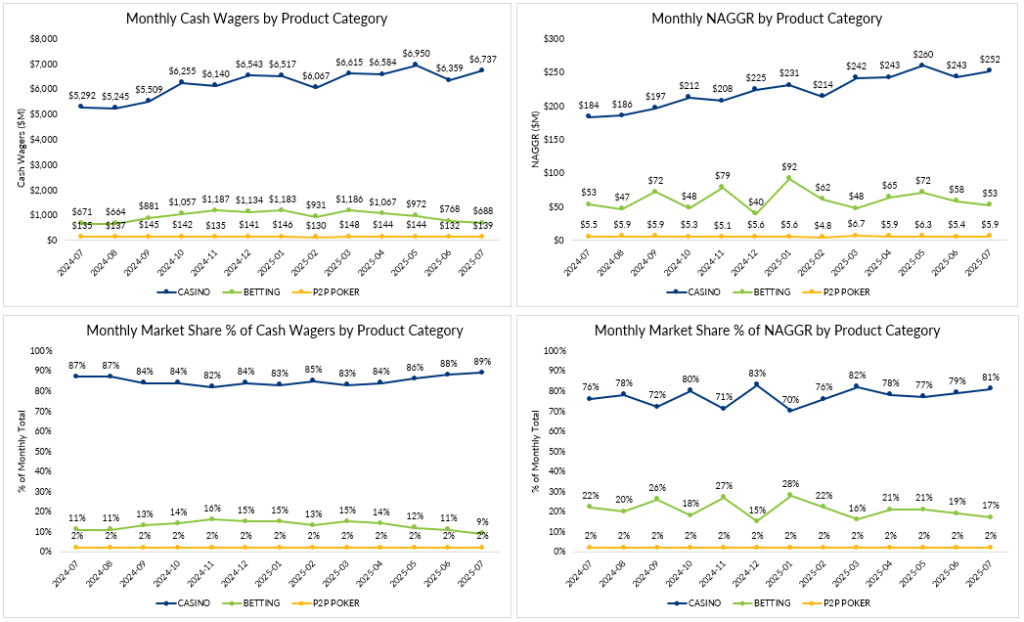
In Ontario’s market, online casino makes up around three-quarters of total operator gross gaming revenue. In some months, when sports results or sports wagering activity are down, that proportion is more like 80-85%.

BetMGM expects Alberta to play to same strengths

Greenblatt was speaking on Monday in response to a question about its plans for new markets, most notably Missouri’s upcoming sports betting market and Alberta’s intended Ontario-like dual iGaming and OSB model.

BetMGM executives have spoken before of the opportunity they see in Alberta. BetMGM’s VP of Canada, Scott Woodgate, told Canadian Gaming Business in an interview last August that the company sees Alberta as being “a key omni-channel market for us.”

BetMGM also prominently uses two of the most famous Canadian athletes ever to emerge from Alberta, past and present NHL superstars Wayne Gretzky and Connor McDavid, as brand ambassadors, which Woodgate suggested could give the brand a leg up in the province.

“Alberta is an area that should play to BetMGM’s strength given its operations in Ontario, which increased market share in the first quarter,” Greenblatt said on Monday. “[We’re] particularly excited for Alberta, which looks still to be on track for a Q1 [2026] launch of both sports betting and iGaming.

“That should be a province where BetMGM really does flex its muscles, given the strength of our business in Ontario … So we’re really excited, really optimistic for Alberta next year.”

Bill 48, the legislation that would establish a framework for Alberta to begin implementing its regulated online gaming market, is awaiting debate in the Alberta Legislative Assembly’s Committee of the Whole as of the time of writing.

AGCO reaches settlement with Woodbine over series of racehorse deaths

The Alcohol and Gaming Commission of Ontario (AGCO) has reached a settlement with Woodbine Entertainment following an investigation sparked by a series of horse injuries late last year.

Ontario’s gaming regulator is requiring Woodbine to make a $200,000 donation to support equine aftercare and welfare and implement more internal and external oversight measures after an investigation found evidence of “inadequate” and “inconsistent” practices for track maintenance.

The AGCO says that the lack of care at Woodbine led to a series of racehorse injuries at the facility between October 2024 and December 2024.

Over a three-month period, Woodbine saw 19 racehorses suffer injuries while competing on the facility’s all-weather Tapeta surface. The injuries led to the euthanasia of 10 of the racehorses. During a single day of training in November, Woodbine had to euthanize three racehorses.

The AGCO’s probe found Woodbine improperly maintained its track equipment while lacking standardized maintenance protocols or proper surface measurements. The regulator also alleged that the racetrack employed undertrained staff who administered underwhelming care.

“The AGCO is committed to ensuring safe horse racing in Ontario. In line with that commitment, Woodbine has agreed to a set of enforceable actions aimed at improving track maintenance practices and protecting the welfare of racehorses competing at Woodbine,” said the regulator in a press release.

Canadian Gaming Business reached out to Woodbine for comment but none was offered.

Woodbine must comply with multiple measures

Those measures include that Woodbine must employ two world-renowned track safety efforts for two years, who will be tasked with conducting safety assessments of Woodbine’s horse racing surface. Woodbine is also mandated to establish a Track Surfaces Committee to monitor the safety and improvements of the track. Its Governance and Compliance Committee will oversee the Track Surfaces Committee.

Woodbine vowed not to contest the penalty levied by the AGCO. If it fails to comply with the AGCO’s measures, Woodbine faces regulatory penalties, including a $200,000 fine.

The AGCO noted that Woodbine has already taken steps to improve its track surface conditions, including renovations, comprehensive training and the installation of tools to ensure safety.

Woodbine will make its $200,000 donation to the LongRun Thoroughbred Retirement Society and the Thoroughbred Aftercare Alliance. The two entities will split the donation evenly.

AGCO imposes another racehorse penalty

The AGCO has dished out penalties to horse racing companies and personnel in the recent past.

Last November, it banned horse trainer Richard Moreau for 10 years after his horse, Funtime Bayama, tested positive for a performance-enhancing drug during standard testing for the North America Cup. Moreau and harness driver Sylvain Filion were fined $40,000 for the drug violation after an AGCO probe found them responsible for the miscue.

Filion was also suspended for 10 years, with his ban to be lifted in October 2034. Last month, Filion had his request to put a stay on the suspension denied by an appeal panel.

‘Notable’ amount of Ontario gambling still done on grey-market sites

Ontario’s success in channelizing online gambling from the unregulated market to the regulated market has rightly been lauded, but a new report suggests that a “notable” proportion of business is still being done in the grey market.

Prior to Ontario’s commercial regulated iGaming market opening in April 2022, it’s estimated that at least  70% of online gambling in the province was occurring on commercial sites and apps rather than on Ontario Lottery and Gaming’s (OLG) government-run platform.

Since the end of the first financial year of Ontario licensing commercial operators to do business, that proportion has been down at around 15%, with roughly 85% of play taking place via licensed operators.

Last year, per iGaming Ontario (iGO) figures, 86.4% of Ontarians surveyed said they did their online gambling on regulated sites.

Last week, an IPSOS study commissioned by the Alcohol and Gaming Commission of Ontario (AGCO) and iGO revealed that the rate had slipped slightly to 83.7%. The study, which surveyed 2,003 Ontarians over the age of 19, found that 16.3% of the respondents who had gambled online over the previous three months did so only on unregulated websites. That number was up from 13.6% last year.

However, in addition to the residents who said they only gamble on unregulated sites, more than one-fifth (20.2%) of the 83.7% who said they gambled via licensed operators disclosed that they have also wagered on unlicensed and unregulated platforms.

While iGO’s latest revenue reporting shows that Ontarians gambled $82.7 billion via regulated sites in the third full year of the open market, up 31% from last year, the AGCO said in its summary of the IPSOS report that the data “underscores that a notable amount of gaming continues to occur on unregulated sites.”

“Those players are therefore not safeguarded by Ontario’s high standards of game integrity and player protections,” added the gaming regulator. “The AGCO continues its efforts to address illegal gambling sites in Ontario and to increase public awareness about the benefits of choosing regulated iGaming sites.”

AGCO COO says agency lacks enforcement power

The AGCO said publicly back in January that it is working on “a comprehensive strategy” to limit industry access to the unregulated market in the province “by delivering a second generation of high-impact, coordinated and relevant regulatory activities.”

Exactly what that entails was not specified.

“Building off of our early channelization success, we continue to work with industry stakeholders and other jurisdictions to combat the unregulated market while continuing to work towards crafting a comprehensive strategy with our government partners,” the AGCO’s Raymond Kahnert told Canadian Gaming Business in January.

iGO’s most recent regulated market report was published shortly before the AGCO’s Chief Operating Officer, Dave Phillips, spoke to attendees at the International Masters of Gaming Law (IMGL) spring conference in Vancouver late last week.

Phillips told attendees that while the AGCO can do “a lot of work to remove the oxygen from the unregulated market,” the agency suffers from “a real significant lack of authority at the provincial level to take action.”

“We, to this point in time, have not been endowed with the investigative enforcement authorities that [are] required,” Phillips said. “My compliance enforcement staff don’t have those investigative authorities that we need. We don’t have the ability to issue cease-and-desist orders or lay charges and so forth. So that’s really restricted our ability to act.”

As some neat North American context, Phillips was speaking on a panel on which he was joined by state regulators from Michigan and Washington. In the U.S., states such as Michigan do have the authority to send C&Ds and even pursue criminal action against unlicensed operators. For instance, the Michigan Gaming and Control Board’s Deputy Director of Licensing & Investigations, Tina Alagna, said on the IMGL panel that the MGCB has sent around 200 C&Ds to offshore operators in a little more than a year, with around one-third of recipients complying with the order.

Swedish developer Gaming Corps licensed to supply to Ontario operators

Gaming Corps has secured a licence from the Alcohol and Gaming Commission of Ontario (AGCO) to launch its content with approved operators in the province’s regulated online gaming market.

The Swedish casino games developer said in a release that it has already signed agreements with “several of the most well-known” of the 49 operators currently live in the iGaming Ontario-managed market. The company said it also hopes to partner with additional operators that have licensed rights to well-known sports brands.

“Being approved for licensing in Ontario is an important step for Gaming Corps and something we are both happy and proud of,” said Gaming Corps CEO Juha Kauppinen. “Ontario is not only one of the most regulated iGaming markets in the world, but also a strategically important gateway to all of North America.

“For us, this is clear proof that our work on compliance, quality and responsibility is of the highest international standard. The licence serves as a quality stamp that we will take with us in our continued expansion, and we are very much looking forward to offering our games to both operators and players in a market where the demand for unique content is growing rapidly. We are also already in several conversations about our RGS solution for this market.”

Market-specific content is already available at launch, with a focus on popular sports such as ice hockey and basketball through the Hoop Champion and Shootout Champion titles.

The Ontario licensure comes a month after Gaming Corps signed a North and Latin American content distribution deal with gaming content provider Oddsworks that spans several U.S. iGaming states as well as and regions in South America. It also partnered with EQL Games last fall to provide a suite of games to U.S. iLottery providers.

Gaming Corps offers a range of casino slots, table games, multiplier games, mine games and Plinko games, as well as its Smash4Cash engine.

Gaming Corps enters multi-billion-dollar Ontario online casino market

Gaming Corps now gets to supply to operators in one of the most lucrative online casino markets in the Americas.

iGaming Ontario’s (iGO) latest reporting shows that in Canadian FY 24-25, from April 1, 2024, to March 31, 2025, total wagering handle across online casino gaming, digital sports betting and online poker increased 31% to $82.7 billion. Gross gaming revenue for the 12-month period eclipsed $3.2 billion, up 33.7% from year two’s $2.4 billion.

Online casino is constantly the biggest revenue driver in the Ontario market and accounted for $69.6 billion of the FY handle (up 34% year over year) and $2.4 billion of FY revenue (up 36%).

Total gross gaming revenue for operators eclipsed $7 billion in the market’s first three years. Of that, nearly $5.2 billion (73%) came from online casino.