Search
Choose a style
Dark
Light

Pollard Banknote signs deals with Belgium and California lotteries

Canadian lottery supplier giant Pollard Banknote has unveiled a couple of deals on either side of the Atlantic in recent weeks.

On Sept. 18, the Winnipeg-based firm announced that the national lottery of Belgium, the Loterie Nationale, had selected it as its gaming platform provider and formally communicated a notice of intent to award the contract to Pollard Banknote after a competitive procurement process.

Pollard Banknote noted that its proposal was determined to be the most economically advantageous, and it is set to sign a 12-year deal with an estimated value of $289 million. The company will provide a full end-to-end solution for both retail and online lottery channels across the European country, including a central gaming system for draw-based games, management of eInstant games, player engagement technology and an instant ticket management system for warehousing and distribution.

“We are honoured that Loterie Nationale has entrusted us with this opportunity and excited to expand our long-standing instant ticket supply relationship with them into the digital realm,” said Pollard Banknote’s Co-CEO Doug Pollard.

California scratchin’

A week later, Pollard Banknote confirmed it had been selected as the new primary supplier of Scratchers instant games and related services to the California Lottery in a six-year agreement.

The company has already worked as a secondary partner of the lottery of the most-populous U.S. state for a quarter of a century, including contributing the lottery’s top-selling product Mystery Crossword (pictured, right, in a California retail store) since 2014. Pollard Banknote said that game alone has generated more than $6 billion in sales for the California Lottery in just over a decade.

Image: The Image Party / Shutterstock.com

Now, it will take on responsibility for around 70% of the portfolio from December 2025. The deal will also see Pollard Banknote provide additional services including retail initiatives, portfolio optimization, print innovations and licensed promotions, designed to support the lottery’s growth in the instant games segment.

“We are extremely excited to expand our relationship with one of the largest and most successful lotteries in the world,” added Doug Pollard. “This expansion into the role of primary contractor marks an exciting new chapter in a decades-long partnership that has delivered a range of innovative and groundbreaking instant ticket experiences to raise funds for public education.”

Deals come after mixed quarter

The two latest deals come after Pollard Banknote secured a gaming vendor licence to supply games and services to regulated lottery operators within the new United Arab Emirates (UAE) market.

The firm is a leading lottery partner to more than 60 lotteries worldwide, including numerous Canadian crown corporation lottery platforms. Last summer, it signed a five-year extension to its 35-year instant ticket agreement with the Interprovincial Lottery Corporation (ILC). The firm provides products and services to the Atlantic Lottery Corporation, Loto-Québec, the Ontario Lottery and Gaming Corporation (OLG), the Western Canada Lottery Corporation (WCLC)and the British Columbia Lottery Corporation (BCLC)until the end of 2028.

This spring, it acquired 100% of Pacific Gaming, a company that specializes in electronic bingo products, services and management systems, for around $14.4 million, rolling Pacific Games into its Pollard Charitable Games Group.

Pollard Banknote reported in August that its revenue for the quarter ended June 30, 2025, reached $142.7 million, up 3.6% year over year. Combined sales, including its share of the NeoPollard Interactive joint venture with Aristocrat Interactive, reached $174.8 million, up 5.3%. The iLottery segment was a particular highlight, with its contribution of $19.5 million up 20% on 2024. However, adjusted EBITDA and income from operations both declined from the same period in 2024.

The company said it expects its third-quarter ticket volumes to be significantly higher than in the first six months of 2025.

Skill games battle continues as AGCO touts successful crackdown

The Alcohol and Gaming Commission of Ontario (AGCO) has continued its ongoing onslaught against so-called skill game machines in the province, while the operator named in the regulator’s enforcement notices maintains that his products are illegal.

On Sept. 26, the AGCO announced it removed more than 50 Prime Slot gaming machines from foodservice, hospitality and retail locations across the province in July and August.

The regulator conducted more than 200 inspections at liquor-licensed and lottery retail establishments, and asserted that the machines had been operating unlawfully and without regulatory oversight in locations accessible to minors and other vulnerable groups. It said it took “strong action to protect the public from unregulated gambling machines.”

“Prime Slots machines have been marketed as games that only require skill, but AGCO testing determined that these machines ordinarily rely on chance,” added the AGCO. “Because of this, they are not permitted under Canadian law unless they are from a licensed supplier, approved and used in a regulated space like a casino or charitable gaming centre.”

In July, the Ontario regulator revoked the lottery seller registrations of several  Greater Toronto Area retailers after finding the Prime Slot machines on their premises.

“While other jurisdictions grapple with the entrenchment of these unlawful gaming machines, the AGCO has taken a proactive stance to ensure they do not take root here in Ontario,” said AGCO Registrar Dr. Karin Schnarr in a new statement on Friday.

Hold up, says Prime Skill Games CEO

Prime Skill Games CEO Matt Zamrozniak told Canadian Gaming Business on Friday that the AGCO has never contacted his company directly, nor issued any formal order against the company.

“The Commission’s actions have always been aimed at our retail partners, not us,” Zamrozniak added. “Faced with repeated threats to those partners, we made the responsible decision to temporarily suspend certain operations. This was our choice, not the result of any finding against our machines.”

The AGCO contested that version of events, telling Canadian Gaming Business that Prime Skill has never applied to the AGCO for a licence or registration and that the commission did directly engage with Prime Skill regarding their Prime Slot offering.

Meanwhile, Zamrozniak pushed back against the idea that Prime Slot machines constitute illegal gambling, as deemed by the AGCO.

“We remain confident in the legality of our technology,” he added. “Our machines are built on a real skill component, and we are ready at any time to present them for independent testing. Unfortunately, despite repeated requests, AGCO has never given us that opportunity or provided transparent standards for review.”

Back in July, Zamrozniak told Canadian Gaming Business that it intends to prove the legality of its machines and the integrity of its operations “through every available means, whether through legal documentation, expert analysis or, if necessary, before the courts.”

The AGCO maintains that the “real skill component” notion is not the legal standard that defines gambling devices in Canada.

AGCO points to GotSkill? decision

Speaking of the courts, the latest comments from the AGCO and Prime Skill Games come a month after an Ontario Superior Court of Justice judge ruled that electronic terminal games from another company, GotSkill?, effectively amount to gambling

Judge Shaun S. Nakatsuru determined that the machines still cannot be defined as pure games of skill and are instead mixed games of skill and chance which include a “systematic resort to chance” and are therefore gambling.

The AGCO’s regulations cite casino games, raffles and bingo as games of chance, sports as games of skill and blackjack as an example of a game of mixed skill and chance. The regulator said it was pleased with the ruling and was committed to continuing its enforcement action.

While Canadian Gaming Business did not receive a response about the court decision from SBG-Skill Based Games Inc., Prime Skill Games’ Zamrozniak supported the competitor firm on Friday.

“We would much rather compete with a legal Canadian business than with truly illegal machines that operate without accountability,” he said. “We share with GotSkill? the same core principle: that skill-based gaming deserves a fair and transparent evaluation under the law. Our commitment has always been the same: protecting our clients, acting with integrity and pursuing the clarity that AGCO has so far denied us.”

12-year-old BC resident sues Roblox, alleging ‘gambling-like mechanisms’

A 12-year-old child from British Columbia has sued online game creation platform Roblox, alleging that it is designed to be addictive and utilizes “gambling-like mechanisms.”

The Kamloops minor’s father filed the class-action claim in B.C. Supreme Court against Roblox Corp. and Roblox Canada Inc. last week on his child’s behalf, as first reported by CBC News.

“Roblox is designed and operates with structural features and gameplay mechanics that are recognized to be addictive, manipulative and financially exploitative,” alleged the filing, dated Sept. 18 and viewed by Canadian Gaming Business.

Roblox allows its users to create games for themselves and other users to play via Roblox Studio. Essentially a metaverse, it hosts a vast range of user-created games with various age limits. Players have virtual avatars and can chat with and connect with each other, among other options outside of the in-world games themselves. As of February 2025, the company claimed the platform has an average of 85 million daily active users.

Signs of addiction at a young age

The filing stated that the child has played Roblox since age five or six and now spends around two hours a day on it, using various technology platforms to do so.

The child, identified throughout the document as D.J., “exhibited signs of addiction” shortly after they first began playing the game at a young age, added the claim.

“Symptoms include but are not limited to anxiety, depression, irritability and mood swings, impaired concentration and memory, emotional instability, anti-social behaviour, loss of interest in other activities, fatigue and low energy, inappropriate behaviour and language and decreased social skills.”

The suit asserts that Roblox, with its supposed deliberately addictive design, targets children as a core demographic and that 40% of its users are 12 or younger.

While Roblox is free-to-play, players can buy and sell using the in-world Robux virtual currency, which can also be purchased with and exchanged for real-world money in some cases. There’s also a monthly subscription service, Roblox Premium, which offers registrants a monthly supply of Robux, discounts on purchasing items, more Robux per purchase, and the ability to trade limited items.

The class-action filing claims that D.J. has spent up to $500 purchasing Robux.

“Roblox does not simply allow microtransactions; it actively equips and incentivizes game creators with tools and monetization systems designed to drive increased spending by users.”

‘Functionally equivalent to gambling’

The lawsuit also took issue with the use of game mechanics like spin-the-wheel contests and mystery boxes. “These chance-based merchandising systems are functionally equivalent to gambling in that they exploit psychological vulnerabilities by leveraging randomized reward structures,” added the lawsuit.

It added that the in-game marketplace encourages speculative trading among minors who lack the financial and cognitive maturity to understand the risks associated with such transactions.

Ultimately, the plaintiffs argued that Roblox’s “harmful design elements” put its users, particularly those underage, at risk of developing recognized addictive gaming disorders. D.J. and his father filed on behalf of all Canadians who claim to be addicted to Roblox and all minors who’ve paid to join Roblox Premium, seeking damages and restrictions on Roblox’s marketing and operation in Canada.

The lawsuit’s claims need to be certified by a judge before it can proceed. A hearing is scheduled for Oct. 3.

“The question the court will ultimately have to decide is whether Roblox engaged in deceptive behavior that prevented users, children and their parents from understanding the risk that could befall users of Roblox, if it is found that Roblox was created in such a way that allowed users and children to become addicted to the platform,” Justin Giovannetti, a lawyer for Slater Vecchio LLP, which helped with the suit, told CBC.

Roblox asks California judge to toss another lawsuit

Roblox has faced legal challenges in the U.S., including one in California that the company asked a federal judge to throw out on Sept. 18, the same day the B.C. suit was filed. That suit alleged that Roblox facilitated gambling by children using its Robux in-house currency in virtual casinos created in the game’s metaverse and operated by third parties.

The California plaintiff claimed that Roblox knowingly allowed those third parties to accept wagers using Robux and charged a 30% fee to convert Robux used in the virtual casinos back into dollars.

ClubWPT Gold preparing Canadian poker launch

The World Poker Tour’s sweepstakes platform, ClubWPT Gold, appears to be gearing up to enter the Canadian market as it overhauls the way it operates in the U.S.

Recent reply posts from the site’s X account suggested to users that a Canadian launch is on the cards later this year. Brand ambassador and pro poker player Doug Polk also referenced a potential Canadian launch in a recent promotional video, stating that, “we’ll have Canada, hopefully, at some point within a little bit here.”

When asked by Canadian Gaming Business, the brand told us to expect Canadian entry “later this fall.” CGB reached out to WPT communications personnel seeking more details, but has not received responses.

WPT announced plans for ClubWPT Gold almost exactly one year ago in September 2024 and it went live south of the border in early 2025. It is currently only available to U.S. players in 44 states. When it was first announced, the website teased launches both north and south of the border (except Québec) and Canadian residents were able to pre-register, but Canada ultimately was not included in the actual launch.

“Canadian players were allowed to register so that they could participate in pre-launch promotional giveaways, but due to legal advice a decision was made to only allow U.S. residents (except those in Idaho, Michigan, Montana, New Jersey, Louisiana or Washington) to play games or tournaments on our platform at this time,” reads an FAQ on its website that was last updated on Sept. 24, 2025. “We hope that the situation changes in the future.”

Would Ontario be included?

It is not certain whether Québec or the regulated iGaming province of Ontario would be included when the site goes live in Canada.

WPT offers its real-money WPT Global site across Canada except for Ontario, which has strict regulations on online poker platforms. Several real-money poker sites are licensed to operate in Ontario, including BetMGM Poker, PartyPoker, GGPoker, PokerStars and 888 Poker, but those platforms cannot pool players with users in other jurisdictions, something that has been queried in court by the province of Ontario and other parties.

In other provinces, WPT Global allows Canadian players to compete against a player pool spanning more than 100 countries.

ClubWPT, a more traditional subscription-based platform than ClubWPT Gold, is also available across Canada. The ClubWPT site says that product is not a real-money poker site but does offer real-money prizes under the sweepstakes gaming model in eligible jurisdictions, including Canada.

ClubWPT Gold shifts in US amid scrutiny

Until this week, ClubWPT Gold site followed a similar pattern in the U.S. as many sweepstakes gaming sites, operating a dual-currency system wherein Gold Coins can be used in free-to-play social games while Sweeps Coins allow users to participate in tournaments for the chance of winning prizes with real-money value.

On Sept. 24, it announced a shift; instead of buying Gold Coins to use on free-play tables, users can now buy the ability for a poker training tool to analyze hands the user has played on the site. For every dollar spent on hand analysis, users earn a dollar in chips that can be used in ring games and poker tournaments, where users can win real-value prizes.

That move came amid intense scrutiny on sweeps in the U.S. Several states have signed bans on dual-currency gaming into effect already this year (including Montana and New Jersey, where ClubWPT Gold has gone dark), and similar approved bills in California and New York are awaiting the respective governors’ signatures.

ClubWPT Gold would fill Global Poker gap

Should ClubWPT Gold launch sweeps-style poker in Canada this fall, as teased, it would step right into the shoes left empty by Global Poker, the VGW-owned brand that is in the process of shutting down its Canadian operations to focus on the U.S.

VGW told Canadian Gaming Business late last month that it is phasing out Canadian operations of its Global Poker and Chumba Casino platforms starting Aug. 28 and will completely withdraw from Canada by Oct. 23. Global Poker previously accepted players from across Canada except Québec.

iGaming Ontario reports all-time record $8.14B in wagers in August

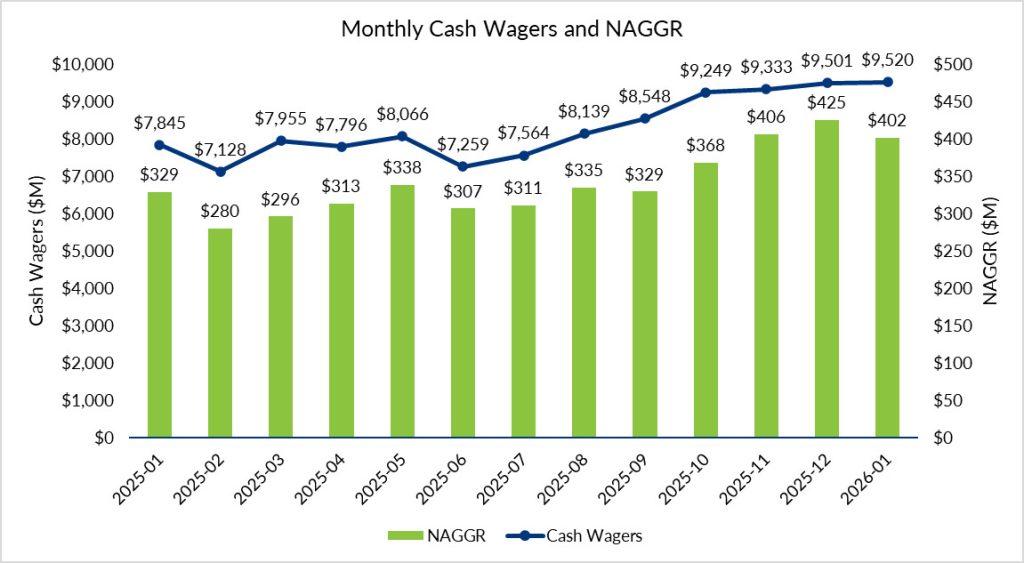
iGaming Ontario (iGO) reported Wednesday that total iGaming wagers hit nearly $8.14 billion in August, a new all-time monthly record and a rise of 34.6% from August 2024. Last month was only the second time in the regulated’s market history that total wagering activity broke the $8 billion barrier, after it first did so in May.

Total operator revenue was $334.8 million, up 40.5% year over year. That was the second-highest total taking in the market’s three-and-a-half-year history, after May 2025’s $338.0 million.

There were 1.016 million active player accounts last month, up from a nine-month low of approximately 948,000 in July and a 41.5% jump from 12 months ago. Those accounts produced an average monthly revenue of $330; only in August 2024 has that total been higher ($332).

Online casino wagers break $7B as Golden Nugget arrives

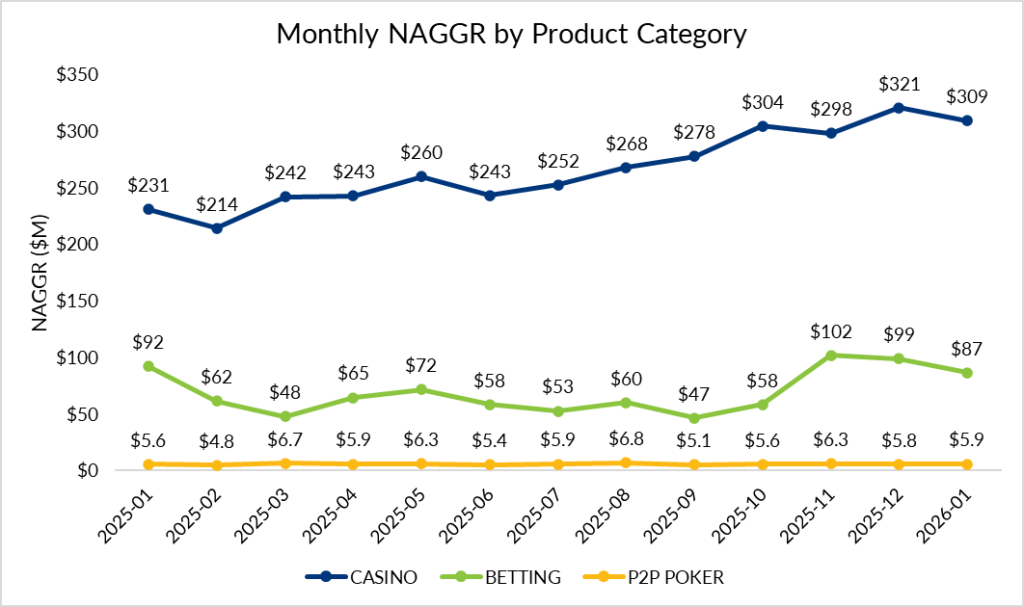
Online casino continued to comprise 89% of market share by spend and around 80% of total operator revenue, just as it did in July. Total iCasino handle hit its own milestone by exceeding $7 billion in a month for the first time ever, as customers played through $7.22 billion in non-promotional bets. That was a 37.7% increase from last year and about $273 million more than the previous monthly record, set in May.

That online casino activity produced another new monthly record, $267.8 million in casino-specific operator revenue. Combined, Ontario’s dozens of licensed online casinos made 44.4% more money from online casino than they did last August.

Ontario’s online casino market was buoyed further by the fact that DraftKingsGolden Nugget Online Gaming (GNOG) platform launched in the market on Aug. 19, joining DraftKings’ flagship sportsbook and casino offering. The online casino, which Eilers and Krejcik Gaming (EKG) ranked as No. 2 in the U.S. market behind DraftKings Casino earlier this year, was already live in four major iCasino states, including the Ontario-adjacent Michigan and nearby Pennsylvania.

Others will arrive later this year. High Roller Technologies CEO Seth Young spoke to Canadian Gaming Business recently about why the Las Vegas-based company feels its flagship eponymous platform will compete well in the province, and absolutebet announced on Sept. 5 that it has been granted registration by the Alcohol and Gaming Commission of Ontario (AGCO).

Sportsbooks’ earnings rebound from July

While sports betting continues to be a sliver of the market compared to online casino, sportsbooks did better in August than either earlier this summer or this time last year.

As the slow sports summer season continued, Ontario gamblers wagered $765 million on sports betting, just 9% of the total spend. That was up 11% from July’s $688 million and 15.2% higher than was wagered on sports in August 2024, although it was still the second-lowest total since this time last year.

There are considerably fewer licensed online sportsbooks in Ontario than online casinos, and those sportsbooks took $60.2 million in revenue from sports wagering in August, more than in both June and July. In a year in which Ontario sports betting has frequently yielded lower monthly revenue for operators than in the same months in 2024, August’s total sportsbook earnings were up 28.4% from August 2024.

Peer-to-peer poker was 2% of both total handle and total operator revenue, as it always is.

iGaming Ontario reporting does not include wagering activity on Ontario Lottery and Gaming (OLG) platforms, including the PROLINE+ sportsbook. OLG will report its results from April 1, 2024, to March 31, 2025, this fall.

BCLC continues rolling out PROLINE retail sportsbooks across province

The British Columbia Lottery Corporation (BCLC) continues to upgrade its in-person sports betting at casinos across the province with new PROLINE sportsbooks.

BCLC opened its fifth retail sportsbook in 2025 on Sept. 21 at Chances Casino Fort St. John, the first of its kind outside the southern band of the province.

The retail sportsbook features a custom-built space with a 24-foot screen, allowing players to watch multiple matches simultaneously, as well as six self-serve PROLINE betting terminals, enabling players to place pre-game and live bets, including single bets and parlays.

A grand opening event was held on Sunday with a showing of the Kansas City Chiefs‘ win over the New York Giants in NFL Sunday Night Football. Customers were given a chance to play for more than $10,000 in prizes, including a Vancouver gameday package consisting of round-trip flights from Fort St. John to Vancouver, a hotel and two tickets to the Vancouver Canucks vs. Edmonton Oilers NHL game at Rogers Arena on Jan. 17, 2026, plus $1,500 in gift cards.

“We are thrilled to open our newest PROLINE Sportsbook Lounge at Chances Casino Fort St. John,” said BCLC’s COO Dan Beebe before the event. “With wall-to-wall displays and a modern sportsbook offering, we believe that the lounge will provide an exciting and memorable experience for both sports fans and bettors alike in Fort St. John and around the Peace River region.”

Reaching out across BC

Image: BCLC

The new sportsbook is BCLC’s fifth retail sportsbook in B.C. It opened the first pair at Vancouver’s Parq Casino and Chances Casino Kelowna in February around the time of the Super Bowl, and added locations at Chances Maple Ridge in May and Casino of the Rockies in June. The Fort St. John is its second location near the Alberta border, after Casino of the Rockies in Cranbrook.

A sixth PROLINE book is expected to open soon at Chances Terrace in west central B.C.

The lounges are destination showcases for BCLC’s expanded and revamped PROLINE sportsbook, which it unveiled last fall on the eve of the NFL season to replace the Sports Action sportsbook that shut down in May 2024 after 33 years.

In an interview with Canadian Gaming Business last year, BCLC’s Manager of Retail Sports Brett Hanson detailed PROLINE’s new and expanded features, which include a move to fully digital bet slips, an exponential increase in bet types and range and a variety of betting markets on local teams.

A destination experience at home

And Senior Manager of Sports Aaron Myette told June’s Canadian Gaming Business magazine that the retail sportsbooks are a key component of the in-person gaming experience BCLC wants to offer people in B.C. and from far beyond.

“Our players are province-wide, so we want to start creating experiences where they are at,” Myette told us. “The sportsbook lounges aren’t limited to sports. What can we do for our fans? What’s the experience we can create? That, to me, is not only a unique advantage but the next step for really giving added value to our players. It’s about creating those destinations here. People from the States, from elsewhere in Canada, even from other parts of B.C., are coming to Vancouver for that destination experience.

“If we can create that mindset that you don’t need to cross a border or an ocean for a destination, that’s what it’s all about. We want our B.C. players to know they can find a world-class gambling experience in their own backyard.”

SBC Summit 2025: The largest and most international edition yet

SBC Summit 2025 cemented its reputation as the greatest show in gaming with a record-breaking 30,000+ attendees from 150 countries.

This year’s edition delivered 20% year-on-year growth in participation, drawing together the world’s top operators, suppliers, affiliates, regulators, media, fintechs and sports professionals. The summit welcomed over 700 exhibitors and sponsors and 550+ expert speakers across an expanded footprint of 135,000m² at FIL and MEO Arena.

The event also achieved unprecedented international scope, with 16 new countries represented compared to last year. Audience growth was particularly strong across Latin America (78.2%), Asia (68.8%), Africa (40.4%) and Europe (49%). New Global & Emerging Markets stages and regionally focused networking zones also gave delegates fresh opportunities to explore growth markets.

“When there are so many people here from all around the world, that’s the real value we’re after,” said Jesper Svensson, CEO of global operator Betsson Group. “For us, operating in so many different jurisdictions, the opportunity to meet people from different places is invaluable.”

“SBC is one of the best shows in the world,” added Dinos Stranomitis, director and COO of Altenar. “We have clear metrics for deciding which events are worth attending, and SBC Summit stands out as one of the most prominent shows globally. It’s not just about quantity, it’s about quality. People come with a real appetite for business, and we’re having valuable discussions with high-level industry leaders.”

Nearly 6,000 C-suite decision-makers

The summit attracted a senior-level audience at an unparalleled rate. More than 5,900 C-level decision-makers were in attendance, reflecting SBC Summit’s role as the central meeting point for the industry’s most influential leaders.

600 of these C-level executives attended the annual SBC Leaders Summit, just ahead of the main conference days.

“It’s a great opportunity to meet other chief executives from businesses around the world in one place,” said Flutter International CEO Dan Taylor, who spoke at the Leaders event. “It’s a really efficient way to do that, which is fantastic.”

Strong affiliate turnout

Operator attendance grew 31%, while affiliate attendance rose 38%, largely driven by the dedicated three-day Affiliate Leaders Summit and the brand-new Affiliate Leaders Awards ceremony.

“The Affiliate Leaders Summit is incredibly valuable,” said Sarah Sabo, director of affiliate marketing at BetMGM. “I don’t think a lot of conferences do it, so it definitely sets SBC apart. There are excellent sessions, and it’s very niche and focused on our vertical, which is fantastic.”

On the show floor, 235 new sponsors and exhibitors joined the roster, adding to the 700 brands showcasing their latest products and innovations.

Headliners hit the mark

On the conference side, more than 550 industry leaders took the stage to share insights, with highlights including industry celebrities, keynote speakers and sports icons such as Gary Vaynerchuk, Randi Zuckerberg, Oleksandr Usyk and Rubens Barrichello.

“Those are things you don’t get to see often,” noted Entain’s Ivan Gojic. “And, coming from somebody who is a huge sports fan, it really gets me going.”

The launch of the Tech Academies also stood out, offering hands-on learning in AI, blockchain, gamification, and marketing. As Catena Media Chief Operating Officer Pierre Cadena put it, “There’s probably not one attendee that walks through the doors who isn’t thinking about how things like AI, business automation, and data-driven strategies need to affect their day-to-day.”

Overall, the Super Stage at MEO Arena delivered standout moments, from an inspirational talk with soccer legends to the Super CEO Panel, featuring top executives from Flutter International, Super Group, Betfred, Betsson and Fast Track.

Legends Charity Game scores big

Speaking of soccer legends, the star-studded Legends Charity Game treated fans to unforgettable performances from global icons such as Kaká, Alessandro Del Piero, Roberto Carlos and Edwin van der Sar, who went head-to-head with Portuguese greats including Luís Figo, Ricardo Quaresma and Nani. The game has already raised more than C$975,000 for four charities.

Van der Sar then joined TV presenter Kirsty Gallagher to co-host the SBC Awards, where excellence across the industry was celebrated in more than 40 categories. And the evening entertainment stole the show, with the Opening Party at Urban Beach featuring Joel Corry and Imanbek, and the INFINITY Lisbon Closing Party headlined by ALOK and Timmy Trumpet.

The summit’s significance extended beyond the industry, with an estimated 72,000+ hotel room nights booked and a direct contribution of an estimated C$130-160 million to the Portuguese economy.

“We are incredibly proud of what we achieved with SBC Summit,” summed up SBC CEO Rasmus Sojmark. “The event continues to grow not just in size but in impact, bringing the global industry together for meaningful conversations, new partnerships, and memorable experiences. Our priority remains delivering an exceptional delegate experience, strong business ROI, and the greatest show in gaming.”

Let’s do it again in 2026

With planning already underway for SBC Summit 2026, next year promises to raise the bar yet again, introducing new features and experiences while continuing to deliver on SBC’s commitment to being the most international, innovative and impactful event in the gaming calendar.

SBC Summit will return to Lisbon from Sept. 29 to Oct. 1, 2026.

Canadian supplier Jackpot Digital gets second US state license

Vancouver-based gaming supplier Jackpot Digital has been granted a manufacturer and distributor license by the Mississippi Gaming Commission that allows it to supply gaming machines to licensed casino operators throughout the state.

Jackpot Digital specializes in dealerless electronic poker gaming solutions, led by its Jackpot Blitz product that is already on the floors of numerous casinos in several North American markets. Several Mississippi casinos will install Jackpot Blitz, and the Canadian firm expects to expand its footprint rapidly across the state, working with several casino operators.

Mississippi has around 30 land-based casinos, run by a range of operators including Bally’s, Caesars, Hard Rock International, MGM Resorts International and PENN Entertainment, as well as in-state Indian tribes.

The Mississippi license is the second that Jackpot Bitz has received from a state regulator south of the border, after it was given similar state-wide approval in Maine in late February. Until that deal, its U.S. operations had been exclusively through the company’s tribal gaming casino partners,

“We are pleased to receive this important approval from the Mississippi Gaming Commission,” said CEO Jake Kalpakian. “This license will allow us to introduce our Jackpot Blitz platform to commercial operators throughout Mississippi, including some of the most recognized names in the gaming industry. Demand for our technology is strong, and we look forward to delivering our advanced electronic poker experience statewide while reinforcing our commitment to innovation in gaming.”

Canadian supplier deepens footprint both sides of border

Jackpot Digital says its products bridge the gap between traditional poker and table games players and under-served demographics like younger, tech-savvy generations or more casual or tournament-focused players.

already supplies dealerless poker machines to operators in several other U.S. states, including California, Louisiana, Michigan, Minnesota, Montana, New York and Oregon. Twelve months ago, in September 2024, it struck its first major jurisdictional, non-tribal license via a deal with the Saskatchewan Liquor and Gaming Authority (SLGA). It had already been working with the Saskatchewan Indian Gaming Authority (SIGA) via an approved partnership before the gaming regulator licensed it province-wide.

It received approval from the Alcohol and Gaming Commission of Ontario (AGCO) last December to enter that province’s casino market, allowing it to provide its products to brick-and-mortar casino operators. And in March of this year, it signed a master leasing agreement with the casino division of Loto-Québec.

The growing company, which boasts Pro Football Hall of Famer and Super Bowl-winning coach Jimmy Johnson as an ambassador, added in a press release that additional licensing applications are currently pending in other jurisdictions as part of its ongoing growth strategy. A recent investor presentation noted it is awaiting state approval in Louisiana and Michigan and is working through the process in Nevada and New Jersey.

Jackpot Digital also has partnerships with cruise lines including Carnival Cruises, Princess Cruises and Costa Cruises to supply its machines to their on-board casinos.

Canadians more opposed to betting ads, partnerships than Americans: Leger

Canadians love sports, but do they love sports betting? A new study from Leger suggested they may be less keen than they were last year, and also less enthusiastic than Americans.

Leger held an online survey of 1,621 Canadians and 1,015 Americans aged 18 and older from Aug. 29 to 31 and published the results in a September 2025 report.

Asked whether they had gambled on a range of sports over the preceding 12 months, 19% of Canadian adults, extrapolated to roughly equate to 5.9 million people, reported they had. That was down from 21% (6.6 million) from the year before. In comparison, the survey’s findings suggested that 26% of the American adults, equating to 68.4 million people, bet on sports during the same period. That was also a decline, from 30% in 2024.

Those Canadians who bet in fall 2024 and intended to do so again in fall 2025 expected their betting activity/spend to increase compared to last year.

Canadians more averse to betting ads, live odds

Meanwhile, as the debate over sports betting adverts in Canada rumbles on in Parliament, mainstream media and academic studies, Leger found Canadians are significantly more averse to seeing adverts on their screens than Americans.

Overall, six in 10 Canadians (59%) reported they had seen sports betting adverts recently, while 54% of Americans said the same.

Three-quarters (75%) of the Canadians who reported seeing betting ads said that there are too many of them, up from 72% last year. Another 23% said they are fine with the amount of betting advertising they see, while 3% said they would like to see more. In comparison, 59% of the American cohort think betting ads are too common, while 36% are happy with the current level.

The discontent did rise in the U.S., as the proportion of American respondents who believe there are too many ads rose from 52% to 59%.

Image: Leger

Canadians are also more opposed to sports media companies partnering with sportsbooks than Americans are. More than half (51%) of Canadians who bet on sports in the last year either strongly or somewhat agreed that sports platforms should not have deals with betting companies, compared to 30% of Americans.

Almost half (49%) of sports bettors in both countries said that seeing real-time odds on their screens during sports broadcasts is likely to make them bet on the game more, and 48% of Canadians also voiced concerns over match-fixing.

Canadians less au fait with live betting, fantasy

As well as proportionally wagering on sports less than their American counterparts, and disliking betting advertising more, Leger found that Canadian sports bettors are less up to speed on fantasy sports and some more niche methods of wagering.

Nearly one-fifth of the Americans who bet on sports in the last year also participated in some form of fantasy sports (18%), compared to 14% of Canadian sports bettors. In both countries, the proportion declined from 2024.

In addition, American bettors are more likely than Canadian bettors to engage in what the Leger report called “alternative betting types,” including in-play betting, micro betting, peer-to-peer exchange betting and eSports betting.

While four in 10 American bettors (39%) placed in-play bets in the past year, only 22% of Canadian bettors did so. Just 15% of Canadian sports bettors reported they had placed micro bets, typically defined as wagers on an individual event in a sporting event, and the same proportion wagered on exchange betting and esports. In contrast, 24% of American bettors placed micro bets, 26% gambled on exchange betting and 22% wagered on esports.

Image: Leger


When it comes to what Canadians do like to bet on, Leger said the NHL is king, with 41% of sports bettors in Canada putting down bucks on the puck. That’s down slightly from 45% in 2024 but is still far ahead of the U.S., where the NHL betting rate was 20%.

South of the border, the NFL gets the crown, with six in 10 bettors (59%) wagering on pro football. That proportion is less than half in Canada, at 26%, a number that was down significantly from 37% last year. Betting on the NBA was up slightly in Canada year over year, from 16% to 21%, but the number of Canadians who wagered on MLB was down from 21% to 18%. In stark contrast, MLB betting jumped from 28% to 40% in the U.S. over the last year.

OLG and Ontario police unearth $400K in betting gift card fraud

The Ontario Provincial Police (OPP) has charged two men from Thunder Bay, Ont., after an investigation discovered a betting scheme in which the use of compromised resulted in fraud exceeding $400,000.

OPP said that gift cards on sale at gas stations in Thunder Bay and Sault Ste. Marie were “compromised” and used to place bets via OLG’s PROLINE sportsbook. “The investigation revealed that thousands of gift cards had been compromised, resulting in fraud exceeding $400,000,” said the OPP in a news release. Police did not state that OLG-specific gift cards were used.

The value of the fraud cited by police relates to the value of the gift cards, Canadian Gaming Business understands. The dollar value of the fraudulent gambling that happened on PROLINE as a result is thought to be significantly lower.

OLG contacted the police last year on suspicion of the activity, and the OPP’s Investigation and Enforcement Bureau (IEB) looked into the matter. The IEB is a division of the police that is embedded within the provincial gambling regulator, the Alcohol and Gaming Commission of Ontario (AGCO).

“The betting pattern was consistent with money laundering, where individuals place large wagers on both sides of a sporting event to ensure minimal gain or loss,” an OPP spokesperson told Canadian Gaming Business. “Further investigation confirmed that the wagers and purchases at gas bar locations were made using fraudulently obtained gift cards. The gas bars and their employees were unaware the gift cards were fraudulent.”

OPP could not provide information on how the cards were obtained nor the specific value of the gift cards, as the case is before the courts. Police did state that there were multiple transactions across many locations in the province. An OLG spokesperson could not say much for the same reason, but confirmed that it notifies and works closely with the IEB and various local law enforcement agencies whenever it suspects fraudulent activity regarding its lottery games.

Two men have been charged with crimes including fraud over $5,000, laundering proceeds of crime, conspiracy, documentation forgery and possession of property. The accused are set to appear before the Ontario Court of Justice later in September.

Ontario embraces betting gift card sales

Image: Canadian Gaming Business

The AGCO’s regulatory standards allow the sale of gift cards that can be used to fund player accounts. Operators must follow regulations to ensure the gift cards are used properly, including conducting player identity verification before depositing and implementing responsible gambling controls including offering deposit limits.

Other iGaming brands in Ontario also sell gift cards. A company under the brand Game On sells cards that can be used on a range of Ontario-licensed operators, including FanDuel, DraftKings and BetMGM (see inset photo), while BetMGM became the first regulated sportsbook to begin selling single-branded gift cards through retailers in Canada earlier this year through a partnership with payment solutions provider TAPPP.

The OLG has a lengthy set of terms and conditions for the gift cards it sells at gas stations and retailers (see feature photo).