The Vancouver Island-based Snuneymuxw First Nation has celebrated another ‘significant milestone’ after completing its acquisition of Great Canadian Casino Vancouver in Coquitlam, B.C.
The deal – first announced on December 19, 2025 – was completed via Petroglyph Development Group Ltd. (PDG), a wholly owned corporation of Snuneymuxw First Nation.
Great Canadian Casino Vancouver in Coquitlam has been lauded as one of Metro Vancouver’s most established venues, housing more than 900 slot machines, 37 table games and 42 electronic table games within the property.
As well as a 1,050-seat Show Theatre, the casino is also home to Gordon Ramsay Burger, the first of the celebrity chef’s restaurants in Canada.
“The completion of this acquisition reflects the sustained effort and vision of Snuneymuxw people across generations,” said Chief Michael Wyse,Xum’silum, Snuneymuxw First Nation.
“We are building an economy that is ours, one that funds our priorities, honours our responsibilities to neighbouring communities and creates opportunity for our people long into the future.”
Snuneymuxw First Nation solidifies B.C. footprint
With a population of approximately 2,000 members, the Snuneymuxw First Nation is one of the largest First Nations located in B.C. Its land is located on the eastern coast of Vancouver Island, the Gulf Islands, the Fraser River, Burrard Inlet and the Howe Sound.
PDG’s takeover of Great Canadian Casino Vancouver marks the fourth transaction between the Snuneymuxw First Nation and Great Canadian Entertainment, with the former’s portfolio now including Casino Nanaimo, Elements Casino Victoria and, most recently, Chances Maple Ridge.
“This transaction is another milestone in our ongoing collaboration with Petroglyph Development Group and the Snuneymuxw First Nation, and we’re grateful for another successful closing,” said Matt Anfinson, Chief Executive Officer of Great Canadian.
“With this representing our fourth completed transaction with PDG, it speaks to the trust and confidence we have built together. I’d like to thank everyone from our respective teams for their hard work, and I look forward to seeing the properties thrive under PDG’s leadership.”
Now that the acquisition has been completed, Snuneymuxw First Nation has become Canada’s largest Indigenous-owned gaming operator by revenue.
However for Great Canadian, its presence across B.C. has continued to fall, now owning just two properties in the province – a significant drop from the nine casinos that it operated in B.C. just last year.
The addition of Great Canadian Casino Vancouver into PDG’s portfolio marks a significant step in the First Nation’s “sustained and strategic growth” strategy.
“We are building a diversified, sustainable portfolio, while continuing to deliver real benefits for the communities where we operate,” said Ian Simpson, Yaatqumtun, Chief Executive Officer of PDG.
“Great Canadian Casino Vancouver has long been an important part of the Coquitlam community, and that will not change.”
As Responsible Gambling Council (RGC) Chief Executive Officer, Sarah McCarthy plays a leading role in tackling player protection challenges and helping to shape a responsible future for the Canadian gaming industry.
Ahead of her speaking appearance at SBC Summit Canada 2026, we chatted with McCarthy about life since joining RGC in early 2025, and how she assesses the state of play in modern Canadian gambling.
Parts of this interview have been edited for length and clarity.
Canadian Gaming Business: You’ve now been in your role for more than a year. What are some of the biggest points of pride of your time at the organization so far?
Sarah McCarthy: It’s been a remarkable first year. Honestly, what stands out most is the excellence of the team at the Responsible Gambling Council. It’s such a deeply committed organization, and that’s clearly exemplified in our work towards our vision of a world where gambling never comes at a human cost.
Last year was very successful on multiple fronts. Our PlaySmart Centres reached more than 583,000 players, patrons, and venue staff. We launched multiple youth programs, including our Grade 11 and 12 student-athlete training pilot, Beyond the Game, with 92% of students reporting they gained new knowledge on how to access help. We deepened our community reach with Indigenous, South Asian, and Black communities across Ontario.
We’ve worked to strengthen our approaches to translating evidence into initiatives that regulators, operators, and decision-makers can actually use. Last year, we successfully completed 75 RG Check accreditations internationally, and our Advisory Services Team helped shape RG frameworks in Australia, the U.S., and around the world. We’ve continued to demonstrate that RGC’s independent, evidence-based approach is something the whole ecosystem values and trusts.
We also recently launched a new PSA targeting young adult males aged 19 to 24, and released an impact report that documents the results of Ontario’s Responsible Internet Gambling Fund (RIGF) and exemplifies what targeted, publicly funded gambling harm prevention can accomplish by providing critical balance to gambling marketing by promoting informed, responsible choices.
The Responsible Gambling Council is more than 40 years into this work and, if anything, the mission feels more urgent and relevant than ever.
CGB: How have your past working experiences informed and shaped the way you lead RGC?
McCarthy: I’m very grateful for the wonderful opportunities I’ve had over my career. In particular, working for nine years at the Rick Hansen Foundation (RHF) towards a vision of an inclusive world where people with disabilities are living to their full potential was profoundly meaningful in shaping my understanding of leadership and impact.
Throughout my career, I’ve had the opportunity to work with excellent leaders and have learned the importance of putting the team first. Collaboration, internally and externally, is key to addressing big issues. At RHF, I had the wonderful opportunity to lead the Rick Hansen Foundation Accessibility Certification (RHFAC) program, a national measurement and recognition tool for accessibility. Key to the success of that program was active collaboration with the commercial real estate industry, governments, organizations, communities and people with lived experience.
I’m definitely still learning! Effective leadership and meaningful impact require continuous growth, and I’m very committed to continual evidence-based learning as a key to the relevance of an organization. At the Responsible Gambling Council, we’ve been working to integrate evaluation techniques into all of our approaches to ensure our programs have measurable outcomes that directly address our strategic objectives. An agreed-upon transparent method of measurement and a shared understanding of “impact” provide an excellent platform for success.
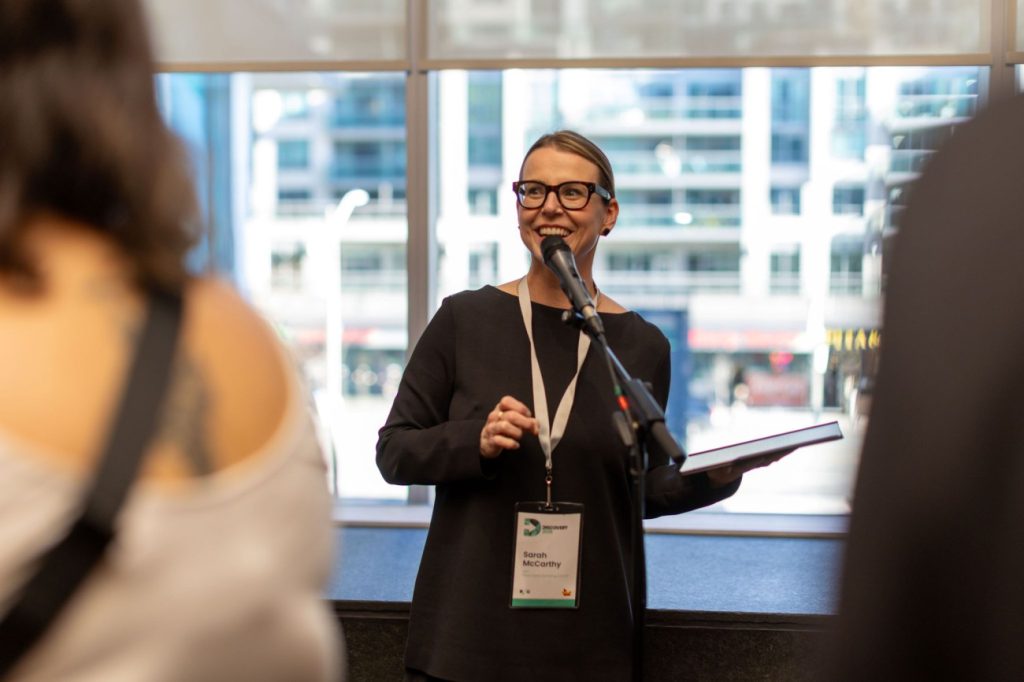
Image: Responsible Gambling Council
CGB: As someone coming into the gaming industry from elsewhere, what are some things that surprised you or stood out about the industry?
McCarthy: It’s been fascinating to learn about nuances and differences in approaches to licensing, markets, and regulations both nationally and internationally. I’m surprised that gambling harm prevention is still a niche topic outside of the sector – these are important themes that need to reach a wider audience.
I’ve been very impressed by the industry’s willingness to collaborate on difficult and complicated issues across so many parts of the broader ecosystem. It’s not just gambling operators stepping up; sports leagues, gaming manufacturers, financial institutions, and community organizations are all recognizing their role in preventing gambling harm. Seeing such a broad range of leaders come together for our Discovery conference every year is an excellent example of this collective commitment. It proves that people across the sector are ready to have substantive conversations to reduce the risks of gambling and protect players.
CGB: Canada has a long history of championing responsible gambling. As Ontario enters its fifth year of regulated iGaming and Alberta gears up to launch, what do you see as the biggest challenges ahead?
McCarthy: The gambling landscape is changing faster than ever, and the biggest challenge is ensuring that safeguards keep pace with innovation. As Ontario matures and Alberta prepares to launch, we need national support structures to provide a safe framework for players.
For the industry, the challenge is moving beyond compliance as a checkbox and viewing player wellbeing as a core pillar of business sustainability. For the Responsible Gambling Council, our challenge is to continue translating complex research into practical, “real-world” tools that actually support players. We want to make sure that as the footprint of gaming grows, the safety net grows with it. We’re looking forward to national approaches to harm prevention that go deeper, are grounded in evidence, and are built for the realities of a rapidly growing market.
The learnings from Ontario’s regulated iGaming environment are valuable; we want to see that knowledge shared and applied across the country as new markets like Alberta come online. That means investing in programs with demonstrated outcomes, applying consistent standards like RG Checkacross jurisdictions, and ensuring diverse communities are not left behind as gambling becomes more accessible.
Prevention cannot be an afterthought. It has to be designed in from the beginning, and that requires national coordination, sustained funding, and a shared commitment to player wellbeing.
CGB: Alberta has made RG Check a requirement, as Ontario did. Can you sum up the mission statement of that accreditation program, and what the response from commercial operators has been like?
McCarthy: RG Check is an independent, international recognized accreditation program that evaluates the strength of a gambling operator’s responsible gambling framework across a comprehensive set of standards, covering everything from player protection tools and staff training to responsible marketing practices. The mission is simple: to provide an independent, rigorous, and evidence-based ‘gold standard’ that ensures gambling operators are doing everything possible to protect their players. It’s about taking the guesswork out of harm prevention.
Overall, the response from commercial operators has been positive. Many even see it as a competitive advantage. It’s a trust signal. Operators want to show their players, and their stakeholders, that they are deeply committed to creating sustainable, safer gambling spaces. They appreciate the clarity and the roadmap for improvement that the accreditation process provides.
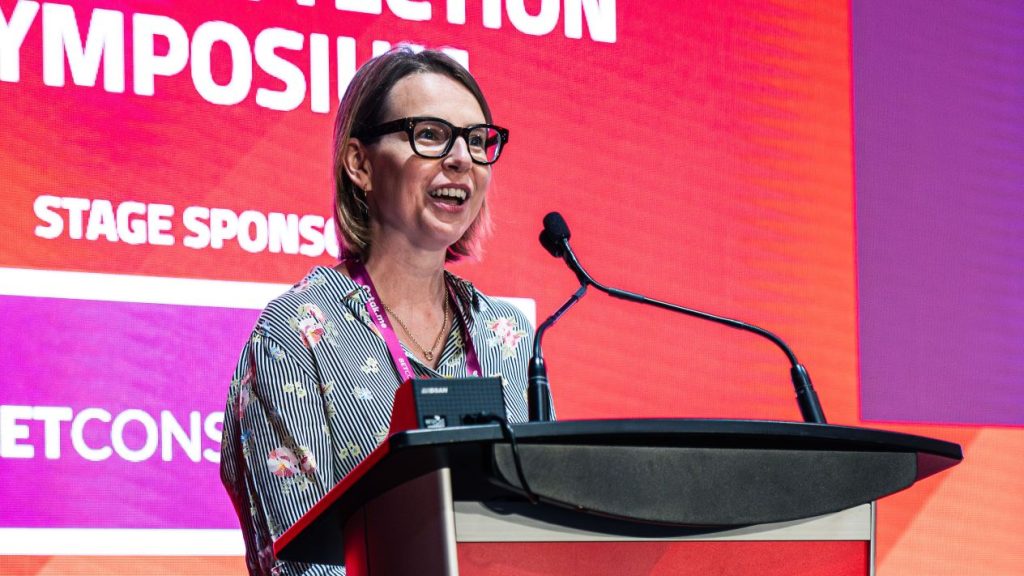
Image: SBC
CGB: Canada has a rich charitable gaming, the topic of your SBC Summit Canada panel. Where do you see that sector heading in the next few years?
McCarthy: cGaming is the heartbeat of many communities, and it’s in the middle of a significant digital transformation. The key will be ensuring that as these platforms evolve and become more accessible, the human-centred safeguards we talk about in iGaming are integrated from the start. We saw a promising example of this last year with the introduction of the first PlaySmart Centre at a cGaming venue. That milestone reflects a growing recognition that player support needs to be embedded in the gaming environment itself, not treated as an afterthought. After the success of that first location, we expect to see that model expand further.
Charitable gaming has a unique social license and protecting that means staying ahead of the curve on player protection and harm prevention.
CGB: Other than your panel, what will you be talking about and listening to at SBC Summit Canada this year?
McCarthy: I’m particularly interested in conversations around AI and data-driven prevention. We’re always looking for ingenious ways to use data to spot early signs of harm, and SBC Summit Canada is giving me the opportunity to dig into exactly these kinds of questions.
On the charitable gaming panel I’m chairing, we’ll be bringing together leaders from across the sector to explore how the industry is raising the bar on player protection. We know that gambling harm doesn’t affect every community the same way, so I’m eager to hear how others are tailoring their player protection strategies to be more inclusive and culturally relevant. I’m always looking for those moments where we can bring different perspectives together to ensure gambling never comes at a human cost.
To catch this panel, along with the full conference program and everything else that SBC Summit Canada has to offer, secure your ticket here. Affiliates and operators qualify for complimentary passes.
As AI expands the attack surface and cyber threats grow more sophisticated, pressure is mounting on the gaming industry to strengthen oversight and control. The Cybersecurity in Gaming Summit returns in 2026 to confront these challenges, with a focus on risk, regulation, and resilience.
Taking place on Wednesday, May 20, the summit forms part of the wider SBC Summit Canada 2026 conference program. Developed in partnership with the Ontario Lottery and Gaming Corporation (OLG), the Cybersecurity in Gaming event brings together cybersecurity leaders, legal and compliance specialists, and industry experts for a dedicated deep dive into one of the industry’s fastest-growing areas of concern.
Beyond identifying risks, the program will explore how organizations can respond, from managing AI-driven threats to building governance frameworks that stand up to increasing regulatory scrutiny.
“Gaming operators handle large volumes of player data and financial transactions, making cybersecurity a critical priority for the entire industry,” said OLG Vice President of Cyber and Information Security Graham Reed. “Every time we take a step forward with technology, the risks evolve with it. With AI, the difference now is the speed and scale of those threats. The question ‘are we moving fast enough?’ is more important than ever. This summit is about ensuring Canadian operators are considering what’s next.”
Cybersecurity in Gaming: Leading voices, critical topics
As the industry grapples with these challenges, the Cybersecurity in Gaming Summit will feature leading voices in AI and ethics, including Nell Watson, philosopher, engineer and author, who will make two appearances throughout the day.
Watson has spent decades working across ethics, emerging technology and AI, holding leadership roles at the Institute of Electrical and Electronics Engineers (IEEE) and the European Responsible Artificial Intelligence Office (EURAIO), and advising companies including Apple and Amazon. She is also the author of two books on AI and has spoken at institutions such as the World Bank, the United Nations General Assembly and the Royal Society.
Watson will deliver a keynote on the Leaders Stage examining how agentic AI is reshaping cybersecurity and forcing organizations to rethink trust and control. “The Agent in the Machine: Trust, Capability and the New AI Era” will also address how operators can deploy AI responsibly while maintaining effective governance.
Watson will also take part in the fireside chat “Bonus Level: An Interactive Conversation with Our Keynote.” Joined by OLG’s Reed, she will answer a series of questions on agentic AI and strategy before opening the floor to a live Q&A with the audience.
The session “Cybersecurity in Gaming: Emerging Risks and Opportunities” will examine how cyber threats are becoming more automated, more organized, and increasingly shaped by AI, including the rise of agentic systems. Experts RickCarville (VP, Cybersecurity & CISO, Great Canadian Entertainment) and BryanPollitt (Associate Partner, Consulting, EY Canada), alongside moderator Reed, will explore where the biggest pressure points lie, how attack methods are changing and how organizations can strengthen resilience.
“Mastering Agentic AI: The Playbook for Safe & Scalable Autonomy” will focus on how agentic AI is transforming how companies and stakeholders operate, requiring a shift from managing risk to building organization-wide capability. Led by GrahamReed and moderated by TomNightingale (Editor, Canadian Gaming Business), the session will examine how to align cybersecurity, IT, and business teams to deploy autonomous systems securely.
The panel “Proving Control: Compliance and Accountability in a Changing Risk Environment” will address how organizations can move beyond understanding risk to demonstrating control and accountability as new technologies evolve. Reed, Tony Wong (General Counsel, OLG), Karl Rempel (Senior Manager, Technology Regulation and Compliance, the Alcohol and Gaming Commission of Ontario) and DanielleM. Bush (Senior Counsel, McCarthy Tétrault) will discuss how to build compliance frameworks that can adapt to regulatory change and emerging technologies.
“Cybersecurity is becoming one of the defining challenges for the gaming industry,” said Aidan Brain, VP of Conference Production at SBC. “Working with OLG allows us to ground this program in real operational experience and focus on the risks organizations are dealing with today.”
Image: Dean Rossiter/SBC
OLG is a crown corporation agency that oversees lottery, casino, digital and charitable gaming operations in Ontario, in addition to supporting the province’s horse racing sector.
Since 1975, it has generated nearly $64bn for the people and Province of Ontario, supporting key priorities such as healthcare, the treatment and prevention of problem gambling and amateur sport. Its proceeds also support host communities, Ontario First Nations, lottery retailers and local charities across Ontario. One hundred percent of OLG’s profits are reinvested back into the province.
SBC Summit Canada will take place May 19-21 at the Metro Toronto Convention Centre, bringing together operators, suppliers, regulators and affiliates at a pivotal moment for the Canadian gaming industry, as Alberta moves towards launching a regulated market expected to follow Ontario’s model.
Ontario online poker enthusiasts will soon be able to play with one of the most iconic poker brands on one of the biggest sportsbook and casino platforms in the province.
PokerStars and FanDuel owner Flutter is uniting the two renowned brands under the FanDuel name in Ontario and its three operational U.S. markets, as confirmed by the poker company on Tuesday, March 3.
PokerStars’ existing Ontario platform will stop offering play on Thursday, May 7, and will be replaced in due course by PokerStars Exclusively on FanDuel.
PokerStars will no longer offering Poker, Casino or Sports on our current platform in Ontario as of May 7.
Your PokerStars account will remain accessible until June 4, 2026.
Any funds not withdrawn from your PokerStars account by June 4 will be sent in the form of a check. pic.twitter.com/GpeFXKNLhd
— PokerStars Ontario on FanDuel (@PokerStarsON) May 4, 2026
On May 4, PokerStars confirmed that its existing licensed platform in Ontario will stop offering online poker, casino, and sports as of May 7. Accounts will remain accessible until June 4, at which point all remaining funds will be returned by cheque.
As of the time of that X post, there is no confirmed final launch date for the new FanDuel-integrated version in Ontario. PokerStars noted that “this requires a short period where the PokerStars tables will close down ahead of relaunch and to ensure we’re fulfilling regulatory requirements.”
Essentially, it will add another major string to FanDuel’s bow in Ontario, adding peer-to-peer online poker to the online sports betting and online casino it already offers in the province.
The move also comes as FanDuel gears up to enter the Alberta iGaming market, which is set to launch on July 13. FanDuel has been approved for a license to offer sports betting and online casino in Alberta; PokerStars may now be a part of their long-term plans in that province, too.
PokerStars and FanDuel are teaming up to launch PokerStars in Ontario exclusively on FanDuel.
PokerStars to share brand, account, wallet with FanDuel
A FanDuel spokesperson told Canadian Gaming Business that PokerStars on FanDuel will create “a best-in-class poker experience.” PokerStars will be available through a dedicated FanDuel-run poker app and desktop site and will be accessible through existing or new FanDuel accounts, just as customers can access both FanDuel Sportsbook and FanDuel Casino through one login and one wallet already.
Once the transition completes, PokerStars’ existing Ontario-facing platform will go offline and a FanDuel account will be required to play PokerStars in the province. FanDuel will hand out welcome offers both for new PokerStars sign-ups on FanDuel and also existing PokerStars customers.
PokerStars is one of the best-renowned brands in online poker, with an operational history of nearly a quarter of a century. It is a licensed online gaming operator in Ontario’s regulated online gambling market, approved to offer not only online poker but also sports betting and casino.
Now, it will combine forces with FanDuel, which is the U.S. sports betting market leader and holds a strong position in Ontario in both sports wagering and online casino. FanDuel will likely see potential for cross-selling customers from sports betting and casino to poker, and vice versa.
The FanDuel logo at Toronto’s BMO Field. Image: ACHPF / Shutterstock.com
But no cross-border play… for now
That advantage for FanDuel will likely be bigger in the U.S. than in Ontario, though. The American side of the PokerStars integration includes a notable geographic expansion, as players in Michigan, New Jersey and Pennsylvania will be able to play against each other in one shared-liquidity pool.
In Ontario, the revamped FanDuel-contained PokerStars will not have that luxury.
While those states and five others share the Multi-State Internet Gaming Agreement (MSIGA), peer-to-peer online poker play in Ontario remains fenced within provincial borders. So, the Ontario PokerStars site will remain segregated on FanDuel as it is now on its own platform, with no shared liquidity with either U.S. players or users outside of North America on PokerStars’ global network.
That may change in the future, pending a legal challenge in the Supreme Court of Canada by multiple Canadian lotteries.
After the Ontario Court of Appeal issued an opinion in November 2025 that it would be lawful under the Criminal Code for Ontario to let players of P2P real-money online games compete with players in other countries, Manitoba Liquor and Lotteries, the British Columbia Lottery Corporation, and the Atlantic Lottery Corporationappealed the decision in Canada’s highest court. Loto-Quebec has since joined the appeal.
PokerStars owner Flutter is an intervening party in that Supreme Court appeal, having supported the idea of cross-border play in the Ontario court question. Along with GGPoker and World Seriesof Poker (WSOP) owner NSUS, the Canadian Gaming Association and the government of Ontario, Flutter hoped that cross-border play would be legal.
Ontario’s ring-fenced P2P player status also applies to paid-entry daily fantasy sports (DFS), a historically important vertical for FanDuel in which it has no Ontario footprint. It means that the likes of FanDuel, DraftKings, and PrizePicks see little point in seeking to offer real-money DFS in Ontario.
Poker a tiny drop in Ontario’s ocean
The lack of shared liquidity for online poker limits the competitive and financial appeal for players in the province who enjoy playing against other people online, even though some of the biggest-name platforms within the vertical are licensed and regulated in Ontario, such as PokerStars, GGPoker, BetMGM Poker and 888poker. Other platforms are available outside of the regulated market, including the World Poker Tour’s ClubWPT Gold sweepstakes-style platform, which launched in most of Canada last year.
The lack of liquidity also means that, on a consistent month-by-month basis, P2P online poker is nowhere near as lucrative in Ontario as it might be if things were different.
While iGO reported almost $9.56n in regulated online gambling handle for March 2026, only $183m of that was wagered on P2P poker, equating to less than 2% of the total provincial iGaming market. Ontario’s licensed operators made $6.9m in gross gaming revenue from P2P poker in January, compared to $61.6m from sports betting and more than $318.5m from online slots, table games, and live casino gaming.
Google Ads updated its gambling and games policy on April 4 to begin allowing licensed online gambling operators to advertise in Alberta ahead of the province launching regulated iGaming on July 13.
The Google policy change, detailed on the Google website, notes that entities that have been authorized by the market’s regulator, Alberta Gaming, Liquor and Cannabis (AGLC), will be permitted to run “brand awareness campaigns” until additional promotional activities become legally permissible in the province.
The Google Ads policy adds that any brand awareness campaigns must be strictly geo-restricted to within Alberta, meaning that online sports betting and online casino operators cannot disseminate Alberta-related marketing in other areas of Canada.
“Advertisers seeking to establish a market presence ahead of the commencement of formal wagering are required to submit valid proof of their AGLC licence application to be eligible for certification,” reads Google’s new policy. “The normal certification requirements will apply after formal wagering commences.”
Image: Paul Brady Photography / Shutterstock.com
Google spells out its Canadian iGaming policy
The change is similar to the one Google Ads made with respect to Ontario in March 2022, just two weeks before that province became the first in Canada to open a regulated, license-based commercial online gambling market.
In Canada, Google Ads allows advertising for lotteries, sports betting, online casinos, and fantasy sports platforms (where licensing is available). Operators of lotteries must be government-run entities or licensed by Canadian federal authorities, while sports betting, online casino and fantasy sports platforms must be licensed by the relevant province and target only that province in their Google advertising.
Alberta’s iGaming advertising standards
In an iGaming compliance guidance document, AGLC notes that it has not established specific regulatory limits or restrictions on advertising and marketing around overall volume, types of channels, or timing.
However, the regulator has set out a few broad responsible gambling-related ad standards, including stipulations that:
Advertising and marketing materials must contain a responsible gambling message
Advertising and marketing of gambling inducements, bonuses, and credits must only be offered on operators’ gaming sites or directly to players who have given consent to receive them
Advertising and marketing must not target underage persons, including where carried out on behalf of an operator by a third-party marketing service
Advertising and marketing must not be intentionally communicated to self-excluded or high-risk individuals
Ontarians placed almost $9.6bn in cash wagers on licensed online casinos and sportsbooks in March, setting a new all-time monthly record for Ontario iGaming.
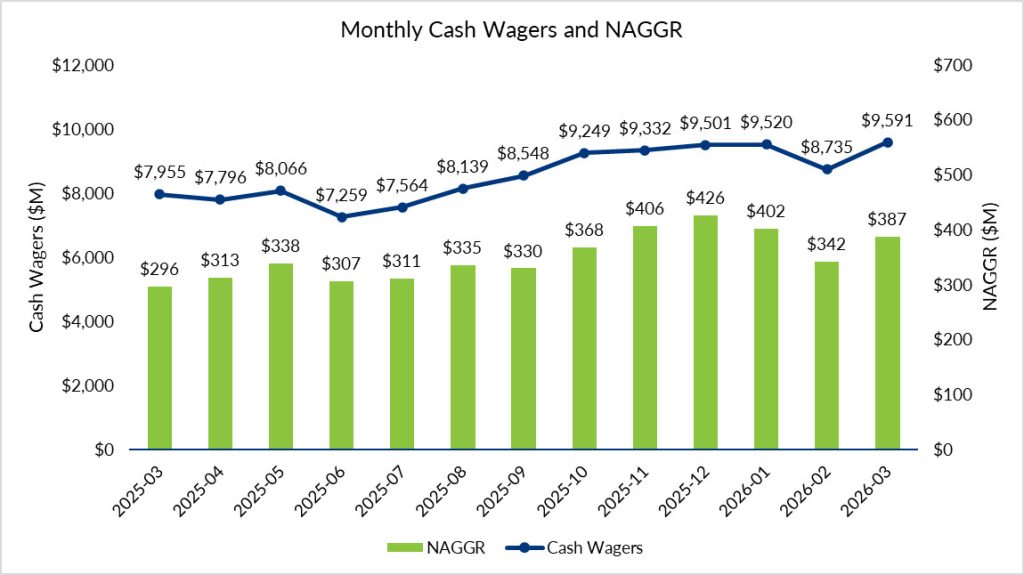
iGaming Ontario (iGO) updated its monthly revenue reporting to show that last month was the biggest ever for the province’s regulated market. March 2026’s $9.59bn in handle beat the previous record high, the $9.52bn reported in January.
Operators’ non-adjusted gross gaming revenue (NAGGR) totaled $387.0m, a 13% jump compared to the short month of February but some way short of the record of $426m set in December 2025.
Revenue climbs 30% year over year
The latest results, which virtually completed Ontario’s fourth year of regulated iGaming since the market launched on April 4, 2022, continue Ontario’s typically strong growth pattern when comparing year over year.
Handle grew almost 21% year over year while revenue climbed at an even greater rate, up 30% compared to March 2025.
Active accounts fall as operators leave
There were 1.235m active player accounts in Ontario last month, 17% more than this time last year. However, that number was the lowest of any month since September, perhaps reflecting the fact that numerous platforms shut down play in the province during March:
As of the time of writing, iGO lists 45 licensed and active iGaming operators running 79 sites in the province, which does not include Ontario Lottery and Gaming (OLG).
The active player accounts in Ontario yielded an average of $313 in gross gaming revenue in March.
Online casino gaming hits record high
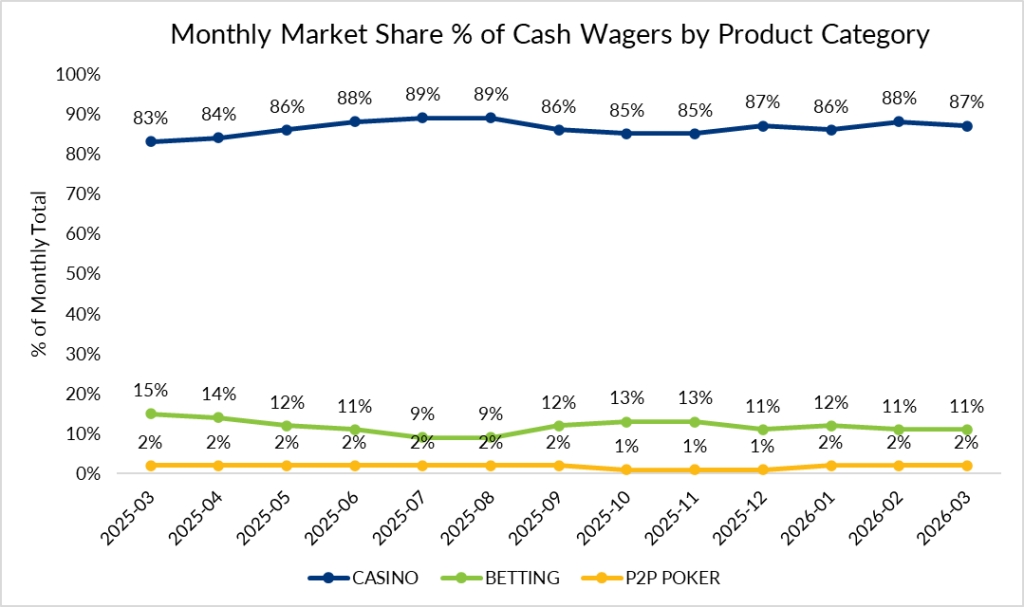
Another all-time monthly record was set in March in online casino handle, which climbed to nearly $8.33bn. The previous high mark for the vertical was $8.27bn in December 2025. iCasino wagering made up 87% of all regulated online gambling activity in March.
Online casino handle grew almost 26% year over year, outpacing Ontario’s overall iGaming handle growth.
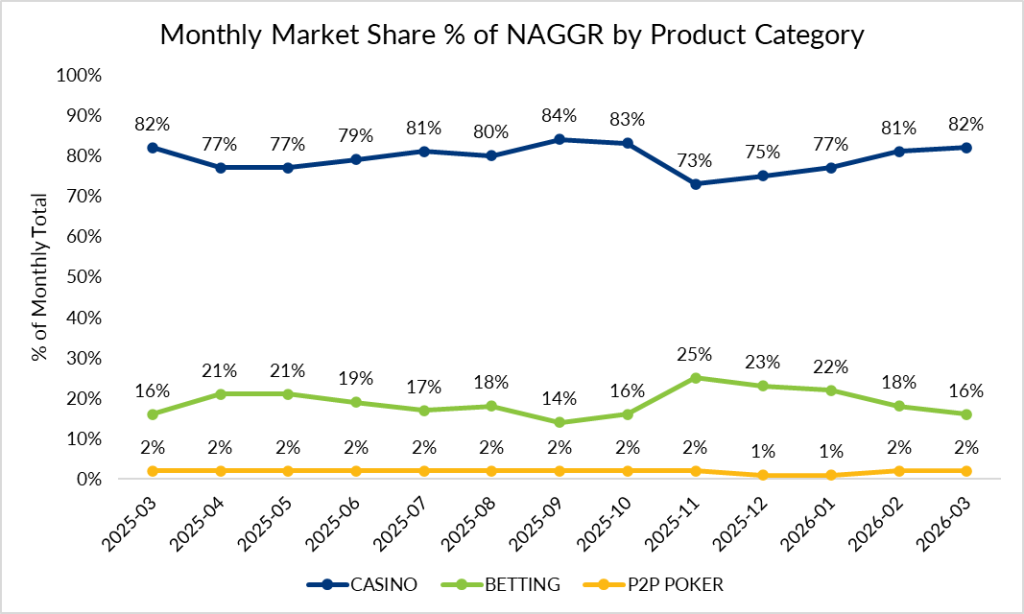
That online casino activity yielded $318.5m in NAGGR for Ontario operators, representing 82% of all operator earnings for the month. That iCasino revenue was 32% more than March 2025.
Sports betting spend down from 2025
In contrast, while sports betting handle bounced back over the $1bn mark to hit $1.08bn, March’s figure was the lowest monthly total in the category since last September.
Sports betting wagering activity is actually down year over year, as March 2026’s handle was 9% lower than March 2025’s. That’s a pattern the market showed in around half of the months of 2025.
And, in the aggregate, sports wagering continues to be a lower earner for operators; revenue was $61.6m, constituting just 16% of total NAGGR for the month. Key context there is that Ontario has numerous licensed operators that offer online casino without offering sports betting, so gamblers have more regulated online casino options available than they do online sportsbooks.
Sports betting constituted 11% of total online gambling handle and 16% of NAGGR for the month.
However, while sports betting revenue continues to be dwarfed by online casino revenue, it was up 29% year from March 2025 despite the year-over-year drop in wagering handle.
Online poker has best month ever
Peer-to-peer online poker had its best month ever in terms of both handle ($183m) and revenue ($6.9m), although it remains a tiny fraction of online gambling activity at less than 2% of Ontario’s total iGaming market.
P2P poker is currently fenced in to Ontario play only, but that could change down the line pending the result of a Supreme Court of Canada appeal case involving almost every Canadian provincial government.
Ontario’s 2026 iGaming tax revenue already at $226m
Through the first three months of 2026, Ontarians have wagered $27.8bn on licensed iGaming sites and operators have reaped $1.13bn in NAGGR. The province’s 20% tax rate means that the Ontario government earned more than $226m in tax from regulated iGaming in the first quarter of this year.
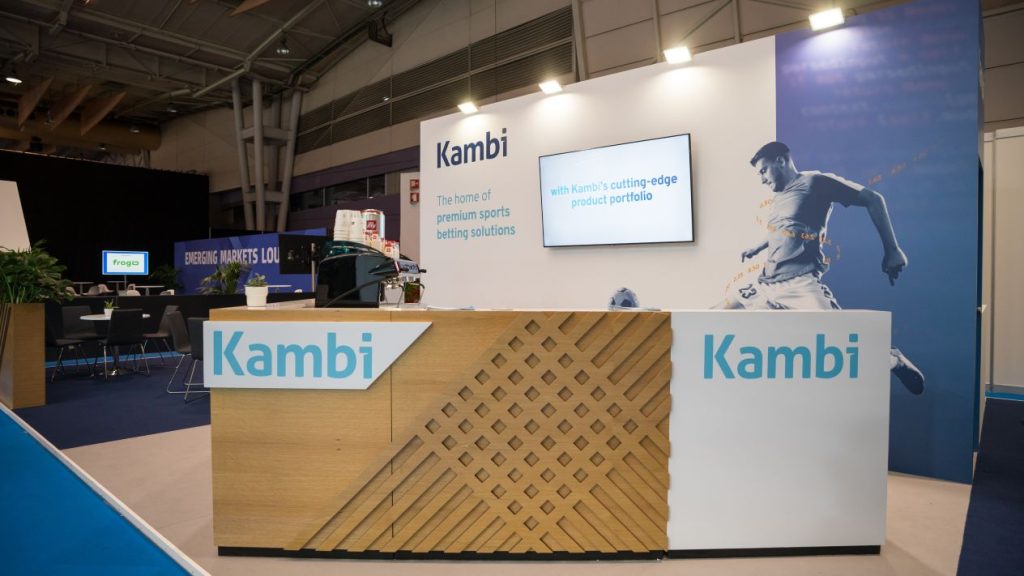
Atlantic Lottery Corporation (ALC) and British Columbia Lottery Corporation (BCLC) have landed on Kambi as the company they want to power their shared multi-province sportsbook.
Kambi announced on Wednesday that ALC and BCLC selected the firm to provide the technology and services for a new PROLINE sportsbook solution. Via the east-coast and west-coast crown corporations, Kambi will deliver its multi-channel Turnkey Sportsbook product at scale across both online and retail channels for the government-run sportsbooks of:
ALC and BCLC had been hunting for a technology provider to power what they described as a “National Sports Betting Solution” since early 2025.
United under the PROLINE brand already used by several crown corporations for sports betting, the idea is that all involved provinces will offer a consistent sports betting experience that is powered by the same tech partner. While the lotteries will share Kambi’s technology and trading foundation, each governmental operator will deliver the service in its respective jurisdiction.
“This collaboration represents an important step forward in how provincial lotteries work together to deliver a consistent, high-quality sports betting experience for players, while maintaining strong governance within each jurisdiction,” said ALC Director of Sports Betting Scott Eagles. “Through this collective approach, we are focused on prioritizing trust, integrity and player protection.”
Kambi’s proven sportsbook technology and omnichannel capabilities, plus its experience supporting global lotteries and U.S. state-owned operators, made it stand out as the strongest of all proposals received, Eagles added in an email to Canadian Gaming Business.
The next step will involve integrating Kambi’s Turnkey Sportsbook platform into the lotteries’ system. Eagles and BCLC each said in separate emails that a target timeline for rolling out the new sportsbook will be determined as that work progresses.
Image: Owen Tetley / SBC
Kambi extends pan-Canadian footprint
Kambi CEO Werner Becher said on an earnings call on Wednesday that the Canadian lotteries deal proves his company has a good reputation among publicly owned organizations and highlights that Kambi is “undoubtedly the industry’s trusted sports betting partner”.
The CEO also suggested that it shows that Kambi’s strategic decision to focus fully on regulated markets only is paying off.
“We would have no chance to win this deal having still a big grey-market footprint,” Becher said. “This is definitely something which is very important for us going forward, that we have done our homework already.”
Becher added that, “when taking into account other planned launches across the Kambi network”, his company’s footprint in Canada stands to reach nine out of 10 provinces. That was likely a reference to Alberta, where Kambi is expected to have some kind of footprint in the province’s upcoming regulated iGaming market. Kambi already works as a B2C supplier in Ontario’s commercial market.
Could Loto-Québec join the shared Canadian sportsbook?
Could it eventually become 10?
ALC and BCLC’s initial RFP, which closed almost one year ago in early May 2025, noted that “additional provincial Operators will have the right, if and when they choose, to join the collective in the future.” It specifically added that “Loto-Québec, at its option, will be able to enter into an Agreement with the Supplier.”
Loto-Québec told Canadian Gaming Business last year that it would be “willing to consider” joining a multiprovincial sports betting platform.
“It remains an option for Loto-Québec to join but there’s no update at the moment,” the crown corporation’s Director of Media Relations Renaud Dugas told Canadian Gaming Business on Wednesday.
PointsBet chose to work with Bede after a competitive selection process as it sought a provider to take its iGaming offering in Ontario (and soon Alberta) to the next level.
The MIXI Australia-owned company offers online sports betting and online casino in Ontario’s regulated market through its own proprietary platform, but wanted to team up with an external provider that could deliver content aggregation and player engagement solutions. PointsBet said the partnership will strengthen its strategy in Canada, which is the only market in which it offers online casino gaming.
“Our strategy emphasizes delivering outstanding digital content that creates exceptional player engagement,” said PointsBet Canada Chief Executive Officer Scott Vanderwel. “I’m excited by the innovative tools we now have available with Bede. This partnership positions us strongly in Ontario and prepares us for future growth across additional Canadian markets.”
More games, greater flexibility
PointsBet Canada has now integrated Bede Gaming’s solution, enabling an expansive library of new, engaging content for its users. The open-API aggregation platform provides the operator with access to a wide array of casino games from renowned suppliers such as:
Games Global
Light & Wonder
Play’n GO
Pragmatic Play
and more
PointsBet said Bede’s solution will enable more competitive player acquisition and improved long-term retention through an enhanced user experience, said PointsBet, while offering greater configurability and flexibility in player engagement and tracking.
“We’re thrilled to partner with the PointsBet Canada team, and eager to support their ambitious goals in Canada,” said Bede CEO Colin Cole-Johnson. “Our Partnership Model means that we mobilize to support the strategies of our customers, and we’re thrilled to already be demonstrating this through the successful launch of this new casino solution.
“Bede remains committed to providing stable, secure and pioneering technical solutions to the North American regulated gaming markets.”
The partnership is the latest evolution of Bede’s Canadian iGaming presence.
Earlier in April, the Ontario Lottery and Gaming Corporation (OLG) rolled out a revamped mobile app experience powered by the technology supplier’s omnichannel React Native App. The company is also a newly minted member of the Canadian Gaming Association (CGA).
Image: Shutterstock
PointsBet and Bede both preparing for Alberta
Meanwhile, PointsBet and Bede said that, as well as applying to PointsBet’s iCasino offering in Ontario, their new multi-year agreement establishes “a shared roadmap” for future provincial launches, including Alberta.
Alberta is due to become Canada’s second commercial iGaming market beginning on July 13, and both PointsBet and Bede have publicly confirmed that they intend to be active in the province.
Back on Feb. 3, well before the July 13 start date was established, PointsBet was one of the very first Ontario-licensed operators to announce that it had applied for a license in the western province and opened pre-registration. “We’re excited to introduce our innovative, Canadian-focused sports betting and online casino products to Alberta residents, supported by industry-leading speed, responsible gaming tools, and local expertise,” said Vanderwel at the time.
On March 23, Bede Gaming confirmed that it had been approved by Alberta Gaming, Liquor and Cannabis (AGLC) for a conditional one-year supplier license, making the UK-headquartered company one of the first international platform providers to be granted approval.
“We have a longstanding investment in the Canadian iGaming industry, and I’m eager for the exciting opportunities ahead in this new market,” said Cole-Johnson at the time. “As one of the first applicants to be formally recognized by the regulator, Bede offers a truly localized service to its partners.”
Bede offers a scalable and adaptable open-API platform, a suite of in-house products, 150+ third-party integrations and other solutions to its operator partners across online casino, lottery, sports betting and bingo. Its platform also integrates into land-based systems. Bede also provides native app and front-end development services and a reporting toolkit.
FanDuel has expanded its roster of sports partners in Canada as Toronto’s WNBA franchise, the Toronto Tempo, has signed up the leading operator as its first official online sports betting and casino partner.
Via a new multi-year agreement unveiled on Tuesday, FanDuel and Canada’s first WNBA team will bring exclusive fan initiatives to FanDuel’s customers in Ontario. The operator will also benefit from in-arena visibility, digital activations, and shared branding and marketing.
“Partnering with the Toronto Tempo in their inaugural season is an exciting opportunity for FanDuel customers and basketball fans,” said FanDuel Vice President of Marketing Tom Burdakin. “As a company that shares the same passion for community and empowering women’s sports, we are proud to support a new franchise that will celebrate fans and elevate women’s professional sports in Canada.”
Tempo prepares to set pace at tip-off
The Toronto Tempo will tip off its inaugural season on the WNBA’s 2026 opening day on May 8 as the league’s first team outside of the U.S. The team will play its home games at Toronto’s Coca-Cola Coliseum, although it will go on tour to play two regular-season games each at Vancouver’s Rogers Arena and Montréal’s Bell Centre.
First announced as an expansion franchise in May 2024, the Tempo’s ownership includes:
Maple Leaf Sports & Entertainment (MLSE) Chairman Emeritus and NBA Board of Governors Chairman Larry Tanenbaum
Tennis iconSerena Williams
Ex-Toronto Raptors President Masai Ujiri
Canadian YouTuber and TV host Lilly Singh
FanDuel said in a press release that the agreement brings together two brands that are committed to expanding women’s sports in Canada. Toronto Tempo Chief Revenue Officer Lisa Ferkul said that partnering with FanDuel will be “transformative” for the team.
“Welcoming FanDuel marks a significant milestone for our organization as we continue to build Canada’s first WNBA team and deepen fan engagement,” she added.
FanDuel goes big on Canadian and women’s sports
The Toronto Tempo adds to a lengthening list of Canadian sports team, league, and broadcast partners for FanDuel. The operator is already officially affiliated with the likes of:
Major sports leagues in Canada, including the NBA, the NFL, the NHL, MLB, and the CFL
MLSE and its team: the Toronto Maple Leafs (NHL), Raptors (NBA), Toronto FC (MLS), and Toronto Argonauts (CFL)
FanDuel has also looked to establish prime positioning in women’s sports.
It has been an official partner of the WNBA since 2022 and in late 2024, it came on board as one of the first official sportsbook partners of the Professional Women’s Hockey League (PWHL) across North America. That deal also established the operator as the exclusive in-app streaming partner of the then-new league in the U.S. The PWHL launched on Jan. 1, 2024, with three Canadian teams: Toronto, Montréal, and Ottawa.
Per FanDuel parent company Flutter, the WNBA bet count at FanDuel rose 273% in 2024 compared to the 2023 season, thanks in no small part to stars like Caitlyn Clark and Angel Reese.
FanDuel CEO Amy Howe said at a recent Semafor conference that the WNBA-led boom in women’s sports offers large untapped growth potential for the operator. “There’s a lot of innovation and experimentation that we’re doing right now that I think is gonna make that product much more accessible for women. We view it as an exciting growth opportunity for us.”
SBC has unveiled the shortlist for the 2026 SBC Awards Americas, highlighting the standout performers across the Americas’ gaming landscape.
Taking place June 10 at the Broward County Convention Center, as part of SBC Summit Americas 2026, the ceremony will bring together 600 industry professionals to celebrate excellence across the North and Latin American gaming industries.
Rush Street Interactive leads with 8 nominations
This year’s edition features 34 categories recognizing standout achievements from operators, affiliates, industry leaders, and a wide range of suppliers, from platform providers and payment specialists to game studios and beyond.
Leading the shortlist is BetRivers operator Rush Street Interactive, with eight nominations, followed by Betting Hero with six. Optimove, Wazdan, and Betsson Group follow closely behind with five nominations each.
“The SBC Awards Americas continue to grow in stature because the competition across the region keeps getting stronger,” said SBC Founder and CEO Rasmus Sojmark. “This year’s shortlist brings together companies that are not only performing at a high level, but also pushing standards forward across operations, technology, marketing, payments, compliance, and player engagement.
“Being shortlisted is a real achievement, and every finalist should be proud of the recognition.”
FanDuel, BetMGM look to defend operator crowns
In the North American operator categories, FanDuel will look to defend its 2025 Sportsbook Operator of the Year title, with BetMGM, Caesars Entertainment, and Hard Rock Bet among the challengers.
BetMGM will aim to retain its 2025 Casino Operator of the Year crown against a competitive field that includes Caesars, Choctaw Casino & Resort – Durant, FanDuel, Hard Rock Bet Casino, and Rush Street Interactive.
On the Latin American side, notable names such as Betsson Group, Kaizen Gaming, Megapari, and Rush Street Interactive have been shortlisted across key operator categories, underlining their continued growth and influence in the region.
Optimove, Wazdan lead supplier noms
Across the supplier categories, companies such as Optimove and Wazdan lead the way with five nominations each, while Sportradar, SoftConstruct, and OpticOdds also feature prominently, highlighting the growing importance of data, platforms, and content in supporting operators across the Americas.
Alea will look to build on last year’s Employer of the Year success. It faces Betsson Group, Rush Street Interactive, and BetMGM in what is set to be a highly competitive category.
In the affiliate categories, Flashscore Network will be hoping to once again earn the Sports Affiliate of the Year – LatAm title, competing against the likes of Better Collective, Betting Hero, and MediaTroopers, all of whom are also nominated in the Sports Affiliate of the Year – North America category.
In the payments and compliance categories, OKTO will look to retain its Payment Solution of the Year – Latin America title, while Trustly aims to defend its North American equivalent. Meanwhile, companies including GeoComply, Gaming Laboratories International (GLI), and OpenBet are among the contenders for the Compliance Solution of the Year.
The awards will also spotlight emerging brands making an impact across the industry, with companies such as Octoplay, BETER, OpticOdds, and WagerWire featured in the Rising Star in Casino and Rising Star in Sports Betting categories.
Please note that a separate ticket is required for attending the ceremony. Table and ticket options can be found here.
Get your ticket for SBC Summit Americas:
Expo Pass (Free): Access to the exhibition floor, featuring hundreds of brands from across North and Latin America, and basic SBC Connect access.
Conference Pass (US$399): Expo access plus the full two-day conference program, featuring 250+ speakers across six stages, and entry to ‘Inner Circle’ sessions.
Networking Pass (US$399): Expo access plus the full SBC Connections program, including ‘The Hive,’ ‘The Exchange,’ ‘The Briefings,’ ‘The Walk Around,’ and ‘The Inner Circle,’ alongside official evening networking events.
Business Pass (US$549): A combined experience, including full access to the expo, the conference program and networking formats, alongside enhanced access to SBC Connect.
VIP Event Pass (US$799): The all-access experience, covering conference, networking, and exhibition, plus premium benefits including access to the Operator Platinum Lounge and complimentary entry to the Food Festival.