
Alberta’s first 100 days as a regulated iGaming market suggest player activity extends well beyond its two largest cities. Owen Compton, Senior Product Manager at mkodo – responsible for developing GeoLocs –, examines geospatial data revealing where engagement is concentrated across the province, why regional communities matter and how location technology can offer operators insights beyond compliance.

(Image: mkodo)
When Alberta’s regulated online gaming market launched, attention naturally focused on operator launches, player sign-ups and the opportunities presented by Canada’s newest competitive jurisdiction. 100 days later, a different picture is starting to emerge.
By analysing geospatial activity patterns across the province, GeoLocs is beginning to build a clearer picture of how Alberta’s gaming market is evolving, where engagement is concentrated and which communities are playing an increasingly important role in the province’s online gaming ecosystem.
The findings suggest a market that is broader, more connected and more geographically diverse than many may have anticipated.
Finding #1: Alberta isn’t a two-city market
When Alberta launched, many expected activity to be overwhelmingly concentrated in Calgary and Edmonton. To a degree, that has proven true. Alberta’s two largest population centres account for the highest concentrations of location activity and remain the province’s primary gaming hubs.
But the data also points to something more interesting.
GeoLocs data indicates as much as 20-30% of observed activity is taking place outside the Calgary and Edmonton metropolitan areas, suggesting that regional Alberta is playing a significantly larger role than many expected.
Activity has been observed throughout the province, stretching from the Lethbridge region in the south to areas approaching Fort McMurray in the north. Significant clusters are visible not only in Calgary and Edmonton, but also in Red Deer, Medicine Hat and communities distributed throughout central and southern Alberta.
For operators, that matters.
Historically, marketing strategies in emerging markets often focus heavily on the largest population centres. Alberta’s first 100 days suggest there may be meaningful opportunities beyond those major urban hubs, particularly as operators compete for market share and customers become more evenly distributed across the province.
The emergence of regional activity also reinforces a broader reality of Alberta’s population landscape. Unlike some regulated jurisdictions where activity is concentrated in a single metropolitan area, Alberta’s population is spread across a network of cities, towns and regional communities that collectively form an important part of the market.
Finding #2: The Calgary-Edmonton corridor has emerged as Alberta’s gaming spine
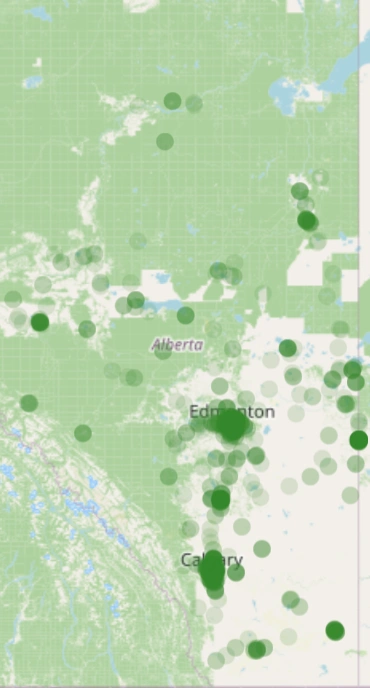
If there is one defining trend within the first 100 days of data, it is the importance of the Calgary-Edmonton corridor. The strongest concentration of activity follows the same route that already serves as Alberta’s economic and population backbone, connecting Calgary, Airdrie, Red Deer, Lacombe, Leduc and Edmonton.
Rather than operating as isolated gaming hubs, Calgary and Edmonton appear connected by a broader ecosystem of player activity stretching throughout the corridor.
For operators, this provides an early indication of how gaming participation aligns with existing population and economic patterns. It also suggests that understanding regional behaviour may become increasingly important as the market matures.
Red Deer is a particularly interesting example. While it naturally generates less activity than Calgary or Edmonton due to its smaller population, the city has emerged as one of the most prominent regional centres visible within GeoLocs Geo-Intelligence data. Positioned almost exactly between Alberta’s two largest cities, it serves as a reminder that meaningful player engagement exists beyond the province’s largest metropolitan areas.
The corridor also highlights how online gaming markets develop differently from simple population maps. The highest levels of activity are not always confined to city centres. Instead, participation often follows broader patterns of commuting, economic activity and regional connectivity.
Finding #3: The rise of Alberta’s satellite markets
One of the clearest insights from the first 100 days is the role being played by communities surrounding Alberta’s major urban centres. Around Calgary, strong concentrations of activity extend into Airdrie, Cochrane, Chestermere and Okotoks. Around Edmonton, notable activity has been observed across St. Albert, Sherwood Park, Fort Saskatchewan, Spruce Grove and Leduc. Taken together, these communities form gaming catchment areas that extend well beyond traditional city boundaries.
In practical terms, this means Alberta’s online gaming market may be better understood as a series of connected regional ecosystems rather than a collection of individual municipalities. For operators, these distinctions are important. Player behaviour in neighbouring communities may share more similarities than players located hundreds of kilometres away despite technically belonging to the same provincial market.
The first 100 days suggest operators who understand these regional patterns could have an advantage as the market becomes increasingly competitive.
Beyond compliance: The rise of Geo-Intelligence
For years, geolocation technology has largely been viewed through the lens of compliance. Its role was simple: verify where a player is and confirm whether they are eligible to wager. Alberta’s first 100 days demonstrate the growing value of looking beyond geolocation as compliance and using it for intelligence.
“What’s most interesting isn’t the volume itself. It’s what the data is telling us about Alberta as a market. Calgary and Edmonton remain the biggest centres of activity, as expected, but we’re also seeing strong engagement across regional communities and throughout the corridor that links the province’s major population centres.” said Will Whitehead, Commercial Director at GeoLocs
“That’s where Geo-Intelligence comes into its own. Operators have looked at location technology primarily as a compliance tool for a long time. What we’re showing is that the same data can provide a much deeper understanding of player behaviour, regional demand and how a newly regulated market is evolving in real time.”
Every location check processed by GeoLocs contributes to a broader understanding of how the market is behaving. Together, those location signals can reveal where engagement is growing, how players are distributed throughout a province and where future opportunities may exist. In other words, location data is no longer just about confirming eligibility. Increasingly, it is becoming a source of market intelligence.
As the market develops and operators look for ways to differentiate themselves, that intelligence could become just as valuable as the compliance layer that sits underneath it.
100 days in Alberta
- Activity observed from southern Alberta to the Fort McMurray region
- Estimated 20-30% of activity occurring outside Calgary and Edmonton
- Calgary-Edmonton corridor emerging as Alberta’s primary gaming spine
- Strong regional activity in Red Deer, Lethbridge and Medicine Hat
- Growing participation across satellite communities surrounding Alberta’s two largest cities
- Evidence of a genuinely province-wide regulated gaming market