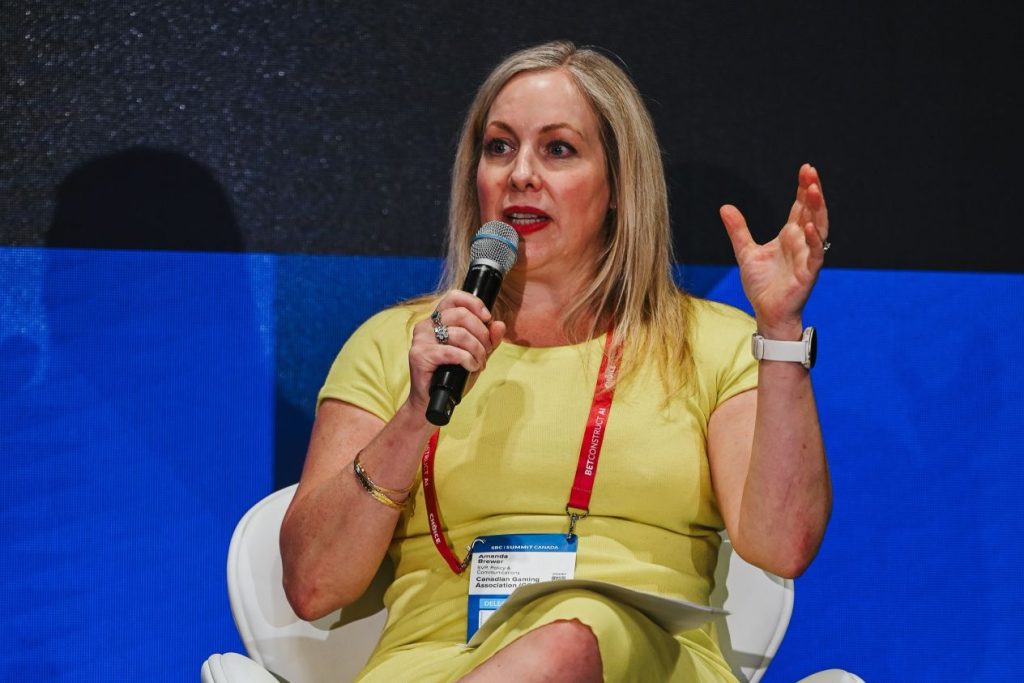
Canadian Gaming Association Senior Vice President of Policy & Communications Amanda Brewer asks whether revenue or player protection is more important to Meta when it comes to gambling advertising.
A version of this story first appeared in the Summer 2026 issue of Canadian Gaming Business magazine.
Canada has historically operated as a grey market for offshore online gaming. Conservative estimates indicate that Canadians have participated in online gambling for nearly two decades. While the exact amount of money exiting the country in this manner remains under debate, it is widely acknowledged as substantial — in the millions of dollars.
Ontario pioneered the introduction of regulatory standards to license and oversee this activity. Recognizing the importance of provider and consumer choice, the Alcohol and Gaming Commission of Ontario (AGCO) understood that it could not feasibly restrict products that had been available without limitation for many years. As a result, Ontario established an open, multi-product market.
Equally vital, however, was the prioritization of player protection measures.
Prior to regulation, there was no assurance that operators were effectively screening customers to prevent underage or vulnerable individuals from opening accounts. Game integrity was not guaranteed, nor was the security of funds, and responsible gaming tools were probably unavailable.
Given the prevalence of online gambling, Ontario’s decision to regulate was prudent and responsible. The advent of regulation brought with it increased gambling advertising; for the first time in four decades, residents were exposed to advertisements beyond those from lottery corporations. Advertising is a privilege afforded by licensing and serves as the primary means by which the public identifies regulated operators.
Channelization is a key metric, representing the migration of players from unregulated websites to legal, regulated platforms. By 2025, Ontario had achieved a channelization rate of approximately 84%, effectively transitioning most users to a safe and taxable environment. Before regulation, up to 70% of online gambling occurred on unregulated sites.
Nonetheless, a notable portion of participants still use platforms lacking Ontario’s comprehensive player protections. This is exacerbated by Meta’s lackadaisical approach to enforcement.
Where’s the logic on gambling advertising?
iGaming Ontario provides a current list of all licensed operators. Ideally, prospective players would consult this list before creating an account. However, many are persuaded by sponsored posts on Meta channels Instagram and Facebook.
As a result, numerous Ontarians struggle to differentiate between regulated operators and unlicensed platforms.
Meta allows users to select categories of interest to them. Included alongside books and cosmetics is a category called “real money gaming”. You might assume that category would geolocate advertisements and require proof of licensing or IP ownership before publishing posts. That seems logical, doesn’t it?

But that’s not the case.
For the past four years, land-based casinos across Canada have been targeted by scammers who use images of their venues to direct users to offshore online platforms. As a result, my Instagram feed is now flooded with sponsored ads for real money operators based offshore, none of whom hold licenses in Ontario.
Even the Canadian Gaming Association is being fraudulently represented (with a micro adjustment as “Canada Gaming Association”) as a platform for Pickering Resort & Casino, a land-based venue operated by Great Canadian Entertainment that, in reality, has no online presence.
With these operators, there are no Know Your Customer (KYC) requirements, which typically involve verification of identity, employment, salary, location, and source of funds. Additionally, some operators utilize virtual private networks (VPNs) to bypass geolocation protocols.
Investigations and leaked internal documents in 2026 revealed the extent of Meta’s earnings from “high-risk” or illegal advertising. Although Meta does not specifically track illegal gambling as a separate revenue stream, its internal evaluations present a clear depiction of the issue.
Leaked reports from 2024-25 indicate that Meta estimated that around 10% of its yearly revenue, equating to about $16bn, is generated by advertisements for scams and banned products such as illegal online casinos.
On average, Meta’s platforms are said to display roughly 15 billion suspicious ads each day.

Inability or unwillingness?
Meanwhile, the gaming industry is under scrutiny from senators and several federal ministers who have expressed regret over their prior support for Bill C-218, legislation that enabled single-event sports betting across provinces. Bill S-211, which is now awaiting House of Commons committee discussion after passing the Senate, aims to reintroduce federal oversight of provincial gaming rights — potentially duplicating regulatory efforts seen in jurisdictions such as Ontario and, soon, Alberta.
Organizations are already engaged in robust regulatory activities, including:
- Ad Standards Canada
- thinkTV
- The Responsible Gambling Council
Even some lawmakers who generally support gaming initiatives feel obliged to endorse Bill S-211, viewing it as a necessary step. Media commentary remains critical of industry practices, with increasing calls for a comprehensive gambling advertising ban akin to those imposed on alcohol and cannabis products.
But consumer protections are effective only if individuals participate on regulated platforms, and advertising plays a crucial role in informing consumers about which operators are officially regulated.
Dr. Kahlil Simeon-Rose, drawing on his recent research into channelization and online gambling regulation, contends that licensed operators should be permitted to advertise through mainstream channels. This provides a competitive advantage over offshore operators, who continue to risk enforcement actions.
Prohibiting gambling advertising would likely eliminate this advantage without curbing the visibility of offshore operators, who maintain exposure through affiliates, social media, and search engines.
With advertising facing multiple threats, including malicious offshore operators, each broadcaster must remain alert, and Meta should address its own issues.
During a speech at ICE in January 2026, Tim Miller, Executive Director of the United Kingdom’s Gambling Commission (UKGC), accused Meta of ignoring illegal gambling sites that advertise on Facebook and Instagram.
Miller described Meta’s platforms as “effectively a window into criminality”. Although Meta’s rules require gambling companies to be licensed in the countries where they advertise, Miller alleges the tech giant isn’t enforcing these requirements. “If we can find them, then so can Meta: they simply choose not to look.”
The UKGC is intensifying its crackdown on illegal gambling operators who target local consumers but evade regulations. The UK has removed hundreds of thousands of websites linked to unlicensed operators and issued cease-and-desist notices, yet the challenge persists as operators constantly change tactics.
Ads for illegal gambling impact vulnerable individuals and benefit “criminals and con artists,” Miller stated. Unlicensed operators do not pay taxes, and consumers are at greater risk of fraud. According to Miller, Meta suggested the UKGC use artificial intelligence tools to identify and report illegal ads, promising to remove them once notified.
But Miller questioned Meta’s willingness to act.
“I would be very surprised if Meta, as one of the world’s largest tech companies, is incapable of proactively using their own keyword facility to prevent the advertising of illegal gambling,” he said. “It could leave you with the impression they are quite happy to turn a blind eye and continue taking money from criminals and scammers until someone shouts about it.”
Meta: A failed partner?
In Ontario, there is currently no indication that Meta is actively enforcing its proof-of-license requirements for gambling advertising.
By transferring responsibility to regulators or individuals to report fraudulent accounts, Meta avoids direct accountability and permits scammers and other bad actors to target unsuspecting customers, including vulnerable groups who should not be exposed to these advertisements.
This underscores the necessity for reforming the Criminal Code to enhance protections for participants and to further safeguard the markets that provincial governments have sought to make more secure.
In 2026, technology is available to geolocate ads and block operators lacking valid licenses or IP verification. Ontario has worked diligently to establish standards and create a safety net for responsible gambling. Meta’s efforts fall short, earning them a failing grade as a partner in this industry.
We have a problem with Meta. And we invite them to do better.