Key Takeaways
- A bill to allow New Brunswick to offer live casino games via the Atlantic Lottery is moving through the provincial legislature.
- Bill 8 would not change the province’s single-operator iGaming model, but the idea of expanding regulated iGaming is being actively considered and again surfaced during Nov. 17 committee discussion.
- In the meantime, Finance Minister René Legacy says the Atlantic Lottery’s product must be as competitive as possible amid growing availability of unlicensed sites.
New Brunswick legislators advanced a proposal to allow the Atlantic Lottery Corporation (ALC) to offer online live casino games in the province, as the government continues to consider greater expansion of its iGaming market.
The Legislative Assembly of New Brunswick’s Standing Committee on Economic Policy reported Finance Minister René Legacy’s Bill 8 forward without amendments at a meeting on Tuesday, Nov. 17.
The approval sends the Act to Amend the Gaming Control Act back to the full House for a third reading and final vote.
Atlantic Lottery offers live casino, but not in New Brunswick
The only government-authorized iGaming operator in Atlantic Canada is the Atlantic Lottery, the crown corporation jointly owned by the four Maritimes provinces: New Brunswick, Newfoundland and Labrador, Nova Scotia, and Prince Edward Island (PEI).
New Brunswick was the first of those four provinces to launch standard online casino games such as slots and virtual table games, doing so in 2020 via an agreement between ALC and the provincial conduct-and-manage agency, the New Brunswick Lotteries and Gaming Corporation (NBLGC).
However, Legacy told committee members that while the Atlantic Lottery already offers live dealer casino products in all of its other provinces, New Brunswick legislation currently does not allow those games.
“Live casino, actually we’re the last jurisdiction that doesn’t have anything in our legislation around that, including the three provinces that are partners with us in ALC,” the minister said. “We’re the last province that doesn’t have this. Nova Scotia and Newfoundland were only last year and PEI was just a little bit before. It was just a matter of prioritization, but we’re slightly behind.”
Legacy’s Bill 8 would provide a legal basis for New Brunswick to add live dealer to the mix. Regulations for the games, as well as potential new regulations for online casino in general, would be brought forward in a separate proposal.
New Brunswick currently makes around $45m per year from its share of Atlantic Lottery iGaming, said Legacy. He estimated that the province would gain an extra $2m from adding live casino in the first year the products become available.
New Brunswick government also exploring expanded iGaming
A spokesperson for Legacy’s office told Canadian Gaming Business that the scope of Bill 8 extends only to adding live casino games through ALC. It would not allow the province to expand the number of authorized online gambling operators.
However, that is something that is also under consideration.
“Government is exploring options around regulating private online operators,” Legacy confirmed to Canadian Gaming Business in late October. “Approaches in other provinces and jurisdictions are being monitored as government considers how best to maintain a safe, responsible, and appropriately regulated gaming environment for New Brunswickers. The review is ongoing.”
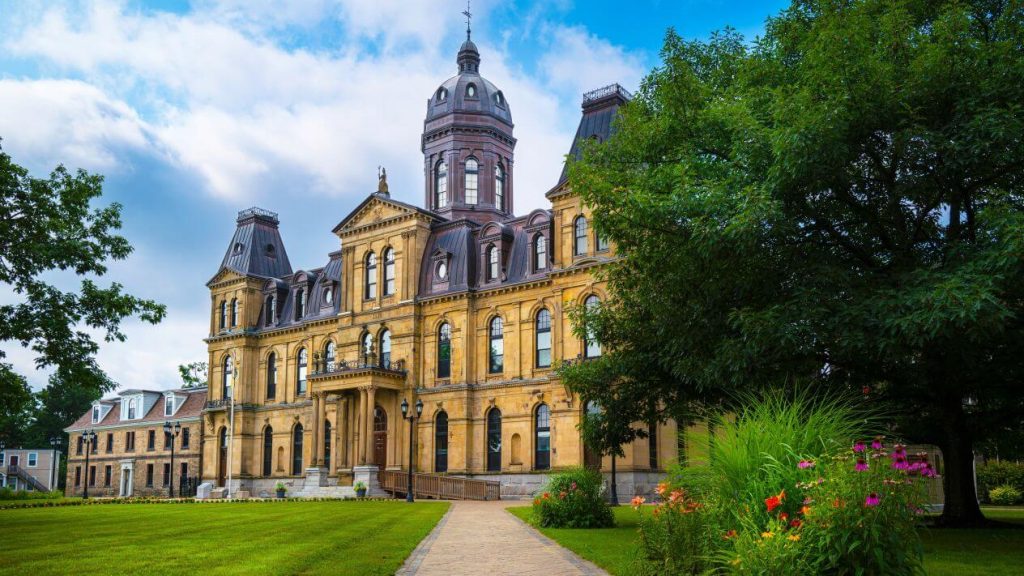
The Finance Minister added in Tuesday’s committee hearing that New Brunswick is keeping an eye on what Ontario and Alberta did by welcoming commercial iGaming operators in a licensed, regulated, taxable market.
“We know that Alberta learned a lot from Ontario,” Legacy told members. “A lot of provinces are trying to see what they’ve done to learn from them … It’s an interesting concept and something that’s being talked about across essentially across all the provinces, because there is quite an amount of dollars that are being spent going outside of our province or outside of our country.
“So, it’s something that we’re actively looking at, especially since we have two model cases right now that we can review.”
Battling unauthorized gambling operators ‘like trying to catch smoke’
Last month, Legacy and Atlantic Lottery President and CEO Dallas McCready both referenced the challenges that the ALC faces in the Maritimes in trying to compete with unlicensed operators. McCready stated in ALC’s 2025-26 annual report in October that the “the growth of illegal online gambling has fundamentally changed the competitive landscape.”
Atlantic Lottery itself estimates that it holds 35% of its own iGaming market across its four provinces, and that it misses out on more than $250m in revenue each year due to unregulated play.
Speaking in the committee meeting on Tuesday, more than one legislator described contending with unauthorized iGaming operators as “like trying to catch smoke.”
“The reality is, right now in our society, access is available easily for gambling,” Legacy said in response to concerns that opposition political parties raised about increasing the online casino options available in New Brunswick. “There is easy access no matter what.”
ALC must be competitive, says New Brunswick minister
That argument that online gambling is already happening without the benefits of regulatory oversight is familiar.
It underpinned the government of Alberta’s reasoning for following Ontario by legalizing commercial iGaming and launching it in July 2026, and it was cited by Quebec political leaders including new Premier Paul St-Pierre Plamondon as why ushering in competition for Loto-Québec in the coming years might be a good idea.
It’s also why Nova Scotia’s own Finance Minister John Lohr said recently that province is also considering its own future iGaming options.
In the meantime, Legacy stressed, Bill 8 to add live dealer casino is one step to ensuring that the Atlantic Lottery’s regulated online gambling offering is as competitive as can be.
“Making ALC the worst provider of service is not going to help,” he concluded on Tuesday. “It’s just going to send them all to the illegal sites, and then we have no control.”